Language embodies complexity, precision, and evolution—nowhere is this more evident than in the pluralization of borrowed words. The term "matrix" presents a fascinating case study in linguistic adaptation and grammatical nuance. When communicating effectively in English, understanding the correct plural form becomes essential for clarity in fields ranging from mathematics to cultural discourse.
What Is a Matrix?
Before delving into pluralization, we must establish what "matrix" actually signifies. The term derives from the Latin word "mater," meaning "mother" or "source." In its modern application, a matrix represents:
- A rectangular array of numbers, symbols, or expressions in mathematics
- The intercellular substance in which tissue cells are embedded in biology
- An environment or material in which something develops in general contexts
- A mold from which a relief surface is made in manufacturing and printing
This versatility underscores why understanding its plural form matters across diverse disciplines and contexts.
The Plural Forms of Matrix
The English language offers two accepted plural forms for "matrix":
Matrices
The traditional form "matrices" (pronounced /ˈmeɪtrɪsiːz/) follows Latin pluralization rules, where words ending in "-ix" transform to "-ices" in plural form. This pattern mirrors other Latin-derived words such as vertex/vertices and appendix/appendices.
Matrixes
The alternative form "matrixes" adheres to standard English pluralization rules, simply adding "-es" to words ending in "-x." This follows the pattern used for box/boxes and fox/foxes.
Which Plural Form Is Correct?
Both "matrices" and "matrixes" are grammatically correct, but their usage differs significantly based on context, field of study, and formality level.
Matrices: The Predominant Form
"Matrices" remains the overwhelmingly preferred plural form, particularly in:
- Academic and scientific writing
- Mathematical contexts
- Technical fields
- Formal communications
The preference for "matrices" is so pronounced that usage data shows it appears approximately 10 times more frequently in published works than "matrixes." This disparity becomes even more dramatic in mathematical literature, where "matrices" appears almost exclusively.
Matrixes: The Alternative Form
While less common, "matrixes" appears in:
- Less formal writing
- General contexts outside specialized fields
- Modern, evolving English usage
- Some American English publications
Usage Considerations Across Different Fields
The choice between "matrices" and "matrixes" often depends on the specific field and intended audience.
Mathematics and Science
In mathematics, "matrices" dominates almost completely. Consider these examples:
"The researcher calculated determinants for several matrices to validate the theorem."
"The properties of square matrices differ fundamentally from non-square matrices."
Mathematical convention strongly favors the Latin-derived plural, creating a de facto standard within the discipline.
Computing and Technology
Similarly, in computer science and technology, "matrices" prevails:
"The algorithm processes sparse matrices more efficiently than dense ones."
"Graphics processing involves transformation matrices to render three-dimensional objects."
Biology and Medicine
In biological and medical contexts, both forms appear, though "matrices" remains more common:
"The extracellular matrices provide structural support for surrounding cells."
"The study examined bone matrices under various conditions."
General Usage
In everyday contexts, flexibility increases:
"The social matrixes that define community behavior continue to evolve."
"Cultural matrices influence how individuals interpret artistic expression."
Historical Evolution of the Term
The word "matrix" entered English in the mid-16th century, initially referring to a breeding female or a place where something is developed. By the 1800s, it had expanded into mathematics and printing, and later into other scientific fields.
The term's growing prominence in mathematics, especially following the development of matrix theory in the 19th century, cemented "matrices" as the dominant plural form. However, English's natural tendency to regularize pluralization has kept "matrixes" alive as an alternative.
Grammatical Analysis
Why Two Plural Forms Exist
This dual pluralization exemplifies a broader pattern in English, where words borrowed from Latin or Greek often retain their original plural forms while simultaneously developing Anglicized alternatives. Consider these parallel examples:
Consider these parallel examples:
- Index becomes indices (Latin plural) or indexes (English plural)
- Vertex becomes vertices (Latin plural) or vertexes (English plural)
- Appendix becomes appendices (Latin plural) or appendixes (English plural)
The existence of dual plurals reflects English's status as a flexible, adaptive language that readily incorporates foreign words while gradually naturalizing them.
Countability and Usage
"Matrix" functions as a countable noun, making pluralization necessary when referring to multiple instances. This contrasts with uncountable nouns like "information" or "evidence" that don't take plural forms.
This countability affects usage patterns:
- "One matrix is sufficient for this calculation."
- "Several matrices were generated from the dataset."
- "The matrixes created by the algorithm all showed similar patterns."
Common Mistakes and Misconceptions
Several errors frequently occur when using the plural of "matrix":
Incorrect Forms
Some incorrectly attempt plurals like "matricies" or "matrixs," neither of which is standard. The correct forms remain "matrices" and "matrixes."
Pronunciation Errors
Even when written correctly, "matrices" is often mispronounced. The correct pronunciation is /ˈmeɪtrɪsiːz/ (may-trih-seez), not /mə-triks-əs/ or other variations.
Confusion with Related Terms
"Matrix" sometimes gets confused with related terms like "array" or "grid," which have their own pluralization rules. An array becomes "arrays," while a grid becomes "grids."
Examples in Context
Mathematical Contexts
"The eigenvalues of these matrices determine the system's stability."
"We must calculate the determinants of both matrices to solve the equation."
Biological Contexts
"The experiment examined how cells interact with different extracellular matrices."
"The dentist explained how the tooth's enamel matrixes had been damaged."
Cultural and Social Contexts
"Modern identity formation occurs within complex social matrices."
"The film explored digital matrixes as metaphors for human perception."
Business and Organizational Contexts
"The company developed decision matrices to evaluate potential investments."
"These management matrixes help visualize departmental responsibilities."
Digital Age Applications
The term "matrix" has gained renewed prominence in the digital age:
Computer Graphics and Animation
"Transformation matrices enable the rendering of three-dimensional objects on two-dimensional screens."
Data Science and AI
"Neural networks process weight matrices to identify patterns in complex datasets."
Cybersecurity
"Access control matrices determine which users can access specific system resources."
Statistical Trends in Usage
Usage data reveals interesting patterns in how these plural forms appear in published works:
- "Matrices" appears approximately 10 times more frequently than "matrixes" in academic literature
- The preference for "matrices" becomes even more pronounced in mathematical texts
- "Matrixes" shows slightly higher relative usage in American English compared to British English
- Technical fields demonstrate the strongest preference for "matrices"
- General writing shows more flexibility between both forms
Field-Specific Recommendations
Different disciplines have developed their own conventions regarding the plural of "matrix":
For Mathematicians and Scientists
Strongly prefer "matrices" in all formal communication, as this form has become the de facto standard in these fields.
For Writers and Editors
Consider the publication context and audience. Academic and scientific publications should use "matrices," while general-audience publications have more flexibility.
For English Language Learners
Learn "matrices" as the primary form, but understand that "matrixes" exists as an acceptable alternative in certain contexts.
Practical Guidelines for Usage
When deciding which plural form to use, consider these factors:
- Audience expertise: Technical audiences expect "matrices"
- Formality level: Formal writing favors "matrices"
- Field conventions: Follow the prevailing standard in your discipline
- Consistency: Choose one form and use it consistently throughout a document
- Style guide requirements: Some publications specify which form to use
The Evolution of Language
The dual pluralization of "matrix" exemplifies how English evolves as a living language. While prescriptive grammarians might argue for adherence to Latin pluralization rules, descriptive linguists recognize that language naturally transforms over time.
The tension between tradition and evolution remains evident in the ongoing usage of both "matrices" and "matrixes." This pattern reflects the broader linguistic principle that usage ultimately determines correctness more than etymological purity.
Broader Implications for English Grammar
The case of "matrix" illustrates several important principles about English grammar:
Linguistic Flexibility
English readily incorporates words from other languages while gradually adapting them to its own patterns.
Rule Hierarchy
When rules conflict (Latin pluralization versus English pluralization), usage patterns often establish precedence rather than rigid grammatical dictates.
Contextual Appropriateness
Correctness depends not only on grammatical rules but also on discourse context, audience expectations, and field-specific conventions.
Learn Any Language with Kylian AI
Private language lessons are expensive. Paying between 15 and 50 euros per lesson isn’t realistic for most people—especially when dozens of sessions are needed to see real progress.

Many learners give up on language learning due to these high costs, missing out on valuable professional and personal opportunities.
That’s why we created Kylian: to make language learning accessible to everyone and help people master a foreign language without breaking the bank.
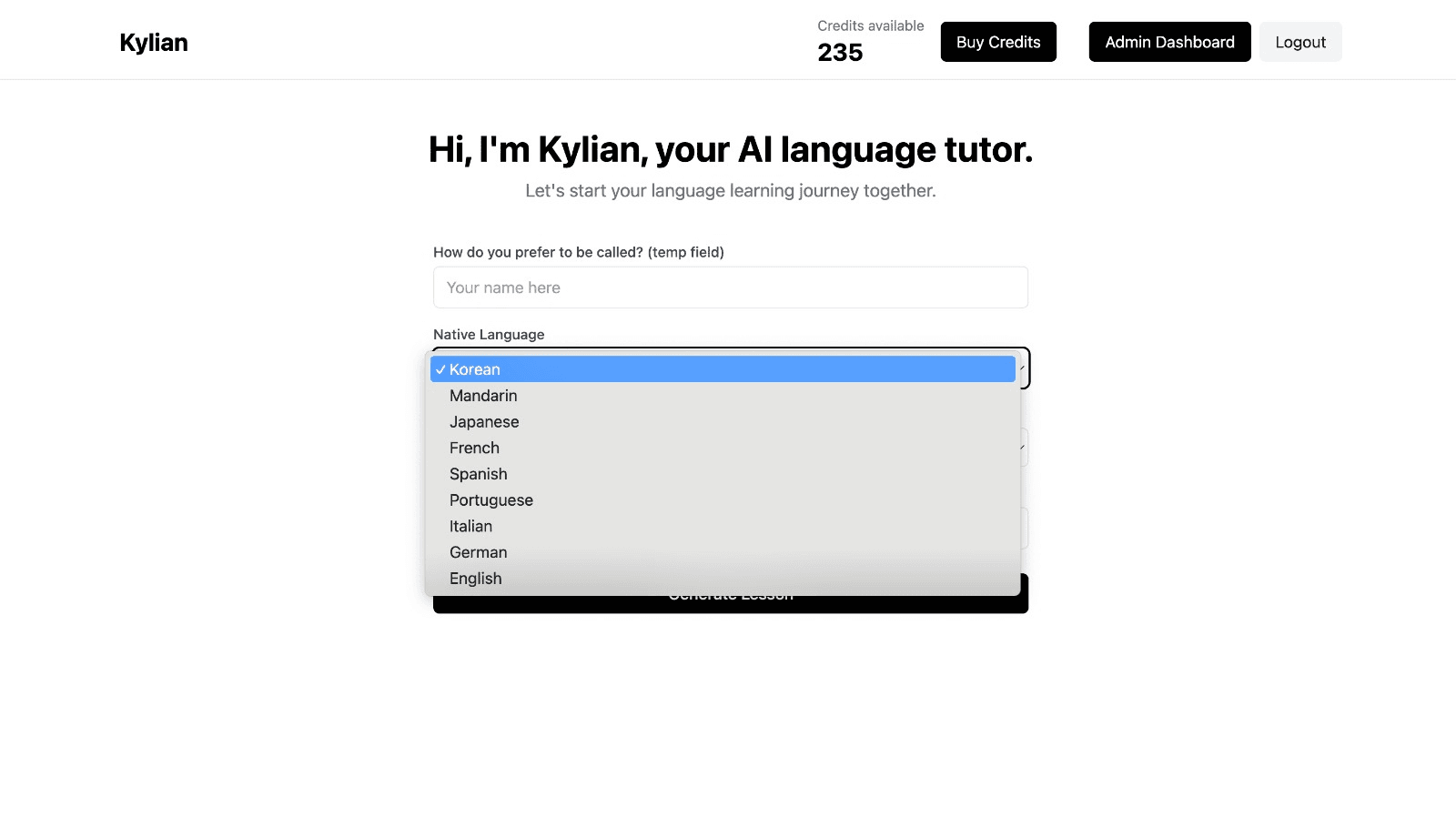
To get started, just tell Kylian which language you want to learn and what your native language is
Tired of teachers who don’t understand your specific struggles as a French speaker? Kylian’s advantage lies in its ability to teach any language using your native tongue as the foundation.
Unlike generic apps that offer the same content to everyone, Kylian explains concepts in your native language (French) and switches to the target language when necessary—perfectly adapting to your level and needs.
This personalization removes the frustration and confusion that are so common in traditional language learning.
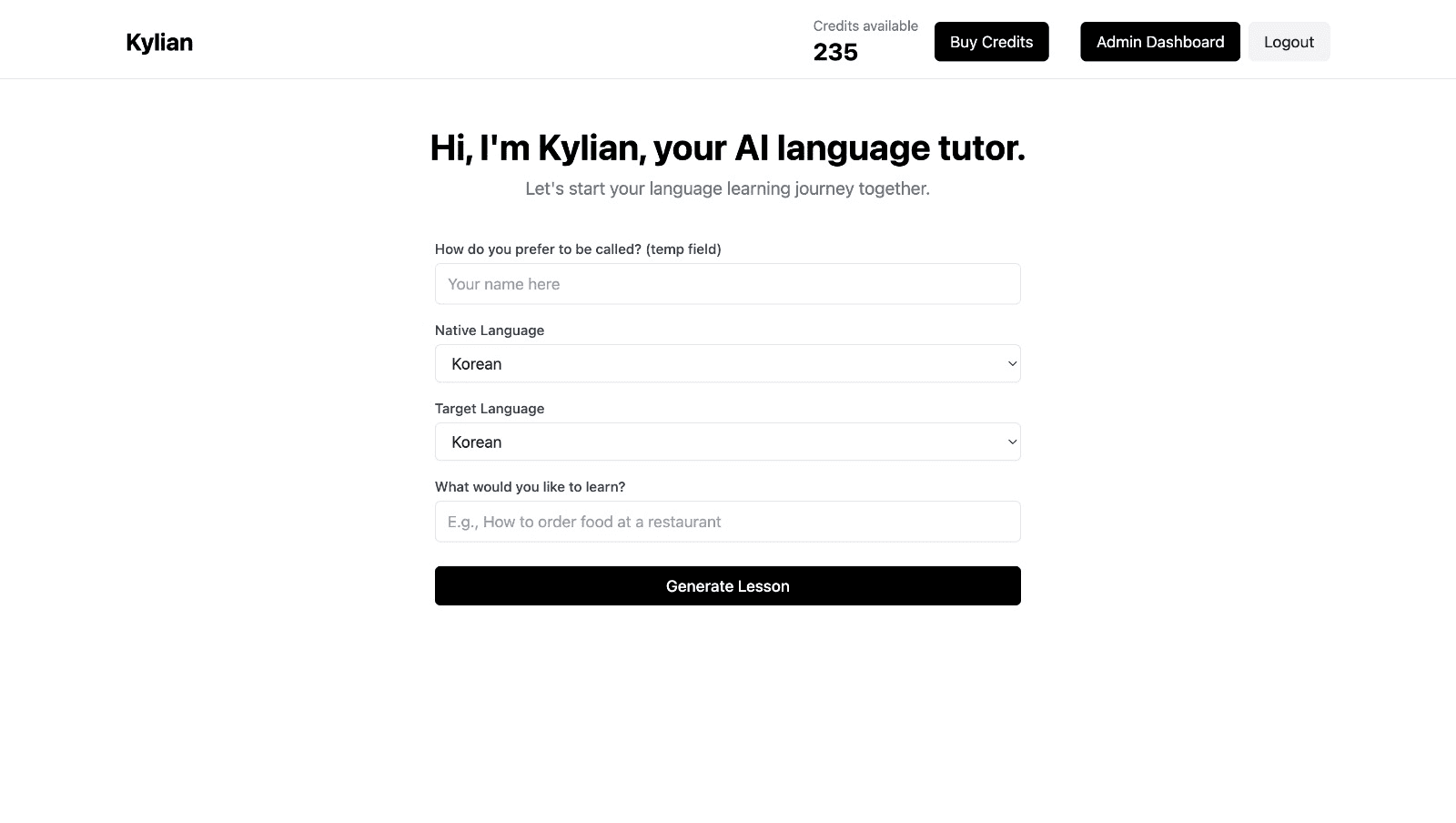
Choose a specific topic you want to learn
Frustrated by language lessons that never cover exactly what you need? Kylian can teach you any aspect of a language—from pronunciation to advanced grammar—by focusing on your specific goals.
Avoid vague requests like “How can I improve my accent?” and be precise: “How do I pronounce the R like a native English speaker?” or “How do I conjugate the verb ‘to be’ in the present tense?”
With Kylian, you’ll never again pay for irrelevant content or feel embarrassed asking “too basic” questions to a teacher. Your learning plan is entirely personalized.
Once you’ve chosen your topic, just hit the “Generate a Lesson” button, and within seconds, you’ll get a lesson designed exclusively for you.
Join the room to begin your lesson
The session feels like a one-on-one language class with a human tutor—but without the high price or time constraints.
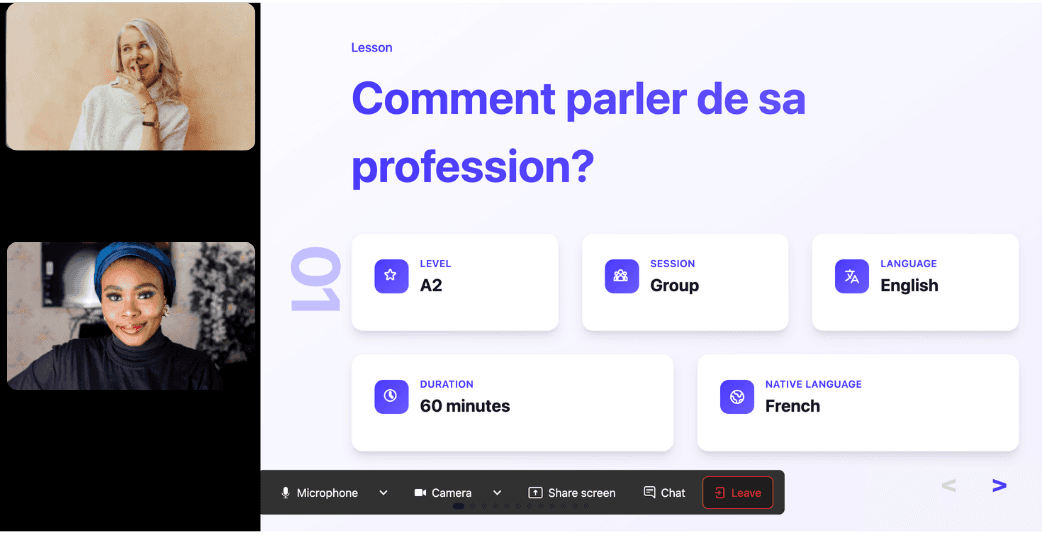
In a 25-minute lesson, Kylian teaches exactly what you need to know about your chosen topic: the nuances that textbooks never explain, key cultural differences between French and your target language, grammar rules, and much more.

Ever felt frustrated trying to keep up with a native-speaking teacher, or embarrassed to ask for something to be repeated? With Kylian, that problem disappears. It switches intelligently between French and the target language depending on your level, helping you understand every concept at your own pace.
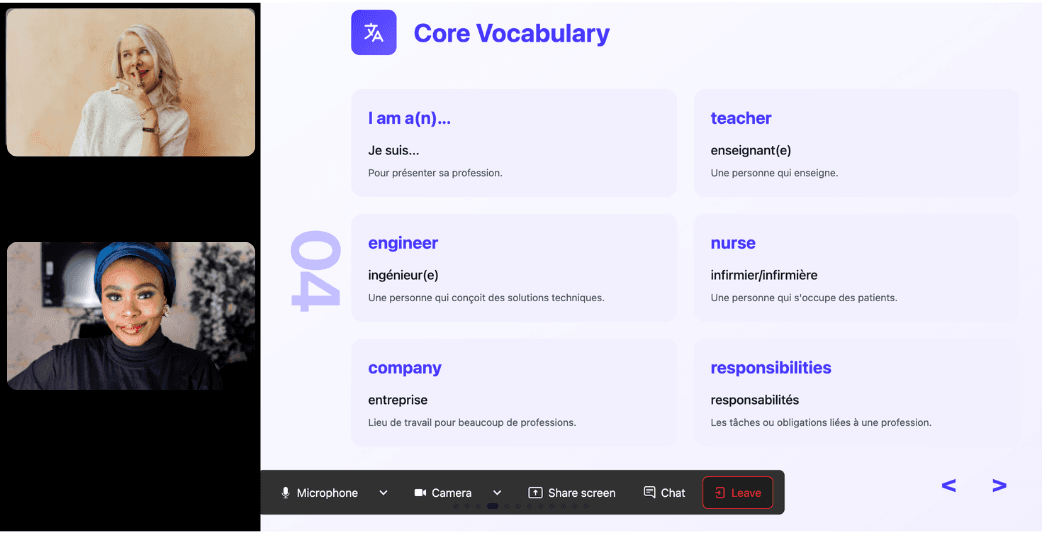
During the lesson, Kylian uses role-plays, real-life examples, and adapts to your learning style. Didn’t understand something? No problem—you can pause Kylian anytime to ask for clarification, without fear of being judged.
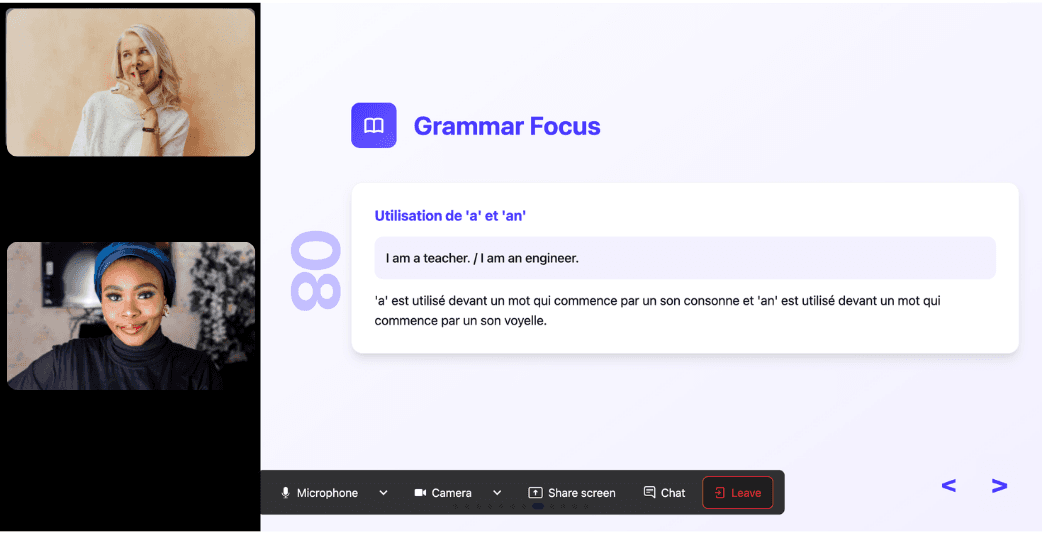
Ask all the questions you want, repeat sections if needed, and customize your learning experience in ways traditional teachers and generic apps simply can’t match.

With 24/7 access at a fraction of the cost of private lessons, Kylian removes all the barriers that have kept you from mastering the language you’ve always wanted to learn.