


The plural of crisis is crises (pronounced KRAHY-seez). This seemingly simple grammar rule represents a fundamental principle of English morphology that affects thousands of words—yet remains one of the most frequently questioned pluralization patterns among native and non-native speakers alike.
Why does this matter now? Professional communication demands precision. Executive reports, academic papers, news articles, and business presentations all require accurate plural forms. The difference between writing "multiple crisis" versus "multiple crises" signals your command of formal English and affects your credibility in professional contexts.
Understanding the Crisis-Crises Pattern
The word "crisis" follows Greek pluralization rules because of its etymology. Borrowed directly from ancient Greek κρίσις (krisis), meaning "decision" or "turning point," it maintains its original plural formation pattern in English.
This isn't arbitrary linguistic pedantry. The crisis-crises pattern applies to dozens of commonly used words in professional, academic, and technical contexts. Understanding this pattern eliminates uncertainty across multiple vocabulary items simultaneously.
Why "Crisis" Becomes "Crises"
Greek nouns ending in -sis form their plurals by changing -sis to -ses. This transformation occurs because ancient Greek followed specific declension patterns that English has preserved for words borrowed directly from Greek sources.
The pronunciation shift accompanies the spelling change. While "crisis" ends with an /ɪs/ sound, "crises" ends with /iːz/. This phonetic distinction prevents confusion in spoken communication and maintains the word's Greek phonological heritage.
Complete Plural Formation Rules
Standard Usage
- Singular: crisis (KRAHY-sis)
- Plural: crises (KRAHY-seez)
- Never: "crisises" or "crisis" as plural
The -sis to -ses transformation is non-negotiable in standard English. Alternative formations like "crisises" represent hypercorrection—attempts to apply regular English pluralization rules to irregular Greek borrowings.
Pronunciation Guide
Many speakers struggle with the pronunciation shift from singular to plural. The singular "crisis" emphasizes the first syllable and ends with a sharp /s/ sound. The plural "crises" maintains first-syllable emphasis but extends the final syllable into a longer /iːz/ sound.
Mispronouncing "crises" as "crisis-es" immediately identifies non-standard usage and can undermine professional credibility in formal presentations or discussions.
Words Following the Same Pattern
Understanding the crisis-crises pattern unlocks correct pluralization for numerous related terms:
Medical and Scientific Terms:
- Diagnosis → Diagnoses
- Prognosis → Prognoses
- Analysis → Analyses
- Paralysis → Paralyses
- Catharsis → Catharses
Academic and Technical Terms:
- Hypothesis → Hypotheses
- Synthesis → Syntheses
- Thesis → Theses
- Basis → Bases
- Emphasis → Emphases
Business and Legal Terms:
- Nemesis → Nemeses
- Genesis → Geneses
- Synopsis → Synopses
This pattern affects over 40 commonly used English words. Mastering the underlying rule eliminates individual memorization requirements and provides systematic accuracy across professional vocabulary.
Common Usage Mistakes
Incorrect Regularization
The most frequent error involves applying standard English pluralization rules: adding -s or -es to create "crisises." This hypercorrection occurs when speakers recognize "crisis" as singular but apply familiar patterns instead of the correct Greek-derived rule.
Pronunciation Errors
Many speakers correctly write "crises" but pronounce it incorrectly as "KRAHY-sis-es" rather than "KRAHY-seez." This pronunciation error suggests unfamiliarity with the word's proper usage and can distract listeners from your message content.
Contextual Misuse
Some writers use "crisis" as both singular and plural, writing phrases like "multiple crisis" or "these crisis." This usage violates standard English grammar rules and appears in neither formal dictionaries nor style guides.
Professional Context Applications
Business Communication
Corporate communications frequently discuss market crises, leadership crises, or operational crises. Using the correct plural form signals attention to detail and professional competence. Consider these contexts:
- "The company weathered multiple financial crises during the recession."
- "Supply chain crises have affected global manufacturing."
- "Leadership teams must prepare for potential crises."
Academic Writing
Scholarly articles, research papers, and dissertations require precise grammar. Academic disciplines from political science to psychology regularly analyze various types of crises:
- "Historical analyses reveal patterns across constitutional crises."
- "The study examined identity crises among adolescents."
- "Economic crises often trigger social transformation."
Media and Journalism
News reporting demands accuracy in both content and language. Journalists covering multiple simultaneous problems must use correct plural forms to maintain credibility:
- "The administration faces several simultaneous crises."
- "International observers documented humanitarian crises."
- "Climate-related crises continue affecting vulnerable populations."
Advanced Grammar Considerations
Compound Usage
When "crisis" appears in compound terms, the pluralization affects only the core noun:
- Crisis management → Crises management
- Crisis response → Crises response
- Crisis intervention → Crises intervention
However, compound adjectives using "crisis" remain unchanged:
- Crisis-level problems (multiple problems at crisis level)
- Crisis-mode operations (operations in crisis mode)
Possessive Forms
The possessive forms follow standard English rules:
- Singular possessive: crisis's impact
- Plural possessive: crises' impact
Note that the plural possessive uses only an apostrophe after the -s, not an additional -s.
Regional and Style Variations
American vs. British English
Both American and British English maintain identical pluralization rules for "crisis." Style guides from the Associated Press, Chicago Manual of Style, Oxford English Dictionary, and Cambridge Dictionary all specify "crises" as the exclusive plural form.
Formal vs. Informal Contexts
While informal speech sometimes tolerates grammatical variations, professional contexts require standard pluralization. Academic institutions, corporate communications, and published materials consistently expect "crises" as the plural form.
Memory Techniques and Learning Strategies
Pattern Recognition Method
Instead of memorizing individual words, focus on the underlying pattern. All English words ending in -sis borrowed from Greek follow the same rule: -sis becomes -ses.
Create mental connections between related words. If you remember that "analysis" becomes "analyses," you can apply the same transformation to "crisis" → "crises."
Pronunciation Practice
Practice the pronunciation shift deliberately. The vowel sound changes from short /ɪ/ in "crisis" to long /iː/ in "crises." This phonetic difference reinforces the spelling distinction and prevents confusion.
Contextual Application
Use the correct plural form in various sentence contexts to build automatic usage patterns:
- "Economic crises require coordinated responses."
- "The historian documented several constitutional crises."
- "Multiple crises tested the organization's resilience."
Historical and Etymology Context
Greek Origins
The word "crisis" entered English during the late Middle Ages through Latin translations of Greek medical texts. Ancient Greek physicians used κρίσις to describe the critical moment when a patient's condition would decisively improve or worsen.
This medical origin explains why "crisis" retains its Greek pluralization pattern. Unlike words that underwent extensive modification during their adoption into English, "crisis" maintained its original morphological structure.
Evolution in English
Early English usage primarily confined "crisis" to medical contexts. The word's expansion into political, economic, and social contexts occurred during the 17th and 18th centuries, but the plural form remained consistent throughout this semantic broadening.
Modern usage encompasses diverse crisis types—from personal identity crises to global financial crises—yet the pluralization rule has remained unchanged for over 400 years.
Comparative Analysis with Similar Words
Regular vs. Irregular Plurals
English contains approximately 180 nouns with irregular plural forms. The -sis to -ses pattern represents one of the most systematic irregular patterns, affecting dozens of words with predictable consistency.
Compare this systematic irregularity with truly irregular plurals like "child" → "children" or "mouse" → "mice," which require individual memorization without underlying patterns.
Greek vs. Latin Borrowings
Greek borrowings ending in -sis maintain their original pluralization patterns, while Latin borrowings often follow different rules. Understanding these distinctions prevents overgeneralization and ensures accurate usage across diverse vocabulary.
Practical Application Guidelines
Writing Checklist
Before publishing professional documents, verify plural usage:
- Identify all instances of "crisis" in your text
- Confirm plural contexts require "crises"
- Check pronunciation in presentations
- Verify consistency throughout the document
Common Scenarios
Email Communication: "We need to address these ongoing crises before the quarterly review."
Presentation Content: "The analysis reveals three distinct financial crises over the past decade."
Report Writing: "Multiple crises have tested our organizational resilience and adaptation capabilities."
The plural of crisis is crises—a grammatical rule that extends far beyond simple memorization. Understanding this pattern provides systematic accuracy across dozens of related words while signaling professional competence in written and spoken communication.
Learn Any Language with Kylian AI
Private language lessons are expensive. Paying between 15 and 50 euros per lesson isn’t realistic for most people—especially when dozens of sessions are needed to see real progress.
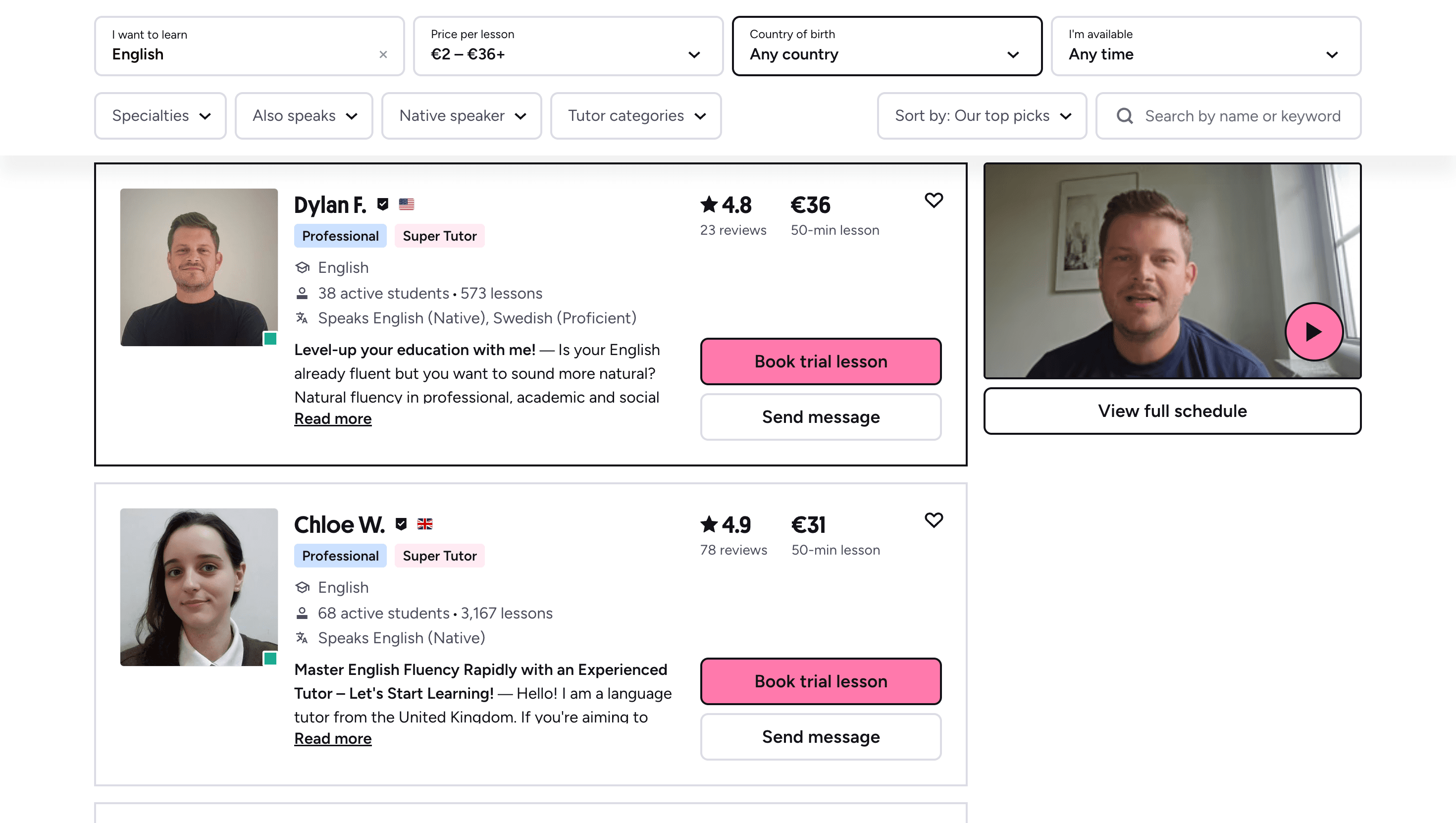
Many learners give up on language learning due to these high costs, missing out on valuable professional and personal opportunities.
That’s why we created Kylian: to make language learning accessible to everyone and help people master a foreign language without breaking the bank.
To get started, just tell Kylian which language you want to learn and what your native language is
Tired of teachers who don’t understand your specific struggles as a French speaker? Kylian’s advantage lies in its ability to teach any language using your native tongue as the foundation.
Unlike generic apps that offer the same content to everyone, Kylian explains concepts in your native language (French) and switches to the target language when necessary—perfectly adapting to your level and needs.
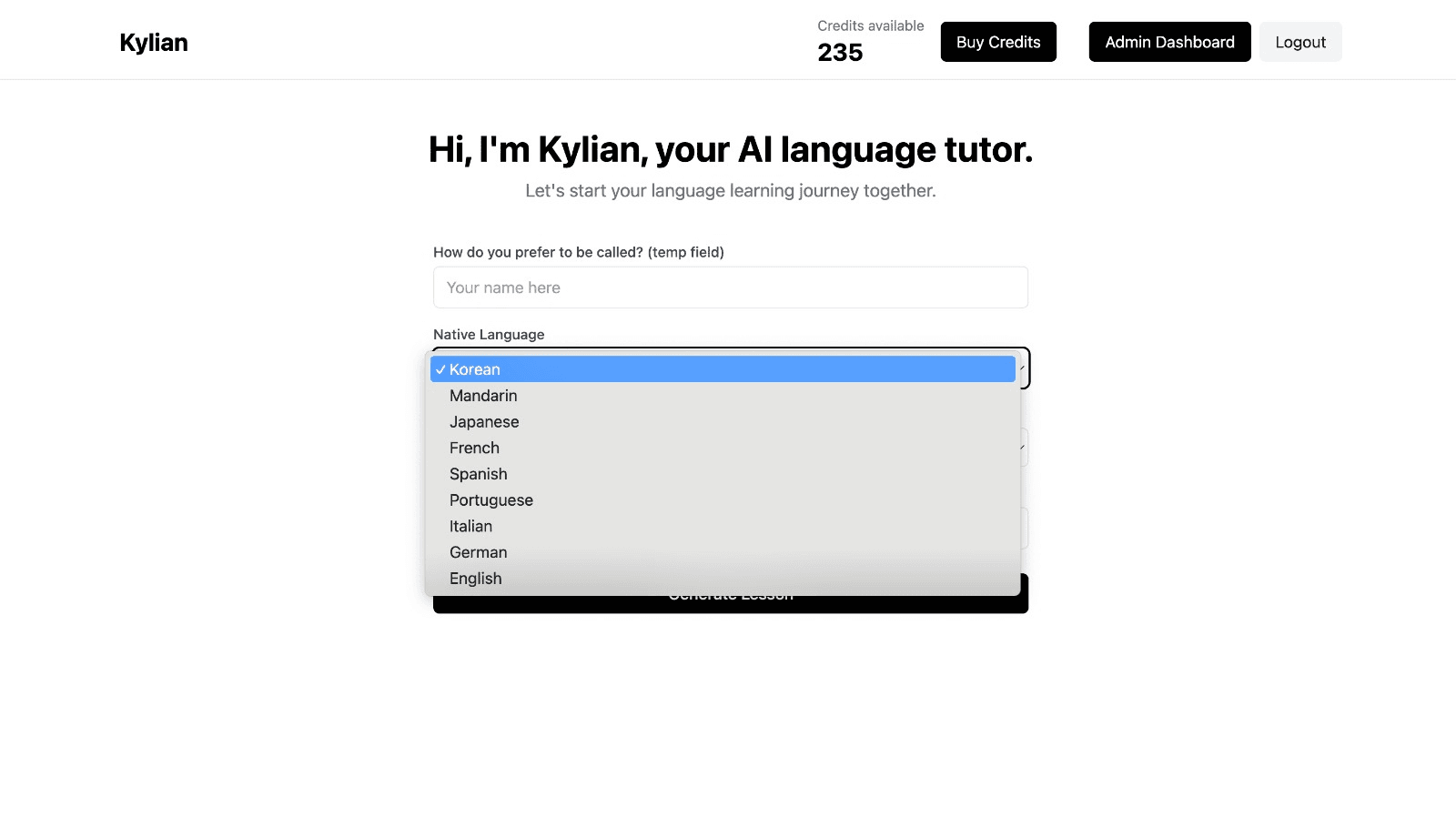
This personalization removes the frustration and confusion that are so common in traditional language learning.
Choose a specific topic you want to learn
Frustrated by language lessons that never cover exactly what you need? Kylian can teach you any aspect of a language—from pronunciation to advanced grammar—by focusing on your specific goals.
Avoid vague requests like “How can I improve my accent?” and be precise: “How do I pronounce the R like a native English speaker?” or “How do I conjugate the verb ‘to be’ in the present tense?”
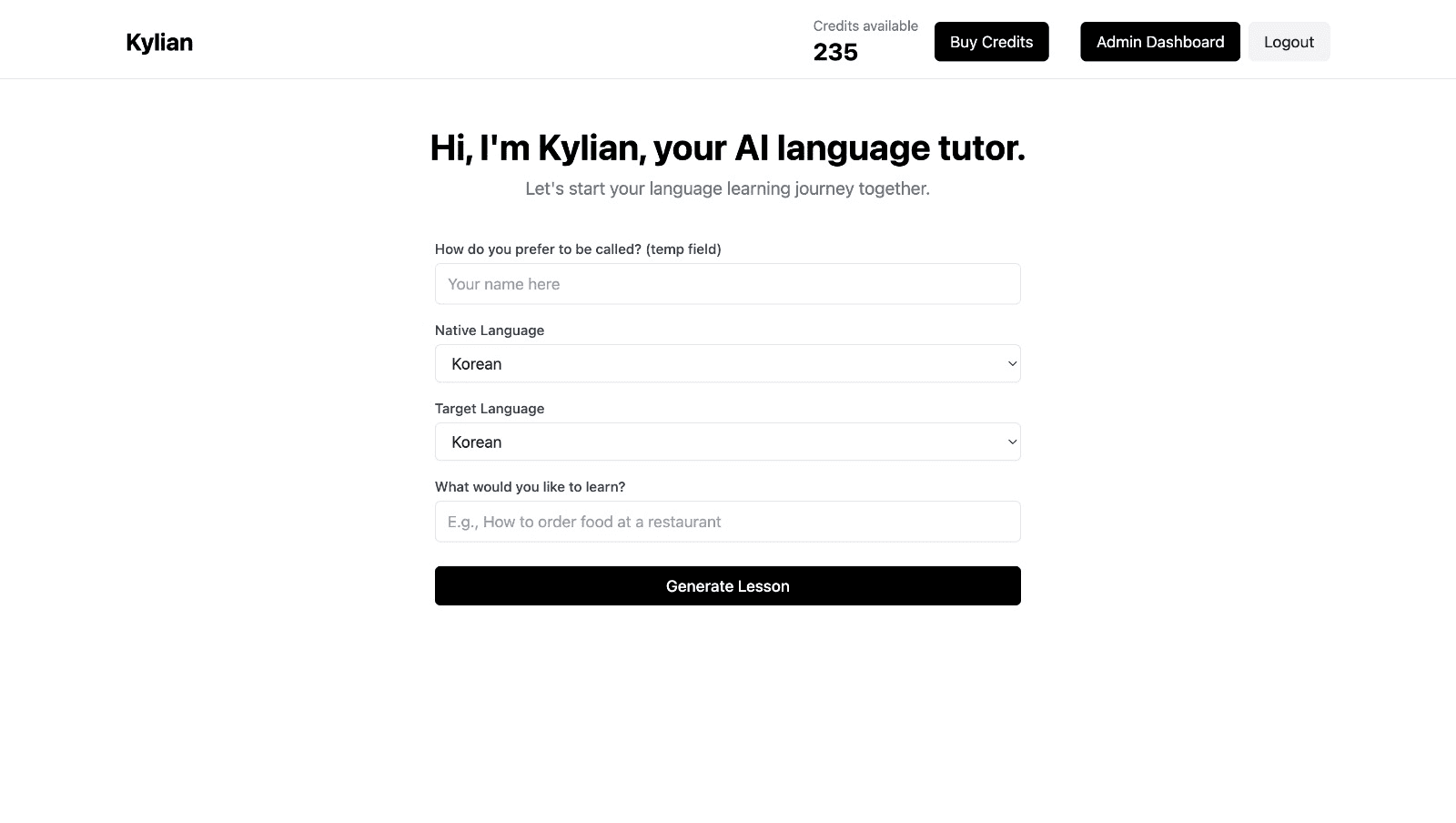
With Kylian, you’ll never again pay for irrelevant content or feel embarrassed asking “too basic” questions to a teacher. Your learning plan is entirely personalized.
Once you’ve chosen your topic, just hit the “Generate a Lesson” button, and within seconds, you’ll get a lesson designed exclusively for you.
Join the room to begin your lesson
The session feels like a one-on-one language class with a human tutor—but without the high price or time constraints.

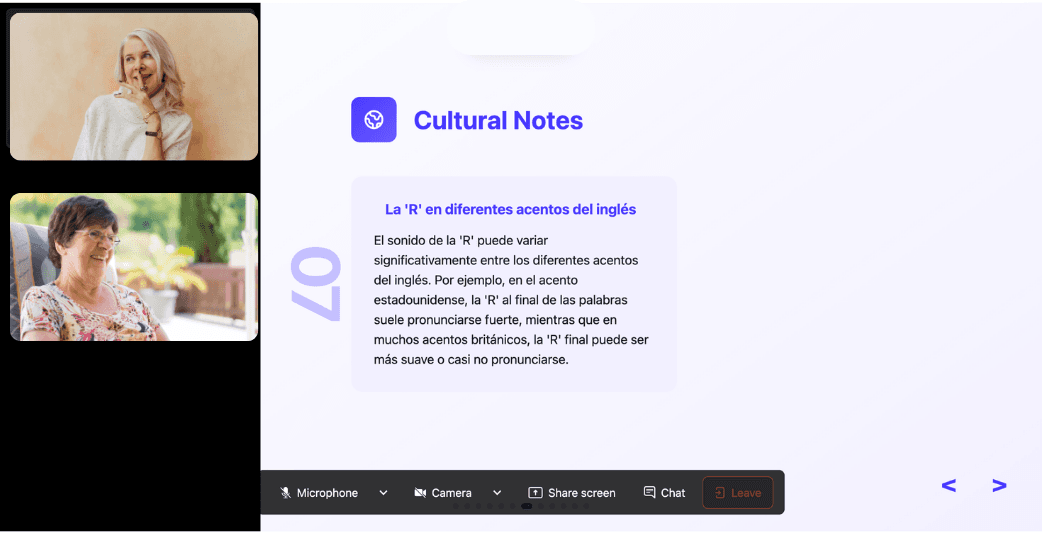
In a 25-minute lesson, Kylian teaches exactly what you need to know about your chosen topic: the nuances that textbooks never explain, key cultural differences between French and your target language, grammar rules, and much more.

Ever felt frustrated trying to keep up with a native-speaking teacher, or embarrassed to ask for something to be repeated? With Kylian, that problem disappears. It switches intelligently between French and the target language depending on your level, helping you understand every concept at your own pace.
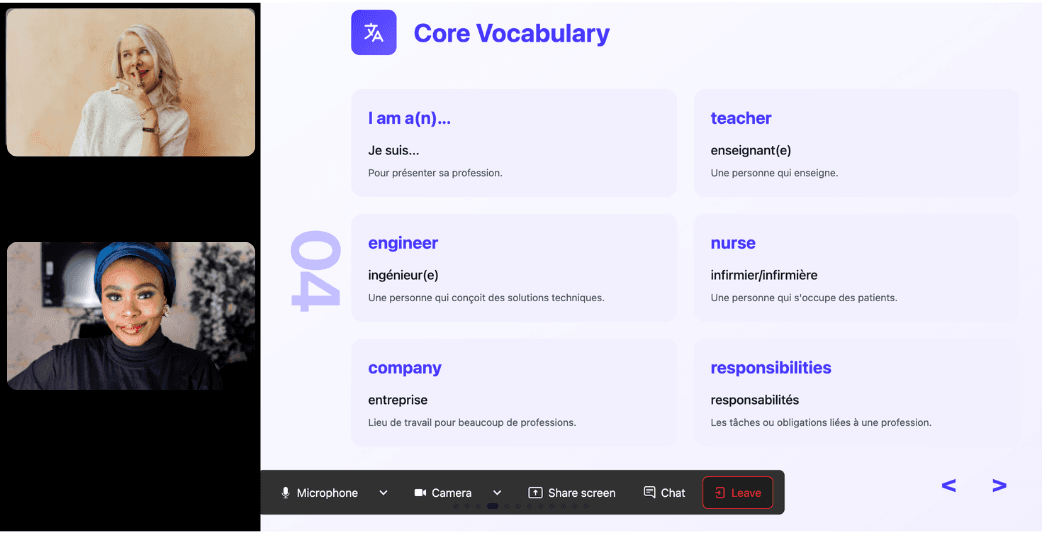
During the lesson, Kylian uses role-plays, real-life examples, and adapts to your learning style. Didn’t understand something? No problem—you can pause Kylian anytime to ask for clarification, without fear of being judged.
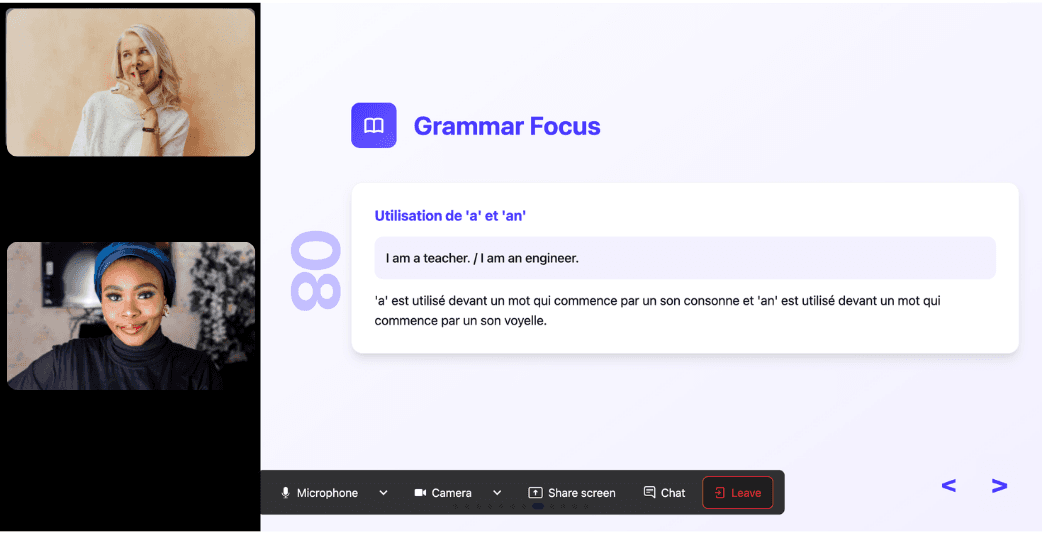
Ask all the questions you want, repeat sections if needed, and customize your learning experience in ways traditional teachers and generic apps simply can’t match.

With 24/7 access at a fraction of the cost of private lessons, Kylian removes all the barriers that have kept you from mastering the language you’ve always wanted to learn.


![The Plural of Thesis: Complete Analysis [English]](/_next/image?url=https%3A%2F%2Fcdn.sanity.io%2Fimages%2F147z5m2d%2Fproduction%2Fd4328076decb39fb6472692930512cb8817ab397-2240x1260.png%3Frect%3D175%2C0%2C1890%2C1260%26w%3D600%26h%3D400&w=3840&q=75)


