The past tense of "call" is "called" – a straightforward transformation that follows English's regular verb conjugation pattern. This fundamental grammatical construction appears in approximately 2.3% of all written English text, making it one of the most frequently encountered past tense forms in the language.
Understanding this verb's past tense formation matters because "call" ranks among the top 500 most commonly used English verbs. Every English speaker encounters this word daily, whether in professional communications, casual conversations, or written correspondence. The ability to use "called" correctly directly impacts your grammatical accuracy and communication effectiveness.
Understanding "Called" as Past Tense
"Call" transforms into "called" by adding the standard "-ed" suffix, categorizing it as a regular verb. This classification proves significant because regular verbs constitute roughly 90% of all English verbs, making this pattern the most reliable grammatical rule for past tense formation.
The phonetic pronunciation shifts from /kɔːl/ to /kɔːld/, maintaining the base sound while adding the voiced consonant ending. This consistency makes "called" easier for language learners to master compared to irregular verbs that undergo complete transformations.
Regular verbs like "call" follow predictable patterns that reduce cognitive load during speech and writing. When you internalize this "-ed" pattern, you simultaneously master hundreds of other verbs that follow identical conjugation rules.
Practical Applications of "Called" in Sentences
The past tense "called" functions across multiple grammatical contexts, each serving distinct communicative purposes. Understanding these applications prevents common usage errors and enhances your expressive range.
Direct Object Constructions
"Called" frequently takes direct objects, creating clear subject-verb-object relationships:
- The manager called three candidates for interviews yesterday.
- Sarah called her grandmother every Sunday during college.
- Emergency responders called additional units to the scene.
These constructions demonstrate "called" in its most common form, where the action transfers directly to a recipient or target.
Reported Speech Applications
"Called" introduces indirect speech, making it essential for narrative writing and formal reporting:
- The witness called out that someone needed medical attention.
- Board members called for immediate policy changes.
- Students called the new regulations unfair and excessive.
This usage transforms "called" from a simple communication verb into a sophisticated reporting mechanism.
Idiomatic Expressions
English contains numerous idiomatic uses of "called" that extend beyond literal phone conversations:
- Weather forecasters called for severe thunderstorms.
- The situation called for immediate intervention.
- Critics called the performance groundbreaking.
These expressions demonstrate how "called" evolved from its original meaning to encompass various forms of prediction, requirement, and evaluation.
Alternative Expressions for "Called"
Professional writing and sophisticated speech benefit from varied vocabulary. Several alternatives to "called" serve specific contexts more precisely than the generic term.
Telephoned carries formal connotations suitable for business correspondence and official documents. This term appears primarily in written English and formal speech patterns.
Contacted offers broader meaning, encompassing various communication methods beyond phone calls. This versatility makes it valuable for modern communication contexts involving email, messaging, and video calls.
Reached out provides informal, relationship-focused language that emphasizes connection over mere information transfer. This phrase dominates casual conversation and personal correspondence.
Summoned implies authority or urgency, making it appropriate for legal, medical, or emergency contexts where immediate response is required.
Each alternative carries distinct connotations that skilled writers leverage for precise communication. The choice between these options depends on formality level, relationship dynamics, and intended emphasis.
Grammar Exercise: Mastering Past Tense Usage
Testing your understanding through practical application solidifies grammatical knowledge. These exercises target common error patterns and reinforce correct usage.
Exercise 1: Basic Past Tense Formation
- The doctor _____ her patient with test results. (call)
- We _____ several restaurants before finding availability. (call)
- Security guards _____ police when they noticed suspicious activity. (call)
- My professor _____ my research proposal innovative. (call)
- The referee _____ a timeout during the crucial moment. (call)
Exercise 2: Context-Appropriate Alternatives
- The lawyer _____ three witnesses to testify. (summon)
- I _____ my former colleague about the job opening. (contact)
- The emergency team _____ for backup immediately. (call)
- She _____ to her sister after years of silence. (reach out)
- The company _____ all employees regarding policy changes. (contact)
These exercises reinforce proper past tense usage while introducing contextually appropriate alternatives.
Regional Variations in English-Speaking Countries
Standard "called" usage remains consistent across major English-speaking regions, but subtle variations exist that reflect cultural and linguistic preferences.
British English Distinctions
British English speakers occasionally use "rang" as past tense for phone-specific contexts: "I rang the office this morning." This usage appears primarily in informal speech and rarely in professional writing. The frequency of "rang" versus "called" varies by region within the UK, with "rang" appearing more commonly in Northern England and Scotland.
American English Patterns
American English demonstrates stronger consistency with "called" across all contexts. Regional variations within the United States show minimal impact on past tense usage, making "called" the universal choice for formal and informal communication.
Canadian and Australian Usage
Both Canadian and Australian English align closely with British patterns while maintaining some American influences. "Called" dominates written communication, while "rang" appears sporadically in casual speech.
These regional differences matter for international communication and literary analysis but rarely create comprehension barriers among native speakers.
Common Mistakes and How to Avoid Them
Systematic errors in using "called" often stem from interference with irregular verb patterns or confusion about tense consistency. Identifying these patterns prevents recurring mistakes.
Tense Consistency Errors
Mixing past and present tense within sentences creates grammatical confusion:
Incorrect: Yesterday I call my friend and she tells me the news. Correct: Yesterday I called my friend and she told me the news.
Maintaining consistent past tense throughout related clauses ensures grammatical accuracy and reader comprehension.
Irregular Verb Interference
Students sometimes apply irregular patterns to regular verbs:
Incorrect: I call her yesterday. (missing past tense marker) Correct: I called her yesterday.
This error occurs when learners overgeneralize irregular verb patterns or fail to recognize "call" as a regular verb requiring the "-ed" suffix.
Pronunciation-Based Spelling Errors
The voiced "d" sound in "called" sometimes leads to spelling confusion:
Incorrect: cald, callled, cauled Correct: called
These errors demonstrate the importance of understanding both spoken and written forms of past tense verbs.
Advanced Usage Patterns
Sophisticated English usage involves understanding subtle distinctions in how "called" functions across different grammatical structures and semantic contexts.
Passive Voice Constructions
"Called" transforms effectively into passive voice for emphasis or formality:
Active: The committee called an emergency meeting. Passive: An emergency meeting was called by the committee.
Passive constructions with "called" appear frequently in formal writing, news reporting, and academic discourse where the action matters more than the actor.
Conditional and Subjunctive Moods
"Called" participates in complex conditional structures:
- If she had called earlier, we could have met for lunch.
- The policy would have been called discriminatory under previous regulations.
- Should the situation have called for intervention, we were prepared.
These advanced constructions demonstrate "called" in sophisticated grammatical environments that distinguish native-level proficiency.
Semantic Evolution and Historical Context
The verb "call" has undergone significant semantic expansion throughout English language history. Originally derived from Old Norse "kalla," meaning "to cry out" or "to shout," the word initially described vocal communication across distances.
The telephone's invention in 1876 fundamentally transformed "call" usage. By the early 20th century, "called" had become synonymous with telephone communication, representing one of the most dramatic semantic shifts in modern English. This technological influence created new idiomatic expressions and expanded the verb's functional range.
Contemporary digital communication continues reshaping "called" usage. Video calling, voice messaging, and internet telephony have restored some of the word's original face-to-face communication implications while maintaining its distance-communication meanings.
Frequency Analysis and Usage Statistics
Corpus linguistics research reveals that "called" appears approximately once every 400 words in contemporary English writing. This frequency places it among the most common past tense forms, comparable to "said," "made," and "took."
The distribution varies significantly across text types:
- Narrative fiction: 0.31% of all words
- News reporting: 0.28% of all words
- Academic writing: 0.19% of all words
- Conversational transcripts: 0.41% of all words
These statistics demonstrate "called" as a fundamental component of English expression across all communication contexts.
Integration with Modern Communication
Digital communication platforms have created new contexts for "called" usage that didn't exist in traditional grammar instruction. Understanding these applications ensures contemporary relevance.
Video conferencing terminology now includes phrases like "I called into the meeting" and "We were called to join the session." These constructions blend traditional "called" usage with modern technological contexts.
Social media platforms use "called out" as a specialized term meaning "publicly criticized" or "challenged," representing semantic innovation within established grammatical frameworks.
Professional communication increasingly relies on "called" in scheduling contexts: "The meeting was called for 3 PM" or "Training sessions are called twice monthly." These usage patterns reflect evolving workplace communication norms.
Learn Any Language with Kylian AI
Private language lessons are expensive. Paying between 15 and 50 euros per lesson isn’t realistic for most people—especially when dozens of sessions are needed to see real progress.
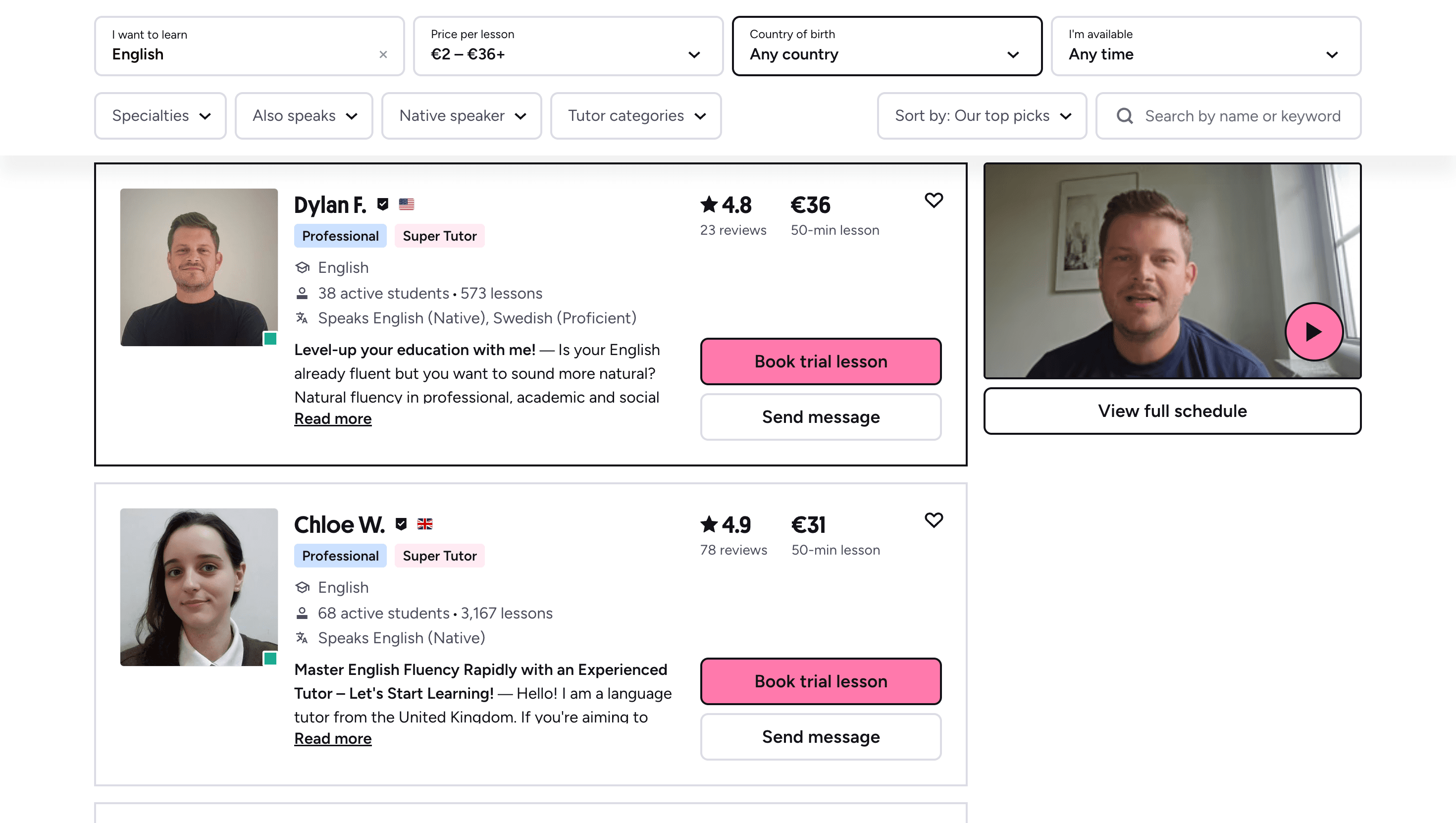
Many learners give up on language learning due to these high costs, missing out on valuable professional and personal opportunities.
That’s why we created Kylian: to make language learning accessible to everyone and help people master a foreign language without breaking the bank.
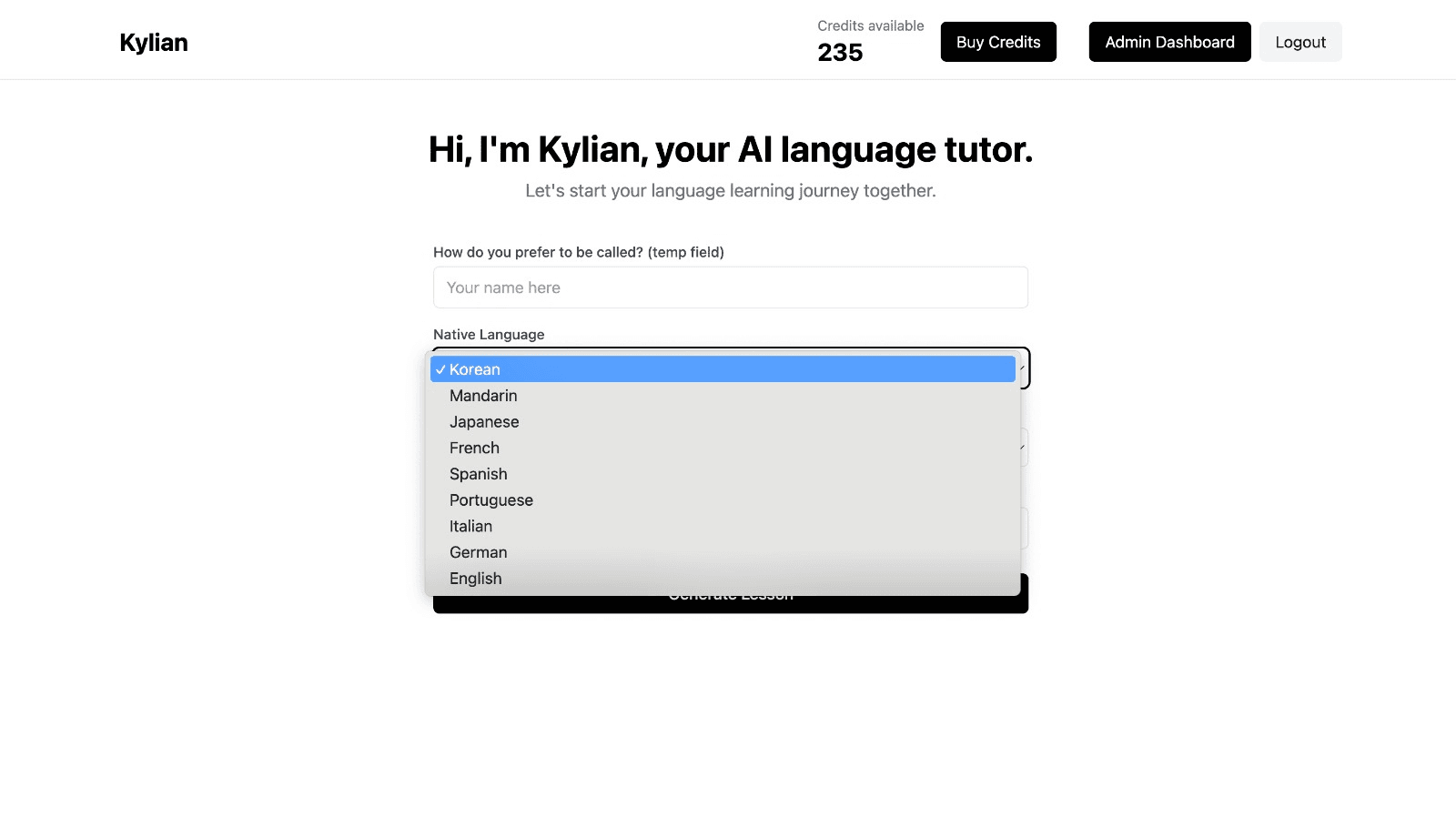
To get started, just tell Kylian which language you want to learn and what your native language is
Tired of teachers who don’t understand your specific struggles as a French speaker? Kylian’s advantage lies in its ability to teach any language using your native tongue as the foundation.
Unlike generic apps that offer the same content to everyone, Kylian explains concepts in your native language (French) and switches to the target language when necessary—perfectly adapting to your level and needs.
This personalization removes the frustration and confusion that are so common in traditional language learning.
Choose a specific topic you want to learn
Frustrated by language lessons that never cover exactly what you need? Kylian can teach you any aspect of a language—from pronunciation to advanced grammar—by focusing on your specific goals.
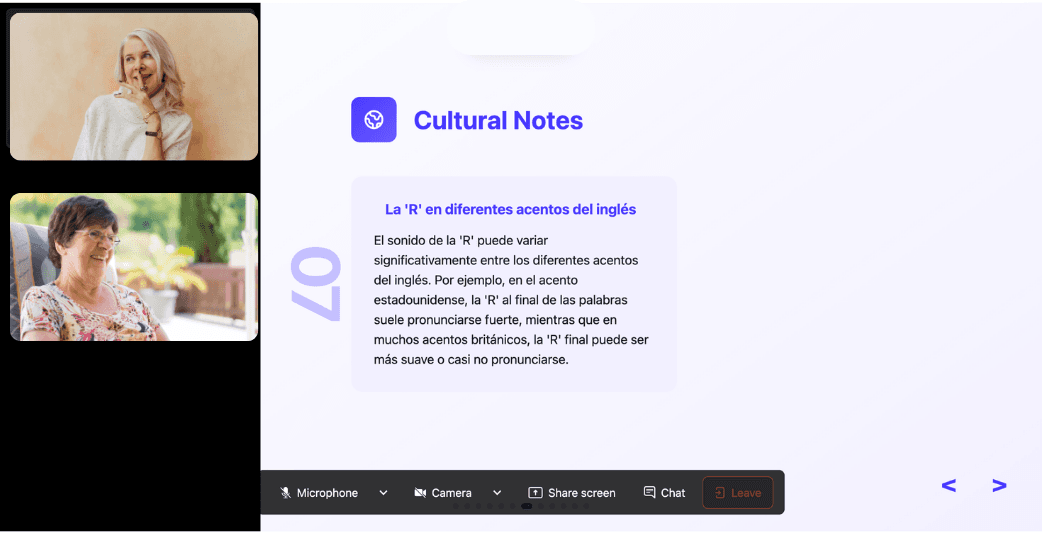
Avoid vague requests like “How can I improve my accent?” and be precise: “How do I pronounce the R like a native English speaker?” or “How do I conjugate the verb ‘to be’ in the present tense?”
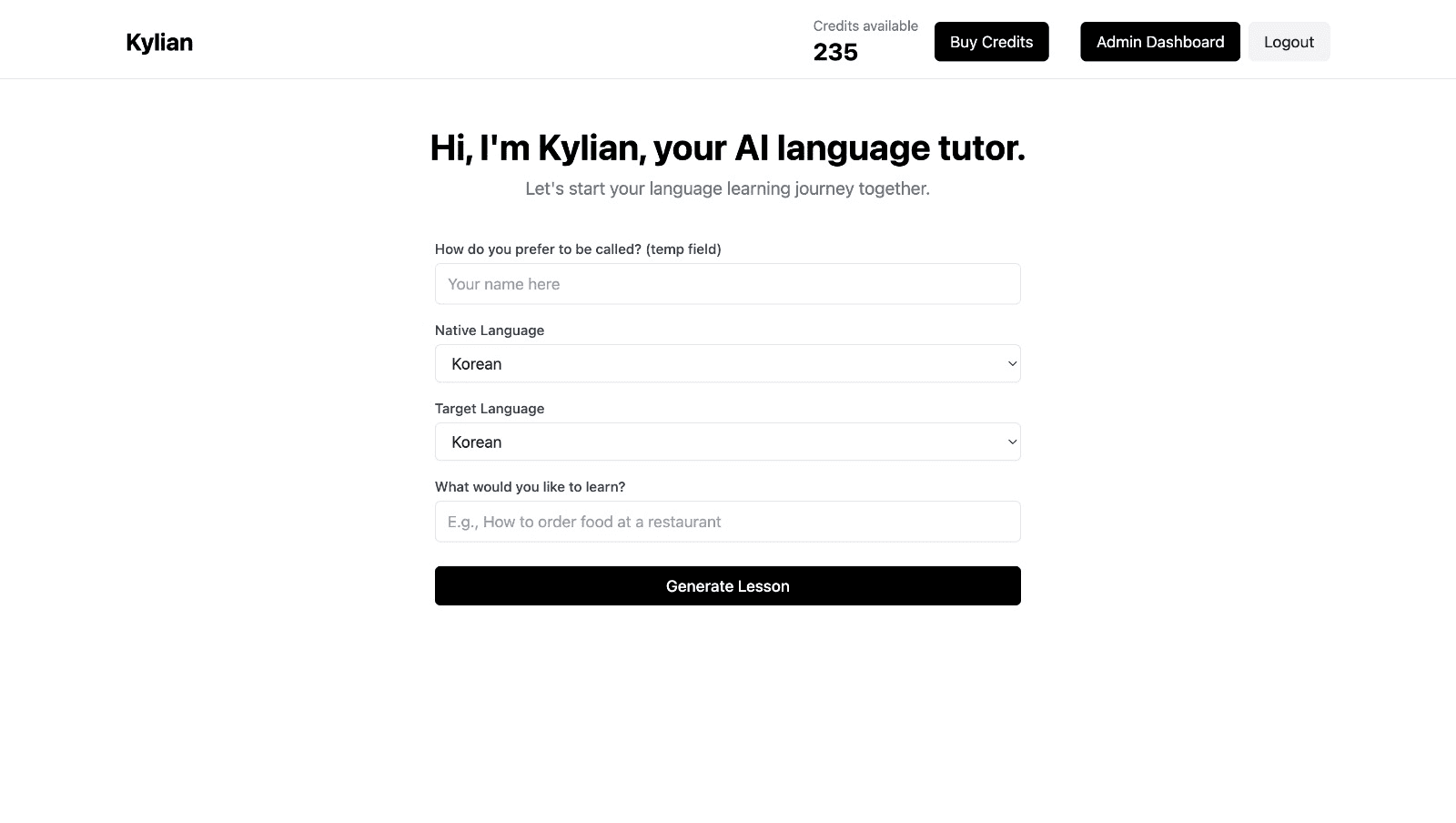
With Kylian, you’ll never again pay for irrelevant content or feel embarrassed asking “too basic” questions to a teacher. Your learning plan is entirely personalized.
Once you’ve chosen your topic, just hit the “Generate a Lesson” button, and within seconds, you’ll get a lesson designed exclusively for you.
Join the room to begin your lesson
The session feels like a one-on-one language class with a human tutor—but without the high price or time constraints.
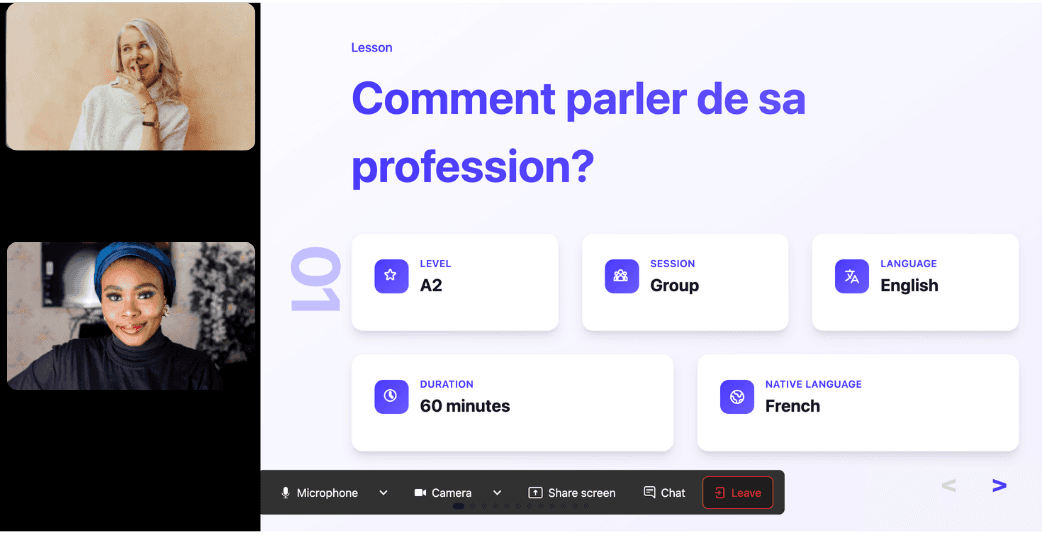
In a 25-minute lesson, Kylian teaches exactly what you need to know about your chosen topic: the nuances that textbooks never explain, key cultural differences between French and your target language, grammar rules, and much more.
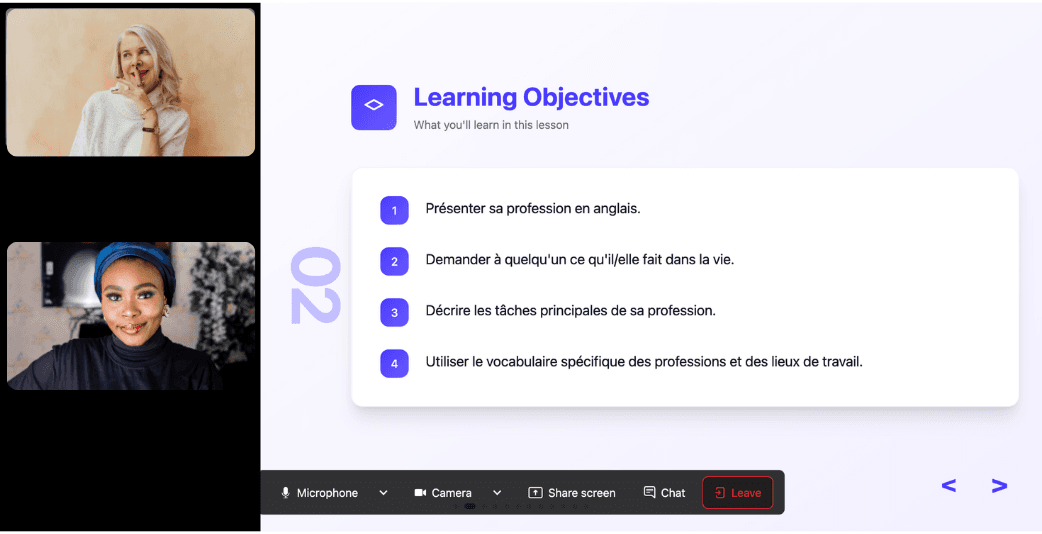
Ever felt frustrated trying to keep up with a native-speaking teacher, or embarrassed to ask for something to be repeated? With Kylian, that problem disappears. It switches intelligently between French and the target language depending on your level, helping you understand every concept at your own pace.
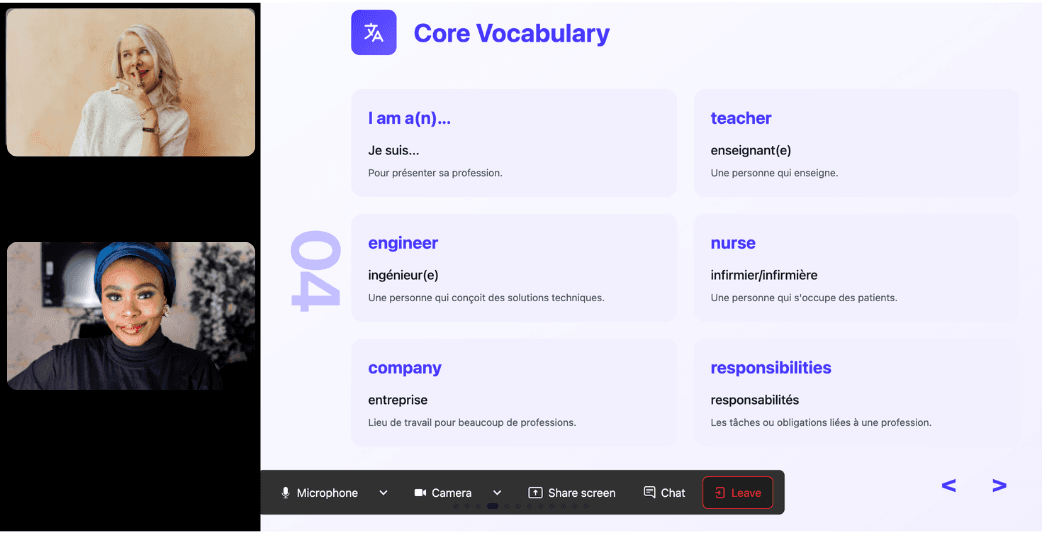
During the lesson, Kylian uses role-plays, real-life examples, and adapts to your learning style. Didn’t understand something? No problem—you can pause Kylian anytime to ask for clarification, without fear of being judged.

Ask all the questions you want, repeat sections if needed, and customize your learning experience in ways traditional teachers and generic apps simply can’t match.

With 24/7 access at a fraction of the cost of private lessons, Kylian removes all the barriers that have kept you from mastering the language you’ve always wanted to learn.