The evolution of language continues to surprise even the most astute observers. Words traditionally anchored in formal contexts often find themselves repurposed in colloquial speech, gaining entirely new dimensions of meaning. "Demure" stands as a compelling example of this linguistic transformation, having undergone a remarkable shift from its conventional definition to its current usage in contemporary slang.
The Traditional vs. Slang Definition of "Demure"
Traditionally, "demure" describes someone who exhibits modesty, reservation, and quietness in their demeanor and appearance. The Oxford English Dictionary defines it as "reserved, modest, and shy," often associated with a person who avoids drawing attention to themselves.
However, in modern slang contexts, "demure" has been cleverly inverted. It now functions as an ironic descriptor, deliberately applied to situations or individuals who are anything but modest or reserved. This sarcastic usage highlights the stark contrast between the word's formal meaning and the bold, attention-grabbing reality it actually describes.
How "Demure" is Used Sarcastically in Slang
The slang application of "demure" relies heavily on irony and contextual understanding. When someone describes an overtly flamboyant outfit as "so demure," they're deliberately employing contrasting language to emphasize just how flashy the clothing actually is. The humor derives precisely from this intentional mismatch between word choice and reality.
This usage has gained significant traction across various communication channels:
- Social media platforms where brevity and wit are valued
- Casual conversations among friends, particularly in fashion and entertainment circles
- Commentary on celebrity behavior or styling choices
- Reality television and its associated online communities
Real-World Examples of "Demure" in Slang Contexts
Understanding how "demure" functions in slang requires examining it in authentic contexts. Here are several scenarios illustrating its ironic application:
"Jake arrived at the club wearing a neon yellow suit with flashing LED accessories. Always keeping it demure, that one!" (Said about someone dressed in an intentionally flashy, attention-grabbing manner)
"She delivered her presentation by jumping on the table and using a megaphone. Such a demure approach to public speaking." (Describing an extremely bold, unconventional performance)
"The new sports car with its bright red paint job and custom exhaust system that can be heard from three blocks away? Oh yes, very demure." (Referencing something deliberately designed to attract attention)
"My demure little dinner party included fire dancers, a live band, and lasted until sunrise." (Describing an elaborate, extravagant event)
"He's so demure with his opinions," said after someone passionately dominated a political discussion for an hour. (Highlighting someone who is extremely vocal and assertive)
The Evolution of "Demure" in Popular Culture
The ironic usage of "demure" gained momentum through various cultural channels. Fashion and beauty influencers, particularly in drag and avant-garde communities, popularized this contrasting application of the term. RuPaul's Drag Race contestants, known for their elaborate and bold aesthetic choices, frequently employ "demure" to describe their most extravagant looks, cementing the term's ironic significance.
This linguistic inversion reflects a broader cultural pattern where communities reclaim and repurpose vocabulary, creating insider language that simultaneously acknowledges and subverts traditional meanings. The slang usage of "demure" exemplifies how language evolves through creative recontextualization.
When and Where You'll Encounter "Demure" as Slang
The sarcastic application of "demure" appears predominantly in specific demographic and geographic contexts:
- Urban centers in the United States, particularly in fashion, entertainment, and LGBTQ+ communities
- Online platforms including Twitter, Instagram, and TikTok, where brief, witty commentary flourishes
- Reality television discussion forums and recap podcasts
- United Kingdom youth culture, especially in metropolitan areas
Interestingly, this usage remains relatively uncommon in many English-speaking regions outside these specific communities. Australia, Canada, and New Zealand employ different linguistic devices to convey similar ironic contrasts.
Related Slang Terms and Expressions
"Demure" doesn't exist in isolation but belongs to a family of traditionally formal or restrained words now employed ironically in slang contexts:
- Understated: "Her entrance with fireworks and a ten-piece band was so understated."
- Subtle: "That neon green mohawk is looking very subtle today."
- Modest: "The 24-karat gold fixtures in his bathroom? Just a modest touch."
- Reserved: "She shared her entire life story within five minutes of meeting you. Always so reserved."
- Discreet: "His announcement via skywriter was extremely discreet."
These terms function through the same mechanism as "demure" in slang contexts—creating humor through deliberate linguistic contrast.
The Psychological Appeal of Ironic Language
The popularity of using words like "demure" ironically stems from several psychological principles:
- Group identity reinforcement: Understanding the ironic usage signals membership in a particular social or cultural group.
- Cognitive satisfaction: The mental processing required to recognize the contrast between literal meaning and intended meaning produces a sense of satisfaction when successfully decoded.
- Humor creation: Irony serves as an efficient vehicle for generating humor through unexpected contradiction.
- Linguistic creativity: Repurposing formal vocabulary in casual contexts demonstrates linguistic agility and creativity.
This pattern—where formal words gain ironic slang meanings—reflects how communities bond through shared linguistic innovations and mutual understanding of contextual meanings.
How to Recognize When "Demure" is Being Used Ironically
Identifying when "demure" appears in its slang context rather than its traditional meaning requires attention to several contextual clues:
- Obvious contradiction: The description contrasts starkly with the reality being described.
- Tone indicators: Exaggerated delivery, elongated vowels ("soooo demure"), or accompanying emojis signal ironic intent.
- Social context: Usage among younger speakers or in fashion, entertainment, or LGBTQ+ communities suggests potential ironic application.
- Accompanying descriptors: Paired with intensifiers like "absolutely," "truly," or "incredibly" when describing clearly non-demure subjects.
Understanding these signals helps language learners and those unfamiliar with this slang usage accurately interpret the intended meaning.
Common Misunderstandings About "Demure" in Slang
Several misconceptions persist regarding the slang usage of "demure":
- Assumption of regional universality: While popular in certain communities, this usage isn't universally recognized across all English-speaking regions.
- Misinterpreting the tone: Some listeners may mistake genuine compliments for sarcasm if they're aware of the slang usage but unfamiliar with context assessment.
- Confusion about appropriate contexts: The ironic usage primarily occurs in casual, social situations and would be inappropriate in formal or professional settings.
- Believing it's a recent invention: Though amplified by social media, ironic usage of "demure" has historical precedents in camp culture and queer communities dating back decades.
These misunderstandings highlight the complexity of slang interpretation and the importance of contextual awareness.
The Linguistic Mechanism Behind "Demure" as Slang
From a linguistic perspective, the ironic usage of "demure" exemplifies several interesting phenomena:
- Semantic inversion: The intended meaning becomes nearly opposite to the word's dictionary definition.
- Pragmatic recontextualization: The word acquires its meaning not from its semantic content but from how it's deployed in specific communicative contexts.
- Sociolinguistic signaling: Using "demure" ironically often signals membership in particular social groups or familiarity with specific cultural references.
- Semantic drift: The word's meaning has expanded rather than completely changed, as its original definition remains intact in formal contexts.
This pattern of ironic repurposing appears throughout language evolution, demonstrating how communities reshape vocabulary to serve new communicative needs.
Practicing "Demure" in Context: Usage Examples
Understanding comes through application. Consider these scenarios where "demure" appears in its slang context:
- Scenario: A friend arrives at a party wearing an elaborate costume with flashing lights. Appropriate slang response: "Looking very demure tonight, aren't we?"
- Scenario: Someone gives an extremely passionate, table-pounding speech about politics. Appropriate slang response: "That was such a demure expression of your opinions."
- Scenario: A celebrity posts photos of their mansion featuring gold-plated fixtures and crystal chandeliers. Appropriate slang response: "Their home decor is so demure and understated."
- Scenario: A chef creates an elaborate 15-course tasting menu with molecular gastronomy techniques. Appropriate slang response: "Just a demure little dinner, nothing fancy."
Each example illustrates how the ironic contrast generates humor and emphasizes the opposite of the traditional meaning.
"Demure" in Digital Communication
The slang usage of "demure" particularly thrives in digital environments where:
- Brief, witty commentaries gain rapid traction
- Visual content can directly contradict textual descriptions, amplifying irony
- Communities form around shared linguistic patterns
- Cultural references spread quickly across geographic boundaries
This makes platforms like Twitter, Instagram, and TikTok especially fertile ground for the propagation of this slang usage. The term frequently appears in captions for deliberately extravagant content or as commentary on bold celebrity behavior.
Teaching and Learning About Slang Usage of "Demure"
For language educators and learners, understanding this slang usage presents unique challenges:
- Contextual learning is essential: Memorizing definitions proves insufficient; learners must experience the term in authentic contexts.
- Cultural references matter: Full comprehension requires familiarity with the communities where this usage originated and flourishes.
- Attention to tone indicators: Learners must recognize verbal and non-verbal signals that indicate ironic intent.
- Practice with feedback: Attempting to use "demure" ironically and receiving guidance on appropriateness helps develop intuitive understanding.
Language instruction that incorporates authentic materials—social media posts, video clips, or recorded conversations—provides more effective learning experiences than decontextualized vocabulary lists.
The Future of "Demure" in Slang
Language evolves continuously, raising questions about the trajectory of "demure" in slang usage:
- Will it remain confined to specific communities, or will it gain broader acceptance?
- Might extended usage eventually influence the word's formal definition?
- Could the ironic usage eventually replace the traditional meaning entirely?
- Will new slang terms emerge that function through similar ironic mechanisms?
Historical patterns suggest that slang terms either become mainstream, losing their subcultural associations, or fade as communities adopt new vocabulary. "Demure" currently exists in an interesting transitional space—widely recognized in certain circles while remaining opaque to others.
Learn Any Language with Kylian AI
Private language lessons are expensive. Paying between 15 and 50 euros per lesson isn’t realistic for most people—especially when dozens of sessions are needed to see real progress.
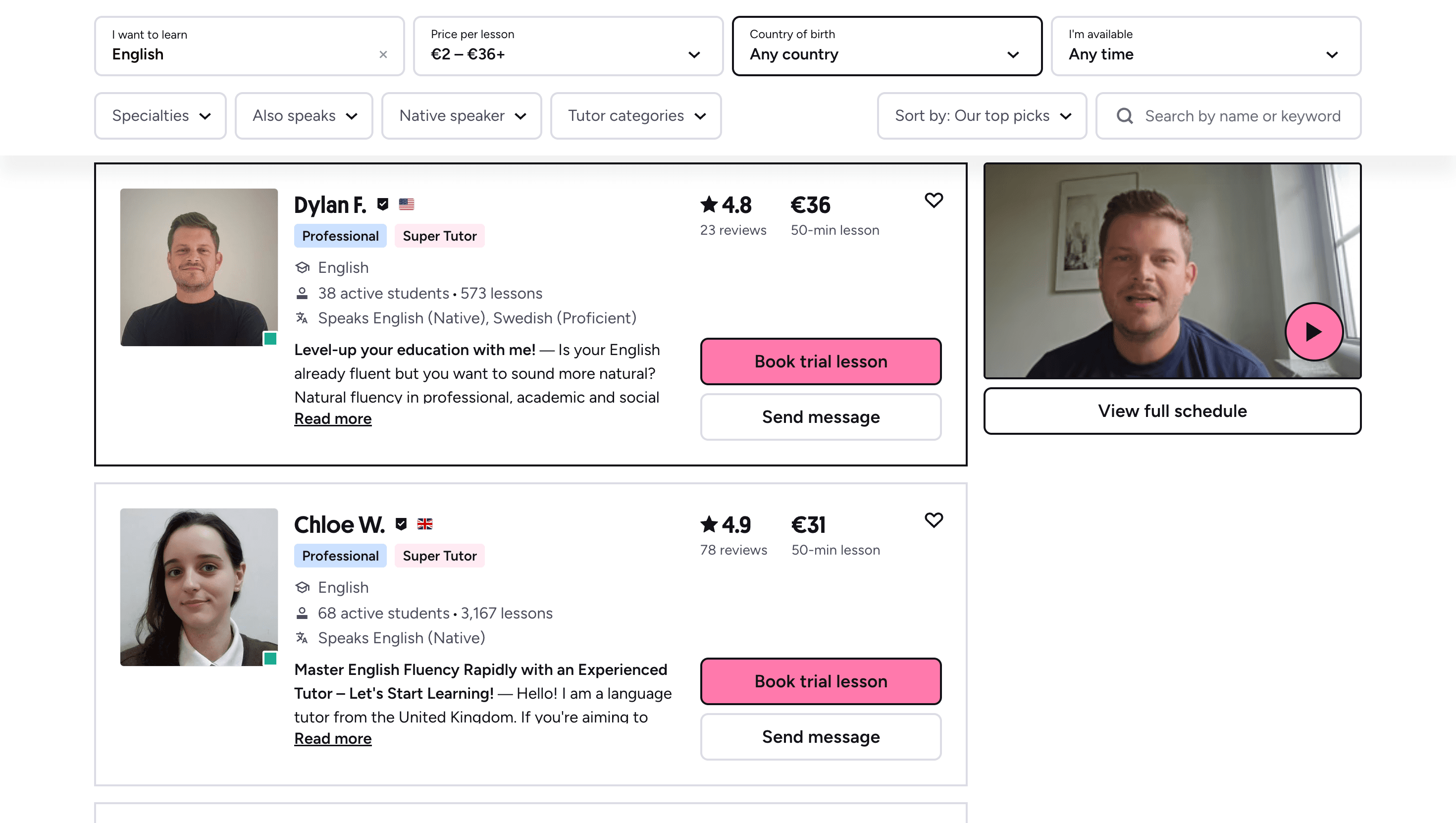
Many learners give up on language learning due to these high costs, missing out on valuable professional and personal opportunities.
That’s why we created Kylian: to make language learning accessible to everyone and help people master a foreign language without breaking the bank.
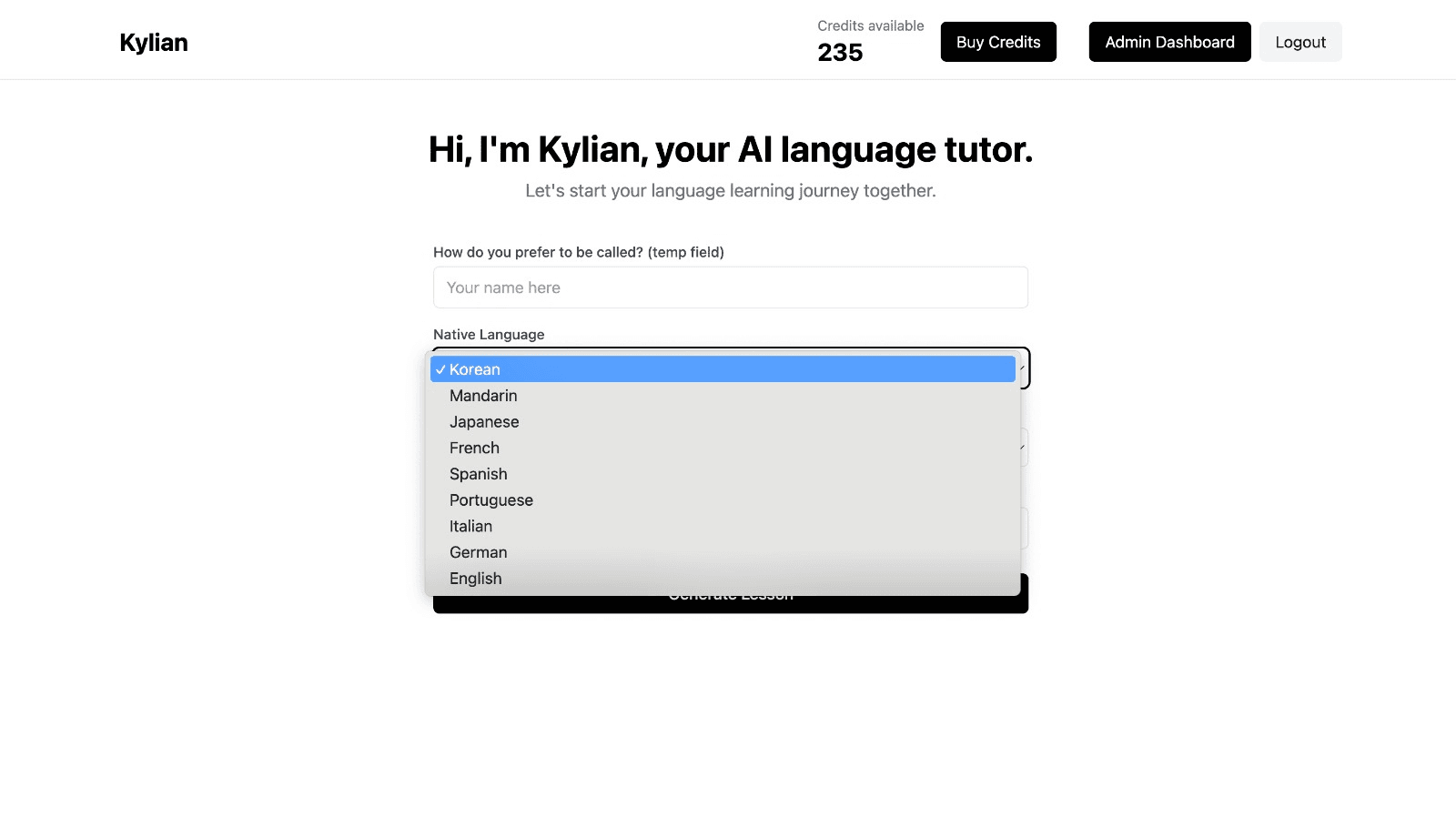
To get started, just tell Kylian which language you want to learn and what your native language is
Tired of teachers who don’t understand your specific struggles as a French speaker? Kylian’s advantage lies in its ability to teach any language using your native tongue as the foundation.
Unlike generic apps that offer the same content to everyone, Kylian explains concepts in your native language (French) and switches to the target language when necessary—perfectly adapting to your level and needs.
This personalization removes the frustration and confusion that are so common in traditional language learning.
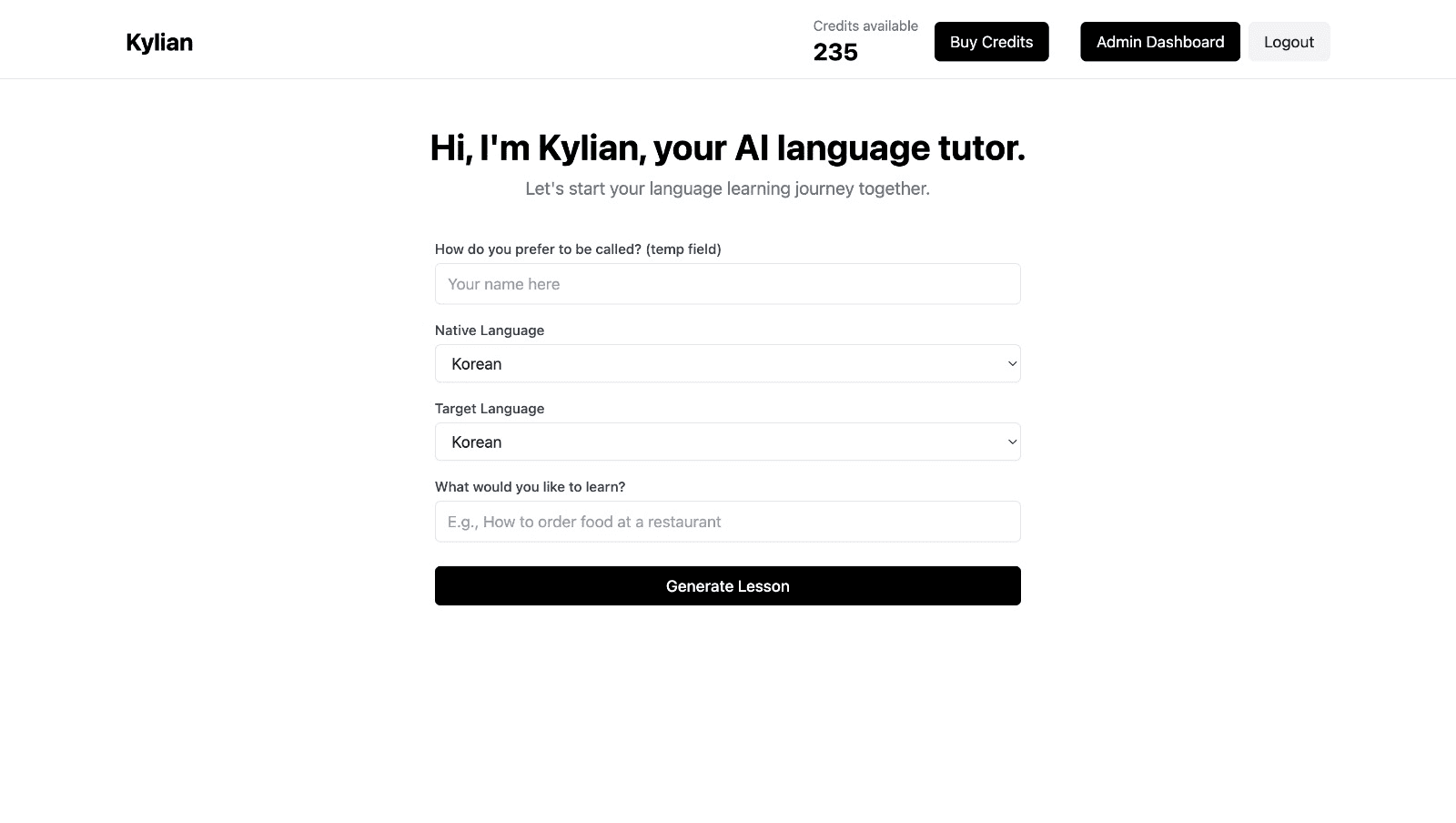
Choose a specific topic you want to learn
Frustrated by language lessons that never cover exactly what you need? Kylian can teach you any aspect of a language—from pronunciation to advanced grammar—by focusing on your specific goals.
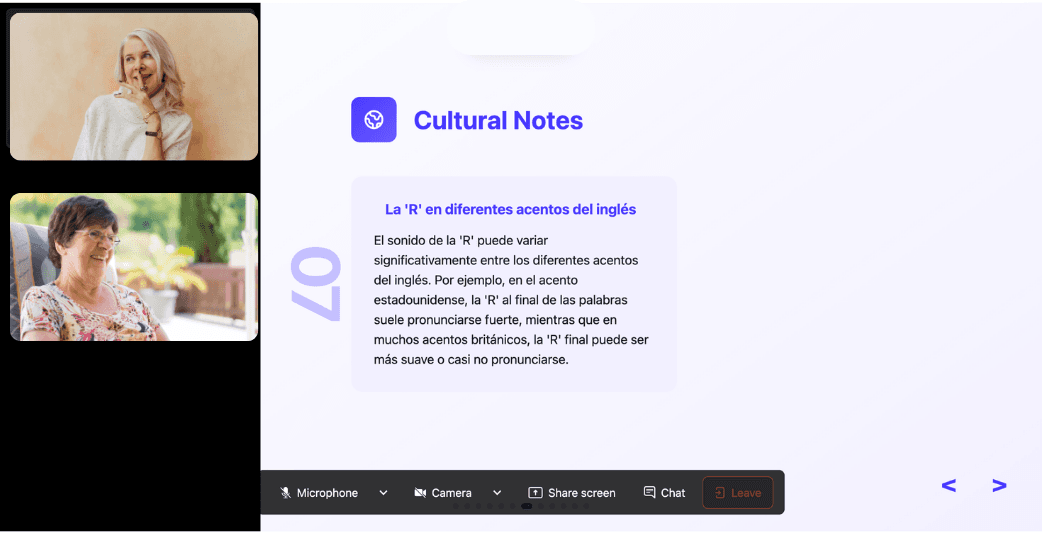
Avoid vague requests like “How can I improve my accent?” and be precise: “How do I pronounce the R like a native English speaker?” or “How do I conjugate the verb ‘to be’ in the present tense?”
With Kylian, you’ll never again pay for irrelevant content or feel embarrassed asking “too basic” questions to a teacher. Your learning plan is entirely personalized.
Once you’ve chosen your topic, just hit the “Generate a Lesson” button, and within seconds, you’ll get a lesson designed exclusively for you.
Join the room to begin your lesson
The session feels like a one-on-one language class with a human tutor—but without the high price or time constraints.
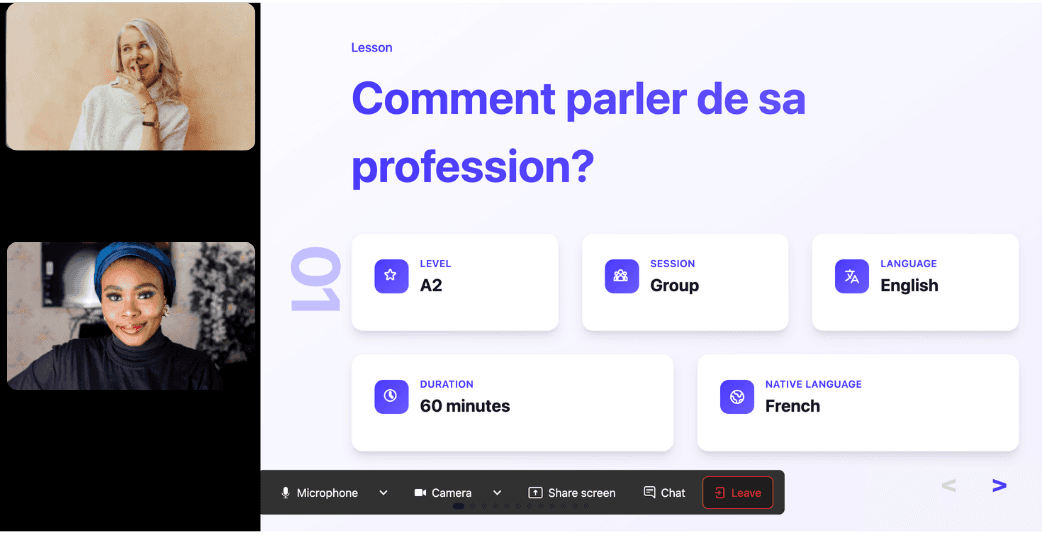
In a 25-minute lesson, Kylian teaches exactly what you need to know about your chosen topic: the nuances that textbooks never explain, key cultural differences between French and your target language, grammar rules, and much more.
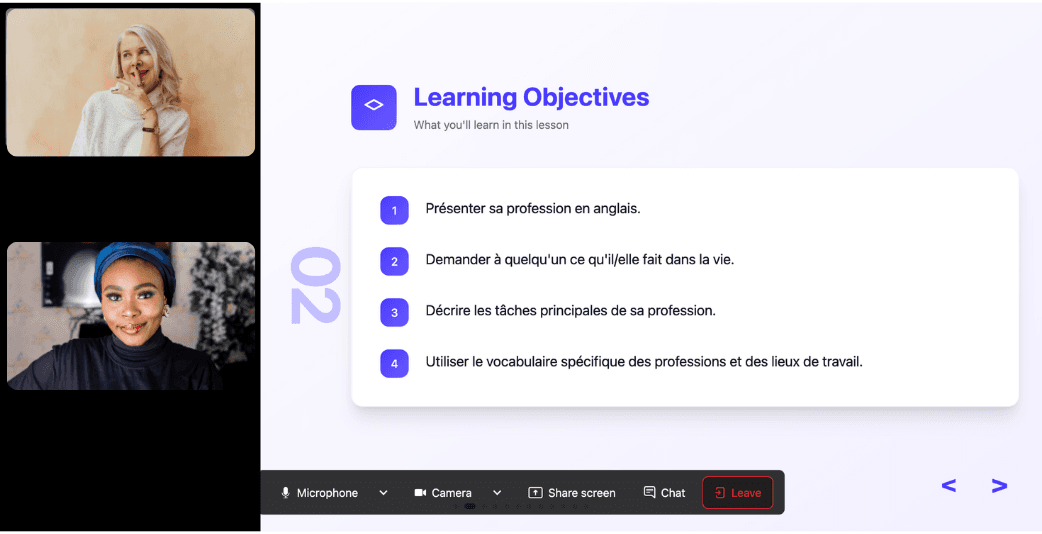
Ever felt frustrated trying to keep up with a native-speaking teacher, or embarrassed to ask for something to be repeated? With Kylian, that problem disappears. It switches intelligently between French and the target language depending on your level, helping you understand every concept at your own pace.
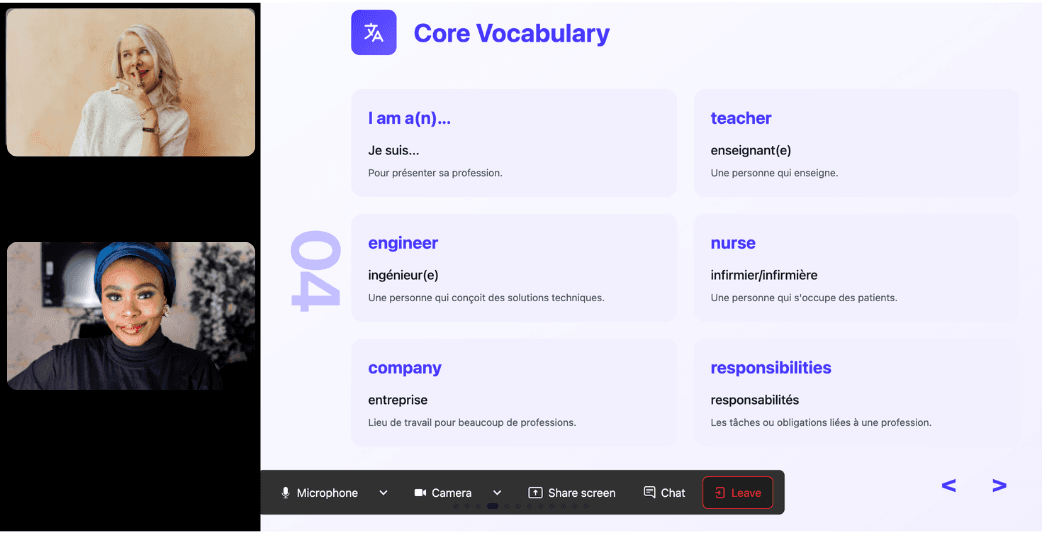
During the lesson, Kylian uses role-plays, real-life examples, and adapts to your learning style. Didn’t understand something? No problem—you can pause Kylian anytime to ask for clarification, without fear of being judged.
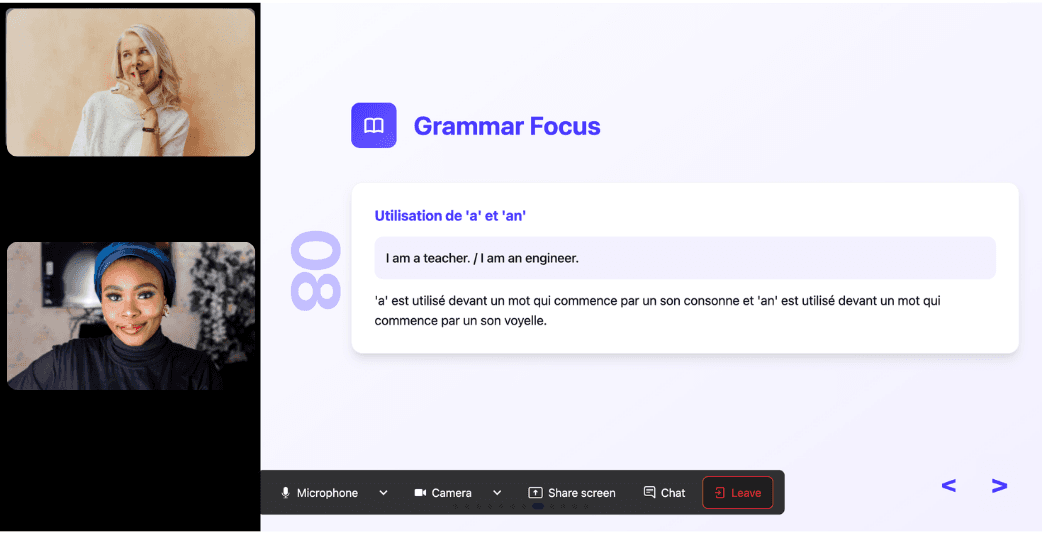
Ask all the questions you want, repeat sections if needed, and customize your learning experience in ways traditional teachers and generic apps simply can’t match.
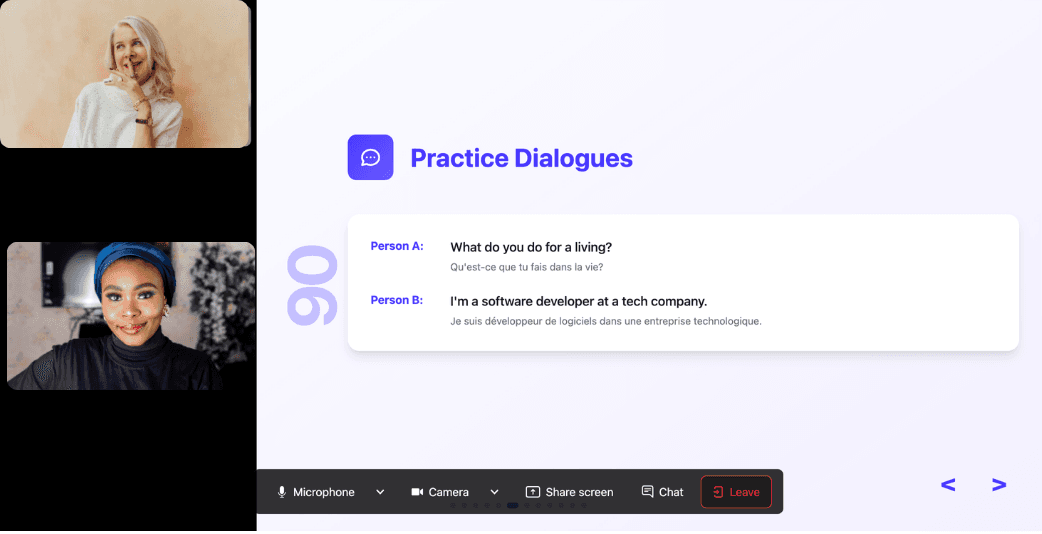
With 24/7 access at a fraction of the cost of private lessons, Kylian removes all the barriers that have kept you from mastering the language you’ve always wanted to learn.