Learning a language begins with understanding its fundamental building blocks. For Portuguese learners, mastering the alphabet creates a solid foundation for pronunciation, reading, and spelling—essential skills that determine your fluency journey's success.
Portuguese utilizes the Latin alphabet, making it initially accessible for English speakers. However, beneath this surface-level familiarity lie crucial differences in pronunciation, accentuation, and letter combinations that significantly impact comprehension and speaking ability.
Understanding the Portuguese Alphabet: Core Elements and Structure
The Portuguese alphabet (alfabeto português) comprises 26 letters—identical to English in quantity and sequence. This structural similarity offers a comfortable entry point for English speakers. However, the parallels largely end there, as Portuguese features distinct pronunciation rules and letter-sound relationships.
Portuguese demonstrates greater consistency between spelling and pronunciation than English, reducing the learning curve for reading and writing. This orthographic transparency means that once you've learned the pronunciation rules, you can reliably predict how written words should sound—an advantage that accelerates language acquisition.
Here's how to pronounce each letter of the Portuguese alphabet:
- A (ah)
- B (beh)
- C (seh)
- D (deh)
- E (eh)
- F (effeh)
- G (geh)
- H (ah-gah)
- I (ee)
- J (zhota)
- K (kah)
- L (el)
- M (em)
- N (en)
- O (oh)
- P (peh)
- Q (keh)
- R (erreh)
- S (ess)
- T (teh)
- U (oo)
- V (veh)
- W (dahblee-veh) - Brazilian: (dahblee-oo)
- X (sheez)
- Y (eepsilon) or (ee-gregah)
- Z (zeh)
Portuguese Vowels: Pronunciation Variations and Patterns
The five Portuguese vowels—a, e, i, o, u—form the backbone of the language's sound system. Unlike English vowels, which can have wildly varying pronunciations, Portuguese vowels follow more systematic patterns based on stress and position.
Understanding four key vowel characteristics is essential:
- Open vs. Closed Sounds: Determined by tongue position
- Stressed vs. Unstressed Position: Affects vowel length and emphasis
- Nasal vs. Oral Pronunciation: Changes based on adjacent letters
- Diphthongs: Vowel combinations creating distinctive sounds
Open and Closed Vowel Sounds
Open vowels involve a lower tongue position, while closed vowels require raising the tongue toward the palate. This distinction is crucial for accurate pronunciation:
- A - Open stressed: like "a" in "father" (má - bad)
- Closed stressed: similar to "a" in "about" (fada - fairy)
- E - Open stressed: like "e" in "bet" (pé - foot)
- Closed stressed: resembles "ay" in "day" (mês - month)
- I - Consistently pronounced like "ee" in "see" (livro - book) with minimal variation
- O - Open stressed: like "o" in "pot" (pó - dust)
- Closed stressed: similar to "o" in "go" (avô - grandfather)
- U - Consistently pronounced like "oo" in "boot" (uva - grape) with minimal variation
The vowels "i" and "u" maintain relatively consistent pronunciation regardless of position, simplifying their learning compared to "a," "e," and "o."
Stressed and Unstressed Vowel Pronunciation
Portuguese, like English, alters vowel pronunciation based on syllable stress. However, Portuguese implements this more systematically:
- Stressed A: Strong "ah" sound as in "father"
- Unstressed A: Reduced to a schwa sound similar to "a" in "about"
- Stressed E (open): Clear "eh" sound as in "bet"
- Stressed E (closed): Pronounced like "ay" in "day"
- Unstressed E: Often reduced to a sound similar to "i" in "bit"
- Stressed O (open): Full sound like "o" in "pot"
- Stressed O (closed): Rounded sound like "o" in "go"
- Unstressed O: Frequently shifts to an "oo" sound, especially in final syllables
Understanding these stress patterns helps distinguish words like "avó" (grandmother) from "avô" (grandfather), where the accent mark indicates both stress and vowel quality.
Nasal Vowels: A Distinctive Feature
Nasal vowels represent one of Portuguese's most characteristic sounds. They occur in several contexts:
- Before M or N: cama (bed), vento (wind)
- With tilde accent (˜): maçã (apple), leões (lions)
- In specific letter combinations: ão, õe, ãe
When pronouncing nasal vowels, the air flows through both the mouth and nose, creating a resonant quality absent in English. Practice by saying the English word "song" while emphasizing the nasal quality of the "on."
Common nasal vowel combinations include:
- Ã, AM, AN: Pronounced similar to "an" in "can" but with more nasal resonance (mão - hand)
- EM, EN: Similar to "en" in "men" with nasal quality (bem - well)
- IM, IN: Like "een" with nasal resonance (fim - end)
- OM, ON: Resembles "on" in "song" with pronounced nasality (som - sound)
- UM, UN: Like "oon" with nasal quality (um - one)
Vowel Reduction in Natural Speech
In conversational Portuguese, particularly European variants, unstressed vowels often reduce or disappear entirely. This vowel reduction, known as "vowel deletion" or "elision," makes native speech seem faster than classroom Portuguese.
For instance:
- "Gente" (people) may sound more like "gent"
- "Setembro" (September) might be pronounced closer to "s'tembro"
These reductions follow predictable patterns worth recognizing, even if beginners should maintain full pronunciation until developing greater confidence.
Portuguese Diphthongs: Vowel Combinations and Their Sounds
Diphthongs—two vowels pronounced together in a single syllable—occur frequently in Portuguese. Unlike English diphthongs, which often have irregular pronunciations, Portuguese diphthongs maintain consistent sound patterns:
Oral Diphthongs:
- ai: Similar to "eye" (pai - father)
- ei: Resembles "ay" in "day" (feijão - bean)
- oi: Like "oy" in "boy" (noite - night)
- ui: Similar to "we" (muito - very)
- au: Like "ow" in "cow" (mau - bad)
- eu: Similar to "eh-oo" blended together (seu - yours)
- ou: Often pronounced simply as "o" in Brazilian Portuguese (sou - I am)
Nasal Diphthongs:
- ão: A distinctive Portuguese sound (mão - hand)
- ãe: Nasal variant of "eye" (mãe - mother)
- õe: Nasal "oy" sound (limões - lemons)
Portuguese Consonants: Pronunciation Rules and Regional Variations
Most Portuguese consonants follow consistent pronunciation patterns, with some notable exceptions. Understanding these patterns will help you navigate the language's sound system effectively.
Consistently Pronounced Consonants
The following consonants maintain relatively stable pronunciation across contexts:
- B: Always like English "b" (bom - good)
- D: Like English "d" (dia - day)
- F: Like English "f" (fazer - to do)
- K: Like English "k" (kilo - kilogram)
- L: Like English "l" (livro - book), except before consonants or at word-end, where it may sound like "w" in Brazilian Portuguese
- M: Like English "m" (mar - sea)
- N: Like English "n" (não - no)
- P: Like English "p" (pai - father)
- T: Like English "t" (tempo - time)
- V: Like English "v" (viver - to live)
Consonants with Context-Dependent Pronunciation
Several Portuguese consonants change pronunciation based on surrounding letters:
The Letter "C"
- Before A, O, U: Hard "k" sound (casa - house, coração - heart)
- Before E, I: Soft "s" sound (cedo - early, cidade - city)
- With cedilla (Ç): Always sounds like "s" regardless of the following vowel (caça - hunt)
The Letter "G"
- Before A, O, U: Hard "g" as in "go" (gato - cat, gosto - taste)
- Before E, I: Soft "j" sound similar to "s" in "measure" (gente - people, girafa - giraffe)
The Letter "R"
Portuguese "R" has multiple pronunciations varying by dialect and position:
- Initial position: Typically a guttural sound in European Portuguese or an "h" sound in Brazilian Portuguese (rato - mouse)
- Double RR: Strong guttural sound or "h" sound (carro - car)
- Between vowels: Softer tapped "r" similar to Spanish (caro - expensive)
- End of syllables: Often softened or dropped in Brazilian Portuguese (porta - door)
The Letter "S"
- Initial position or between vowels: Like English "s" (saber - to know)
- End of words or before consonants: "Sh" sound in most dialects (mais - more)
- Between vowels: "Z" sound (casa - house)
The Letter "X"
Perhaps the most variable consonant in Portuguese:
- Word-initial or after diphthongs: "Sh" sound (xícara - cup, caixa - box)
- Between vowels: May sound like "sh," "ks," or "z" depending on the word (peixe - fish, táxi - taxi, exato - exact)
- After N: "Sh" sound (enxame - swarm)
Special Consonant Combinations in Portuguese
Several letter combinations create distinctive sounds in Portuguese:
- NH: Similar to "ny" in "canyon" (banho - bath)
- LH: Similar to "lli" in "million" (filho - son)
- CH: "Sh" sound as in "ship" (chá - tea)
- QU: Before E, I: "K" sound (quente - hot); Before A, O: "Kw" sound (quando - when)
- GU: Before E, I: "G" sound with silent U (guitarra - guitar)
Accent Marks in Portuguese: More Than Stress Indicators
Accent marks serve crucial functions in Portuguese, affecting both pronunciation and meaning:
- Acute accent (´): Indicates stress and open vowel pronunciation (café - coffee)
- Circumflex accent (^): Indicates stress and closed vowel pronunciation (português - Portuguese)
- Tilde (~): Denotes nasal vowels (maçã - apple)
- Grave accent (`): Used primarily with "a" contractions (à - to the)
- Diaeresis (¨): Rarely used in modern Portuguese to indicate that "u" should be pronounced in "gü" and "qü" combinations
These diacritical marks cannot be omitted in formal writing as they often distinguish between otherwise identical words:
- avó (grandmother) vs. avô (grandfather)
- por (by) vs. pôr (to put)
- pais (parents) vs. país (country)
The Evolving Portuguese Alphabet: Historical Context
The Portuguese alphabet has undergone significant evolution. Before the 1990 Orthographic Agreement, K, W, and Y were not officially part of the alphabet, appearing only in foreign loanwords. This reform standardized orthography across Portuguese-speaking countries, impacting spelling in Brazil, Portugal, Angola, Mozambique, and other Portuguese-speaking nations.
Most notably, the reform removed silent consonants (e.g., "ação" instead of "acção") and altered accent mark usage in certain words, bringing Brazilian and European Portuguese closer orthographically while maintaining pronunciation differences.
Communicating About Spelling in Portuguese
Knowing how to discuss spelling provides practical communication tools for language learners:
Asking about spelling:
- "Como se soletra isso?" (How do you spell that?)
- "Poderia soletrar seu nome, por favor?" (Could you spell your name, please?)
Spelling out words:
- "O meu nome é Ana. Soletra-se A-N-A." (My name is Ana. It's spelled A-N-A.)
Asking about the first letter:
- "Com que letra começa?" (What letter does it start with?)
- "Começa com S ou C?" (Does it start with S or C?)
Correcting spelling mistakes:
- "Acho que você escreveu errado. Escreve-se assim..." (I think you spelled it wrong. It's written like this...)
Common Spelling Challenges for Portuguese Learners
Certain aspects of Portuguese spelling present consistent challenges:
- Similar-sounding consonants: Distinguishing between S/Ç/SS/C (when to use each)
- Nasal sounds: Knowing when to use ÃO, AM, or AN
- Silent H: Always silent but required in certain words
- Accent placement: Learning which syllable receives stress
- Double consonants: When to use RR vs. R or SS vs. S
Digital Communication and Portuguese Special Characters
Typing Portuguese special characters on non-Portuguese keyboards presents a common practical challenge. Here are solutions for different systems:
Windows:
- á: Alt + 0225
- à: Alt + 0224
- ã: Alt + 0227
- â: Alt + 0226
- é: Alt + 0233
- ê: Alt + 0234
- í: Alt + 0237
- ó: Alt + 0243
- ô: Alt + 0244
- õ: Alt + 0245
- ú: Alt + 0250
- ç: Alt + 0231
Mac:
- á: Option + e, then a
- à: Option + `, then a
- ã: Option + n, then a
- â: Option + i, then a
- é: Option + e, then e
- ê: Option + i, then e
- í: Option + e, then i
- ó: Option + e, then o
- ô: Option + i, then o
- õ: Option + n, then o
- ú: Option + e, then u
- ç: Option + c
Alternatively, virtual Portuguese keyboards or browser extensions can simplify typing these characters.
Portuguese Pronunciation Resources and Learning Methods
Mastering Portuguese pronunciation requires both structured learning and immersion. These approaches yield the most effective results:
- Audio resources: Podcasts, language learning apps, and audiobooks provide authentic exposure to native pronunciation
- Mimicry practice: Repeating after native speakers helps train muscle memory
- Speech recognition tools: Apps with speech recognition provide immediate feedback
- Phonetic transcription: Learning IPA (International Phonetic Alphabet) notation helps visualize sounds
- Working with tutors: Personalized guidance for pronunciation challenges
The Portuguese Alphabet as a Foundation for Cultural Understanding
Beyond its functional value, the Portuguese alphabet opens doors to cultural understanding. Portuguese-speaking communities span four continents, with each region developing distinctive linguistic characteristics while maintaining a common foundation.
Understanding how Brazilian Portuguese developed different pronunciation patterns from European Portuguese reveals historical migration patterns and cultural exchanges. Similarly, African varieties of Portuguese reflect colonial histories and indigenous language influences.
Learn Any Language with Kylian AI
Private language lessons are expensive. Paying between 15 and 50 euros per lesson isn’t realistic for most people—especially when dozens of sessions are needed to see real progress.
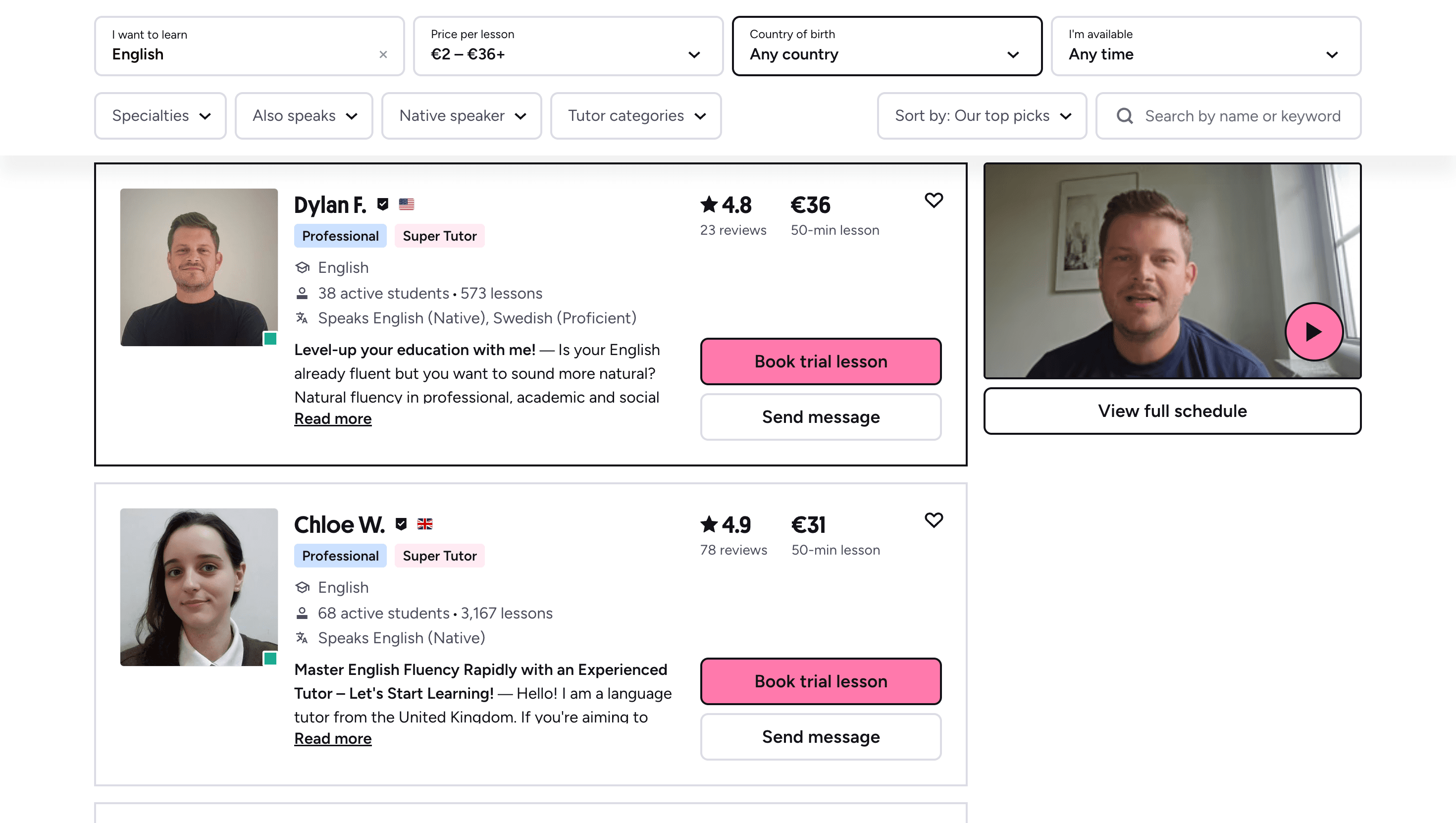
Many learners give up on language learning due to these high costs, missing out on valuable professional and personal opportunities.
That’s why we created Kylian: to make language learning accessible to everyone and help people master a foreign language without breaking the bank.
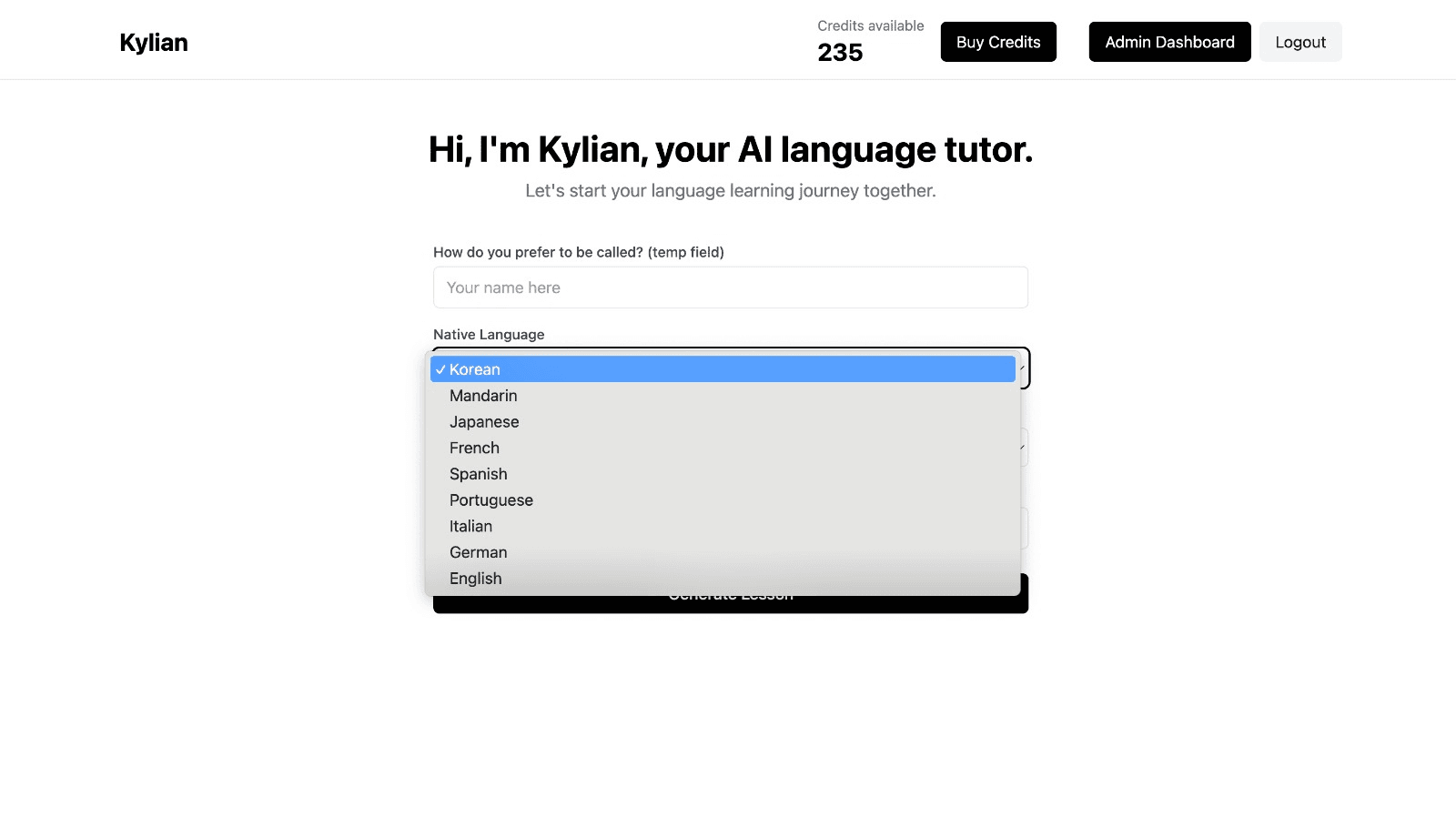
To get started, just tell Kylian which language you want to learn and what your native language is
Tired of teachers who don’t understand your specific struggles as a French speaker? Kylian’s advantage lies in its ability to teach any language using your native tongue as the foundation.
Unlike generic apps that offer the same content to everyone, Kylian explains concepts in your native language (French) and switches to the target language when necessary—perfectly adapting to your level and needs.
This personalization removes the frustration and confusion that are so common in traditional language learning.
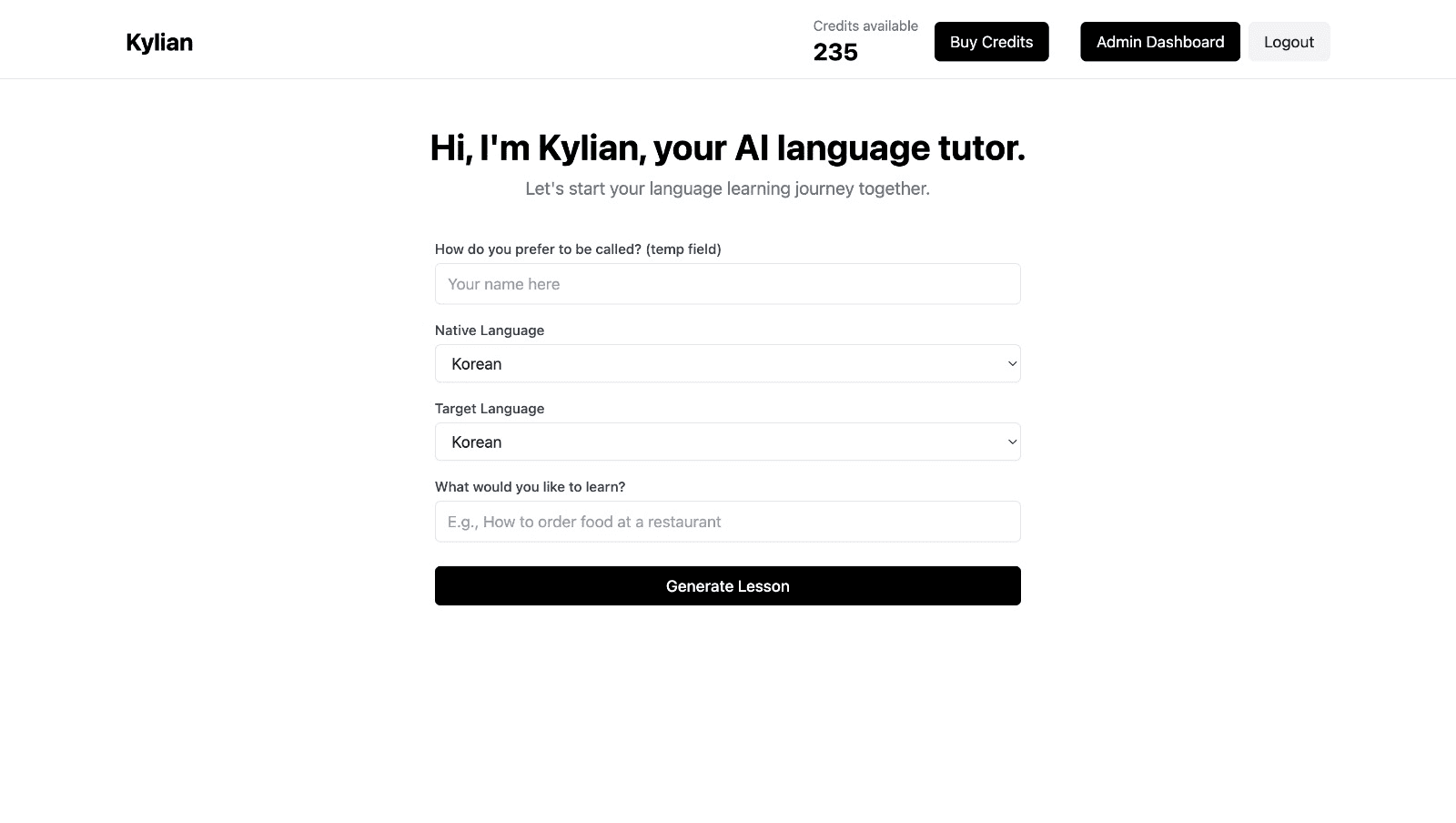
Choose a specific topic you want to learn
Frustrated by language lessons that never cover exactly what you need? Kylian can teach you any aspect of a language—from pronunciation to advanced grammar—by focusing on your specific goals.
Avoid vague requests like “How can I improve my accent?” and be precise: “How do I pronounce the R like a native English speaker?” or “How do I conjugate the verb ‘to be’ in the present tense?”
With Kylian, you’ll never again pay for irrelevant content or feel embarrassed asking “too basic” questions to a teacher. Your learning plan is entirely personalized.
Once you’ve chosen your topic, just hit the “Generate a Lesson” button, and within seconds, you’ll get a lesson designed exclusively for you.
Join the room to begin your lesson
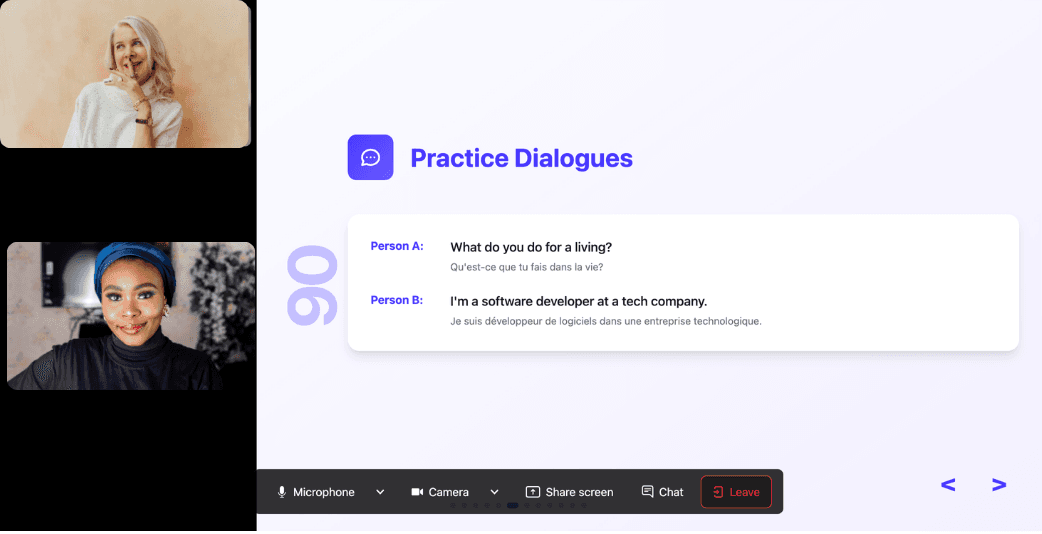
The session feels like a one-on-one language class with a human tutor—but without the high price or time constraints.
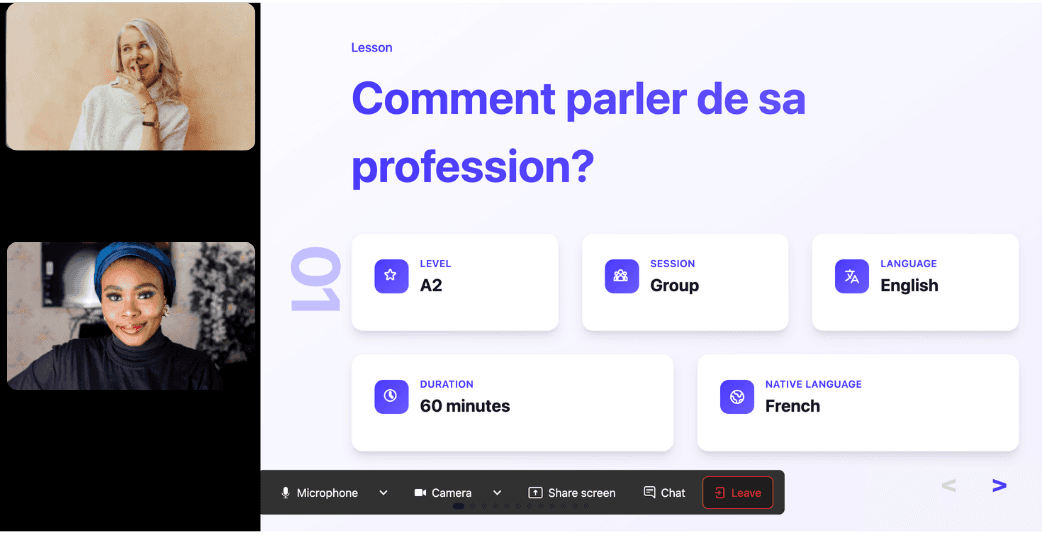
In a 25-minute lesson, Kylian teaches exactly what you need to know about your chosen topic: the nuances that textbooks never explain, key cultural differences between French and your target language, grammar rules, and much more.
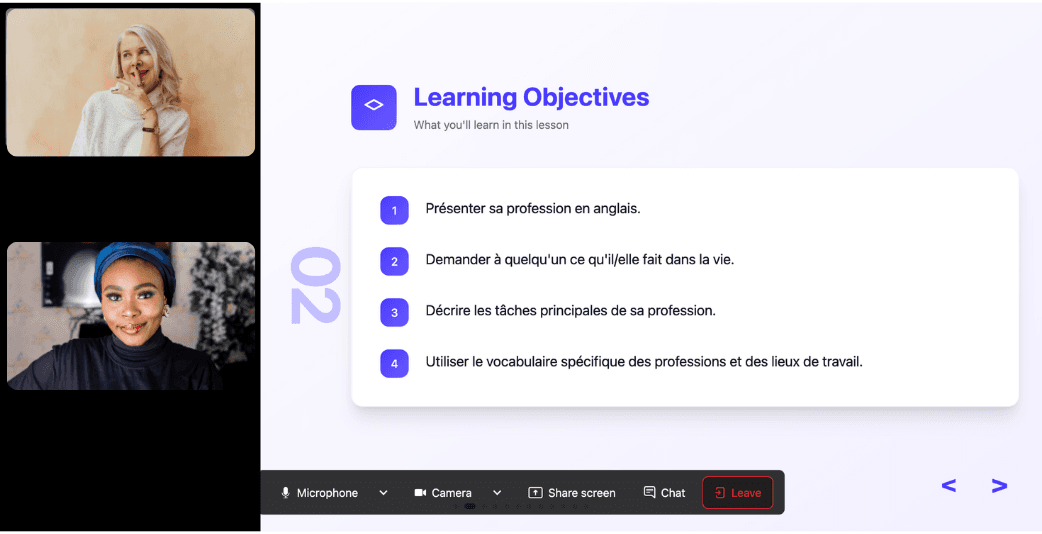
Ever felt frustrated trying to keep up with a native-speaking teacher, or embarrassed to ask for something to be repeated? With Kylian, that problem disappears. It switches intelligently between French and the target language depending on your level, helping you understand every concept at your own pace.
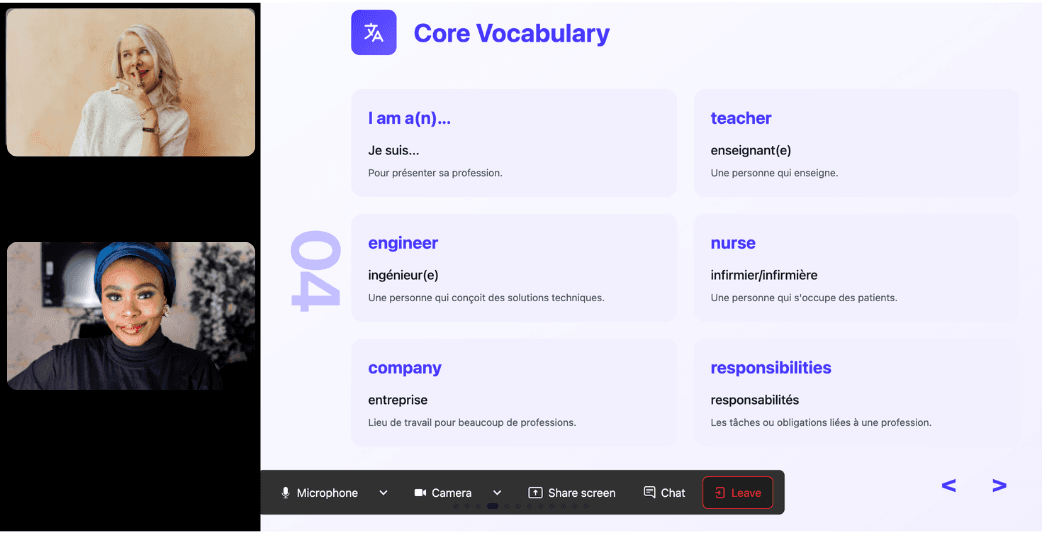
During the lesson, Kylian uses role-plays, real-life examples, and adapts to your learning style. Didn’t understand something? No problem—you can pause Kylian anytime to ask for clarification, without fear of being judged.
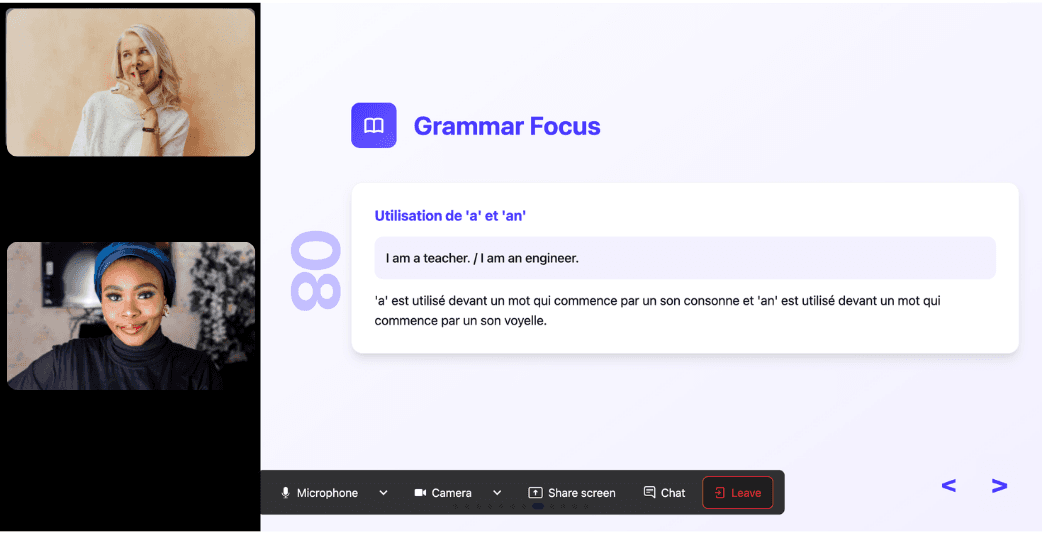
Ask all the questions you want, repeat sections if needed, and customize your learning experience in ways traditional teachers and generic apps simply can’t match.
With 24/7 access at a fraction of the cost of private lessons, Kylian removes all the barriers that have kept you from mastering the language you’ve always wanted to learn.