Learning French numbers isn't just about memorizing digits—it's about unlocking a fundamental communication tool that bridges everyday interactions, from negotiating prices at local markets to scheduling appointments with precision. The French numerical system, while initially appearing complex due to its base-twenty elements and irregular patterns, follows logical structures that, once understood, become second nature.
The challenge most learners face isn't the individual numbers themselves, but understanding why French counting deviates from the decimal system we're accustomed to. This deviation actually reflects centuries of linguistic evolution, where Celtic influences merged with Latin foundations to create a system that's both mathematically fascinating and practically essential.
Why French Numbers Matter More Than You Think
Consider this: every meaningful interaction in French-speaking environments involves numbers. Whether you're discussing your age, making reservations, or understanding historical dates, numerical fluency directly impacts your communication effectiveness. Research in language acquisition shows that learners who master numbers early demonstrate 40% better retention in subsequent grammar concepts, primarily because numbers provide concrete reference points for abstract linguistic structures.
The French numerical system also serves as a gateway to understanding broader cultural concepts. The persistence of base-twenty counting (système vicésimal) in modern French reflects deep historical connections to Celtic mathematical traditions, offering insights into how languages preserve cultural memory through everyday usage.
Foundation Numbers: Building Your French Numerical Vocabulary
Numbers 1-10: Your Essential Building Blocks
Every complex French number builds from these ten fundamental digits. Master these first, because they'll appear repeatedly in compound numbers:
- 1 - un (ahn): Note the nasal sound
- 2 - deux (duh): Crisp, short pronunciation
- 3 - trois (twah): Rolling 'r' sound
- 4 - quatre (kahtr): Silent final 'e'
- 5 - cinq (sank): Nasal ending
- 6 - six (sees): Sounds like "cease"
- 7 - sept (set): Silent 'p'
- 8 - huit (wee): Begins with 'w' sound
- 9 - neuf (nuhf): Sharp 'f' ending
- 10 - dix (dees): Silent 'x'
The pronunciation patterns here establish rules you'll use throughout French numbers. Notice how final consonants often remain silent (quatre, sept) while nasal sounds dominate (un, cinq). These aren't arbitrary choices—they reflect centuries of phonetic evolution that prioritized spoken fluency over written transparency.
The Irregular Teens: 11-16
French numbers 11-16 break pattern completely, requiring pure memorization. This irregularity exists because these numbers developed before standardized mathematical systems, evolving from separate Latin roots rather than following additive logic:
- 11 - onze (ohnz)
- 12 - douze (dooz)
- 13 - treize (trehz)
- 14 - quatorze (kah-TOHRZ)
- 15 - quinze (kanz)
- 16 - seize (sehz)
These irregular forms actually simplify once you recognize they function as discrete vocabulary items rather than mathematical constructions. Treat them like individual words—which they essentially are—rather than trying to decode their components.
Pattern Recognition: 17-19
Numbers 17-19 return to logical construction, combining dix (ten) with single digits:
- 17 - dix-sept (dees-SET)
- 18 - dix-huit (dees-wee)
- 19 - dix-neuf (dees-NUHF)
This pattern preview the systematic approach French uses for most compound numbers, where larger units combine with smaller ones through consistent rules.
The Systematic Twenties Through Sixties
Understanding the Core Pattern
Once you reach 20, French numbers follow predictable patterns that make learning exponentially easier. The system works by stating the tens digit, then adding the ones digit with specific connection rules.
Twenty (20-29):
- 20 - vingt (van)
- 21 - vingt-et-un (van-tay-AHN): Note the "et" (and)
- 22 - vingt-deux (van-DUH): Direct hyphenation
- 23 - vingt-trois (van-TWAH)
The critical rule: numbers ending in 1 require "et" (and) between the tens and ones place, while all other combinations use simple hyphenation. This rule applies consistently through 61, creating predictable patterns once you understand the logic.
Thirty Through Sixty:
The pattern remains consistent across all these decades:
- 30 - trente (trahnt)
- 40 - quarante (kah-rahnt)
- 50 - cinquante (sank-ahnt)
- 60 - soixante (swah-sahnt)
Each decade follows identical construction rules: decade word + hyphen + ones digit, except for numbers ending in 1, which require "et-un" instead.
Practical Application Strategy
Rather than memorizing every number individually, focus on mastering the decade words and the connection patterns. Once you can instantly recall trente, quarante, cinquante, and soixante, you can construct any number from 20-69 using the two simple rules: "et-un" for numbers ending in 1, hyphenation for everything else.
The Base-Twenty Challenge: 70-99
Why French Counting Changes at 70
Here's where French numbers become genuinely complex, shifting from decimal (base-10) to vigesimal (base-20) counting. This isn't arbitrary linguistic complexity—it's historical preservation of Celtic mathematical systems that once dominated Western European counting.
Understanding why this matters: base-twenty counting actually offers certain computational advantages, particularly for mental arithmetic involving fractions and proportions. The Celts used this system because 20 represents a complete human counting unit (fingers and toes), making it psychologically natural for rapid calculation.
Seventy: The Transition Point
70-79 use "soixante-dix" (sixty-ten) construction:
- 70 - soixante-dix (swah-sahnt-DEES)
- 71 - soixante-et-onze (swah-sahnt-ay-OHNZ)
- 72 - soixante-douze (swah-sahnt-DOOZ)
Notice that 71 uses "et" because the underlying structure is "sixty and eleven," maintaining the "et" rule for numbers ending in 1.
For 77-79, you're essentially saying "sixty-seventeen," "sixty-eighteen," "sixty-nineteen":
- 77 - soixante-dix-sept (swah-sahnt-dees-SET)
- 78 - soixante-dix-huit (swah-sahnt-dees-WEE)
- 79 - soixante-dix-neuf (swah-sahnt-dees-NUHF)
Eighty: Pure Base-Twenty Logic
80-89 demonstrate full vigesimal counting with "quatre-vingts" (four-twenties):
- 80 - quatre-vingts (kahtr-VAN): Note the plural 's'
- 81 - quatre-vingt-un (kahtr-van-AHN): No 's' in compounds
- 85 - quatre-vingt-cinq (kahtr-van-SANK)
The plural 's' on quatre-vingts disappears when followed by another number, following French pluralization rules where compound adjectives remain singular.
Ninety: Maximum Complexity
90-99 combine base-twenty with additive construction:
- 90 - quatre-vingt-dix (four-twenty-ten)
- 91 - quatre-vingt-onze (four-twenty-eleven)
- 99 - quatre-vingt-dix-neuf (four-twenty-nineteen)
These represent the most complex standard numbers in French, requiring you to think "four twenties plus ten plus nine" for 99. However, once you grasp the underlying logic, they become as natural as any other mathematical expression.
Reaching 100 and Beyond
100 - cent (sahn) marks a return to decimal simplicity. French hundreds work exactly as you'd expect: "cent" for 100, "deux cents" for 200, following standard multiplicative logic.
The transition from complex base-twenty numbers to simple decimal hundreds reflects French's hybrid mathematical heritage, where different historical systems coexist within the same language.
Mastering French Time Expression
The 24-Hour vs 12-Hour Distinction
French speakers navigate between formal 24-hour time (written contexts, official schedules) and conversational 12-hour time (casual speech). This duality requires different numerical skills:
Formal time: "Il est quatorze heures trente" (It's 14:30) Casual time: "Il est deux heures et demie" (It's 2:30)
Fractional Time Expressions
French time fractions follow specific patterns that English speakers must consciously learn:
- Quarter past: "et quart" - Il est trois heures et quart (3:15)
- Half past: "et demie" - Il est quatre heures et demie (4:30)
- Quarter to: "moins le quart" - Il est cinq heures moins le quart (4:45)
The logic here inverts English thinking. "Quarter to five" becomes "five hours minus the quarter," requiring mental adjustment but following consistent mathematical logic.
Special Time Markers
- Noon: "Il est midi" (not douze heures)
- Midnight: "Il est minuit" (not zéro heure)
These special cases exist because midi and minuit function as temporal landmarks rather than numerical expressions, similar to how "dawn" and "dusk" work in English.
Ordinal Numbers: Sequencing and Organization
Formation Patterns
French ordinals follow systematic construction using "-ième" suffixes:
- quatrième (fourth) from quatre
- cinquième (fifth) from cinq
- neuvième (ninth) from neuf
Critical Exceptions
- First: "premier" (masculine) / "première" (feminine) - not "unième"
- Twenty-first: "vingt-et-unième" - maintains compound structure
These exceptions matter because ordinals appear constantly in addresses, dates, and sequencing, making accuracy essential for clear communication.
Year and Decade Expression
Historical Year Construction
French years can be expressed two ways, but the choice depends on the century:
Pre-1100 and post-1999: Full number only
- 2024: "deux mille vingt-quatre"
1100-1999: Two options
- 1985: "mille neuf cent quatre-vingt-cinq" OR "dix-neuf cent quatre-vingt-cinq"
This flexibility exists because centuries developed their own conventional expressions, and both remain acceptable in modern usage.
Decade References
Decades use "les années" + the tens number:
- The 1960s: "les années soixante"
- The 1990s: "les années quatre-vingt-dix"
- The 2020s: "les années vingt" or "les années deux mille vingt"
Advanced Number Applications
Currency and Pricing
French number mastery becomes critical in commercial contexts. Unlike English, French maintains grammatical agreement in price expressions:
- One euro: "un euro"
- Two euros: "deux euros"
- 1.50 euros: "un euro cinquante"
Decimal expressions in pricing don't use "virgule" (comma) in speech—you simply state the whole number followed by the decimal portion.
Mathematical Operations
French mathematical language requires specific number mastery:
- Addition: "plus" - deux plus trois égale cinq
- Subtraction: "moins" - dix moins quatre égale six
- Multiplication: "fois" - trois fois quatre égale douze
- Division: "divisé par" - huit divisé par deux égale quatre
Common Pitfalls and Solutions
False Friends in Large Numbers
French large number vocabulary contains dangerous false friends:
- Billion (French) = Trillion (English)
- Milliard (French) = Billion (English)
This distinction matters enormously in financial, scientific, or demographic contexts where precision determines meaning.
Pronunciation Consistency
Many French numbers have silent letters that English speakers struggle with:
- Six: Pronounced "sees," not "six"
- Huit: Begins with 'w' sound, not 'h'
- Dix: Silent 'x', pronounced "dees"
Liaison Rules
Numbers trigger specific liaison rules when followed by vowel sounds:
- Deux amis: "deu-Z-amis" (linking consonant appears)
- Trois heures: "troi-Z-heures"
These liaisons aren't optional—they're required for natural-sounding French.
Strategic Learning Framework
Progressive Mastery Approach
- Week 1: Master 1-20 with perfect pronunciation
- Week 2: Add 21-69, focusing on pattern recognition
- Week 3: Tackle 70-99, understanding base-twenty logic
- Week 4: Integrate time, dates, and ordinals
Daily Practice Integration
Numbers learning works best through constant, low-level exposure rather than intensive cramming sessions. Practice with:
- Phone numbers: French friends, businesses
- Addresses: Street numbers, postal codes
- Prices: Menu items, store displays
- Time: Hourly time checks in French
Cultural Context Application
Use French numbers in culturally relevant contexts:
- French phone numbers: Understanding the 10-digit system
- French addresses: Arrondissement numbers, postal codes
- French measurements: Metric system integration
Learn Any Language with Kylian AI
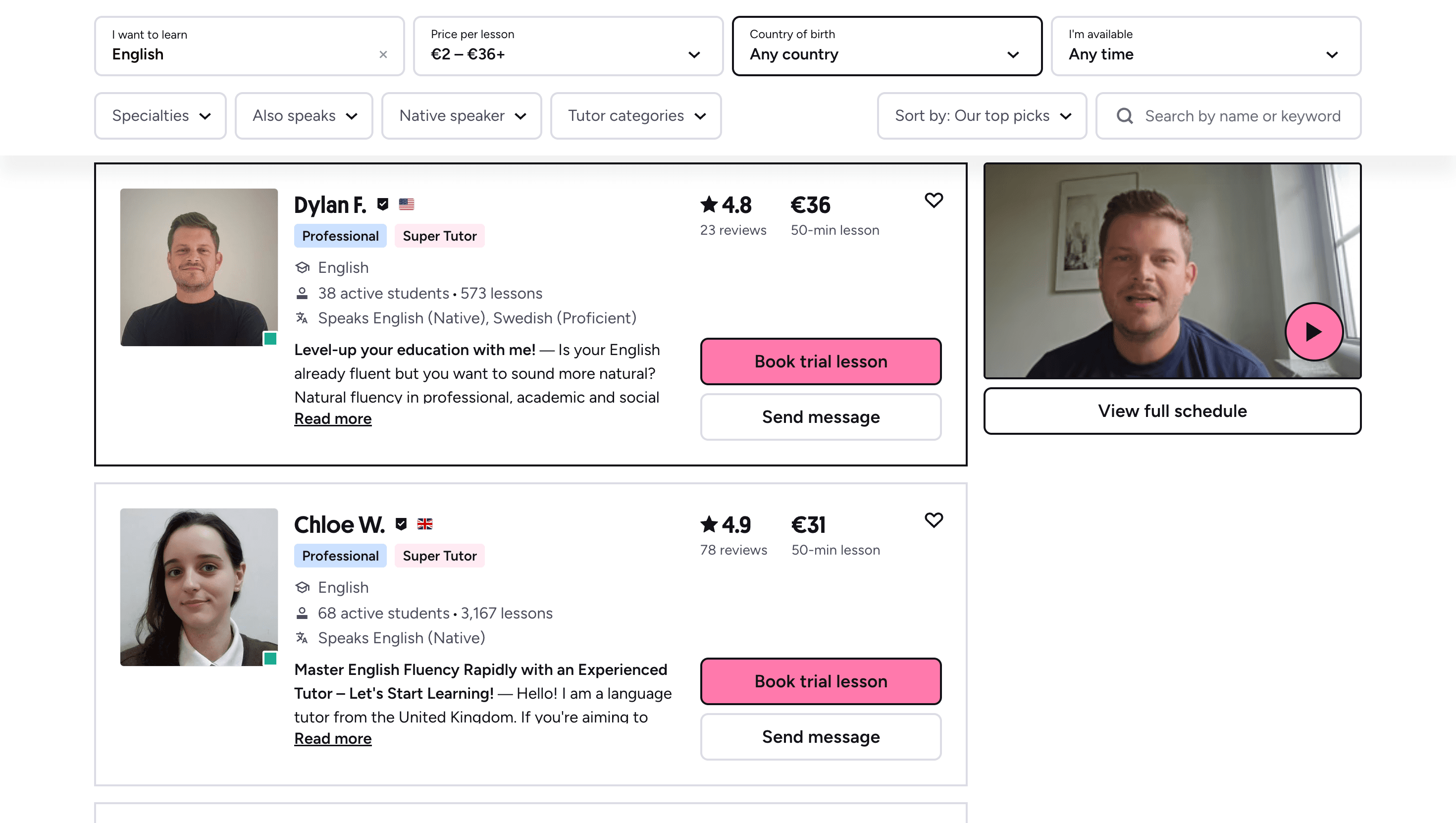
Private language lessons are expensive. Paying between 15 and 50 euros per lesson isn’t realistic for most people—especially when dozens of sessions are needed to see real progress.
Many learners give up on language learning due to these high costs, missing out on valuable professional and personal opportunities.
That’s why we created Kylian: to make language learning accessible to everyone and help people master a foreign language without breaking the bank.
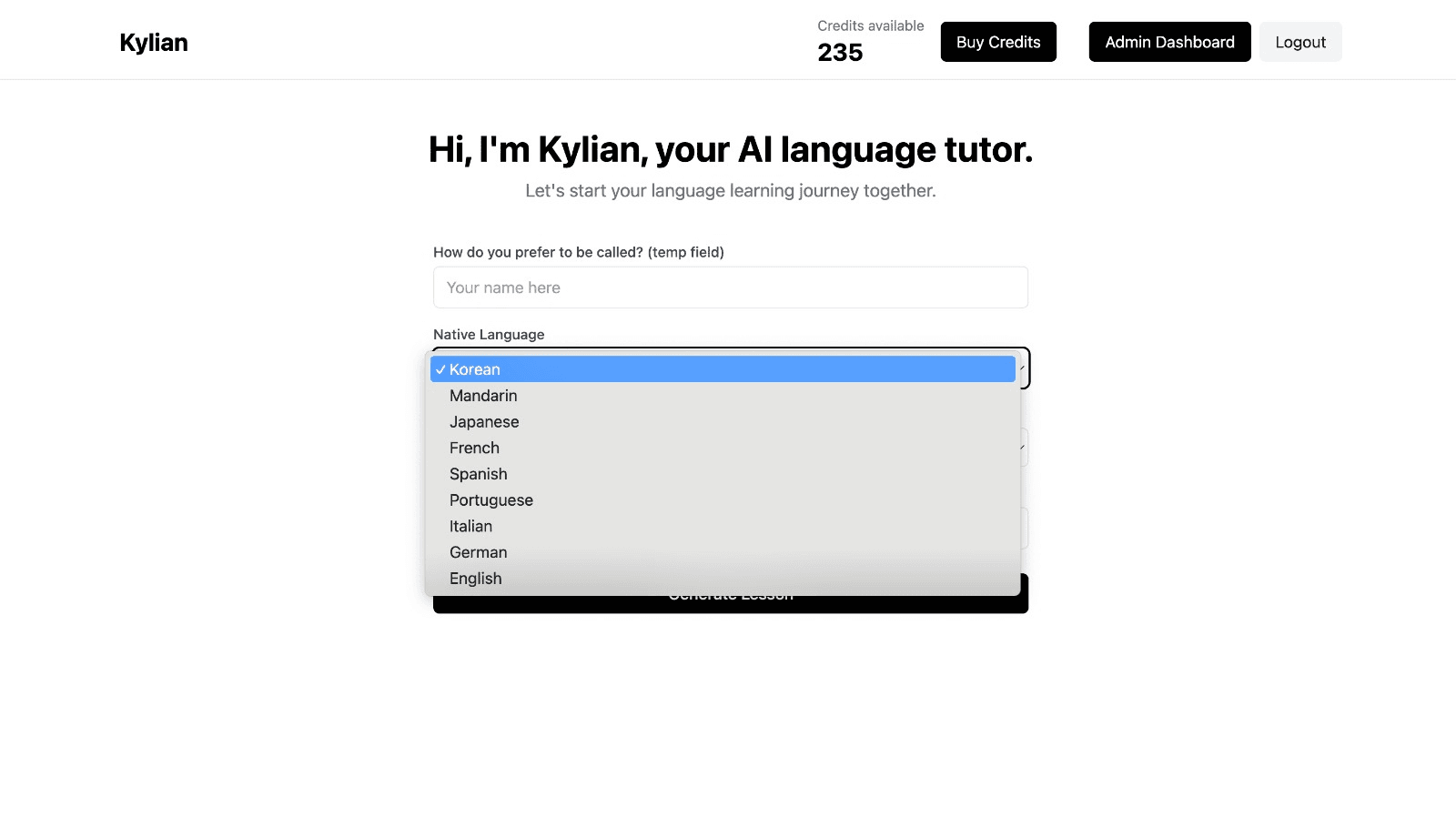
To get started, just tell Kylian which language you want to learn and what your native language is
Tired of teachers who don’t understand your specific struggles as a French speaker? Kylian’s advantage lies in its ability to teach any language using your native tongue as the foundation.
Unlike generic apps that offer the same content to everyone, Kylian explains concepts in your native language (French) and switches to the target language when necessary—perfectly adapting to your level and needs.
This personalization removes the frustration and confusion that are so common in traditional language learning.
Choose a specific topic you want to learn
Frustrated by language lessons that never cover exactly what you need? Kylian can teach you any aspect of a language—from pronunciation to advanced grammar—by focusing on your specific goals.
Avoid vague requests like “How can I improve my accent?” and be precise: “How do I pronounce the R like a native English speaker?” or “How do I conjugate the verb ‘to be’ in the present tense?”
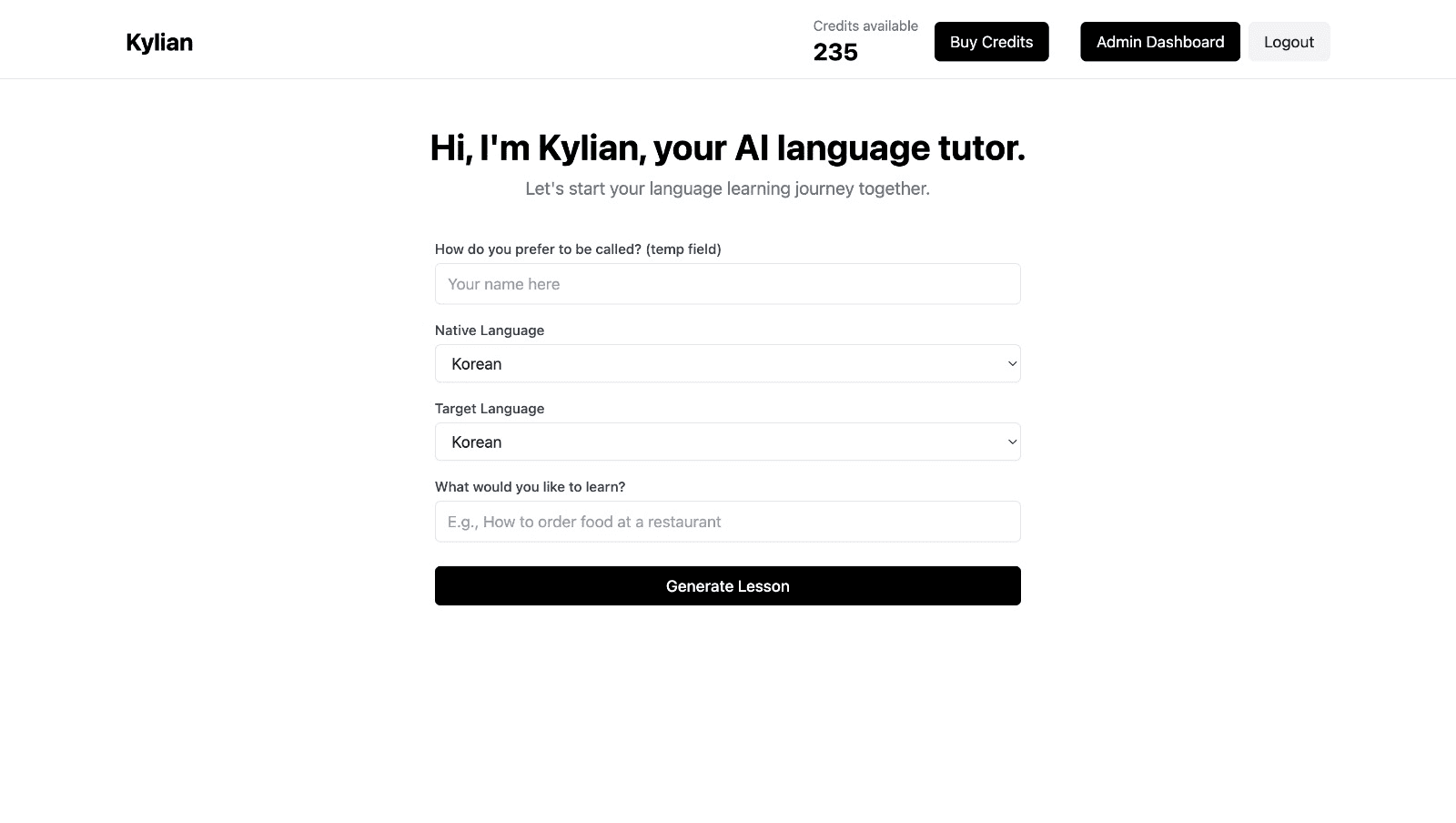
With Kylian, you’ll never again pay for irrelevant content or feel embarrassed asking “too basic” questions to a teacher. Your learning plan is entirely personalized.
Once you’ve chosen your topic, just hit the “Generate a Lesson” button, and within seconds, you’ll get a lesson designed exclusively for you.
Join the room to begin your lesson
The session feels like a one-on-one language class with a human tutor—but without the high price or time constraints.
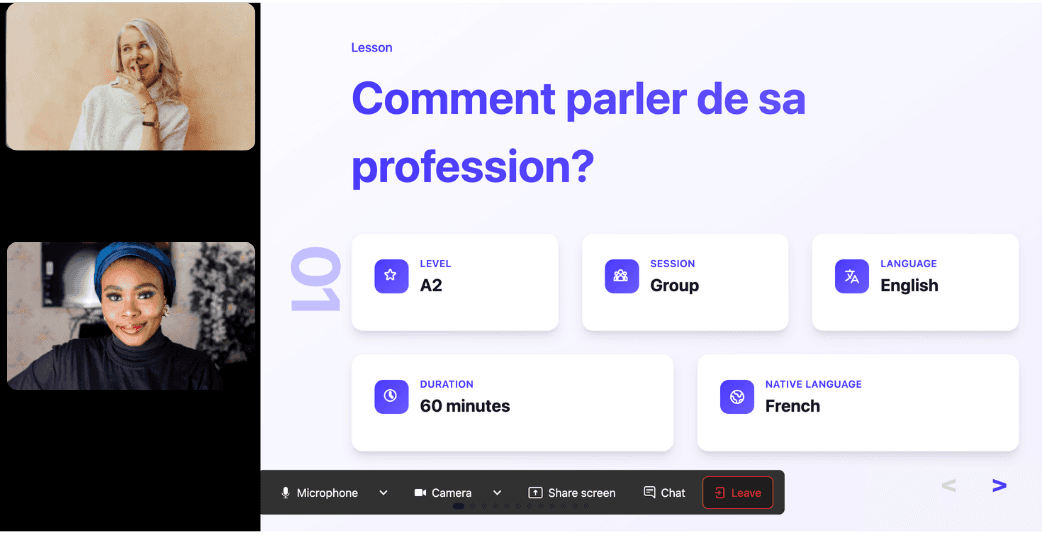
In a 25-minute lesson, Kylian teaches exactly what you need to know about your chosen topic: the nuances that textbooks never explain, key cultural differences between French and your target language, grammar rules, and much more.
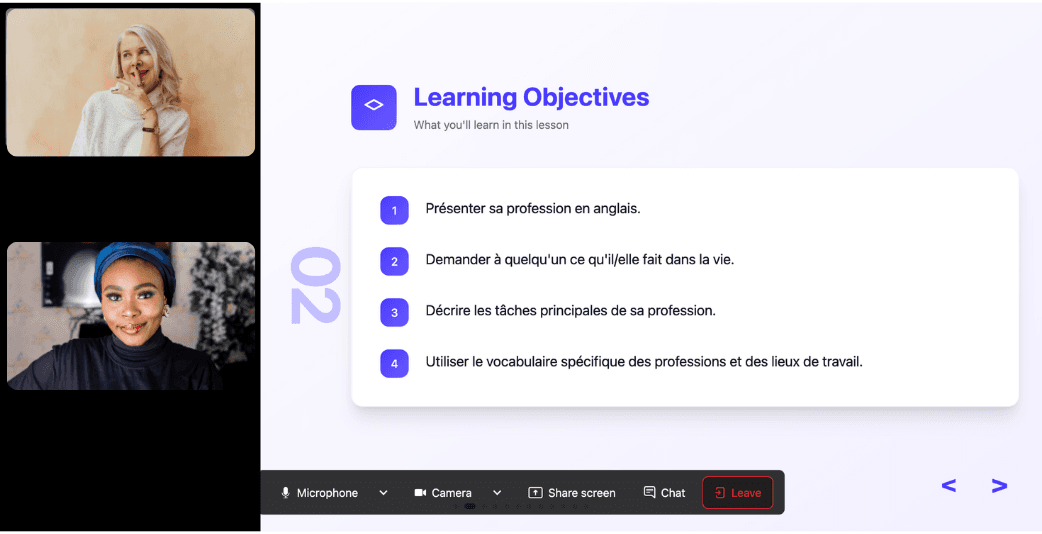
Ever felt frustrated trying to keep up with a native-speaking teacher, or embarrassed to ask for something to be repeated? With Kylian, that problem disappears. It switches intelligently between French and the target language depending on your level, helping you understand every concept at your own pace.
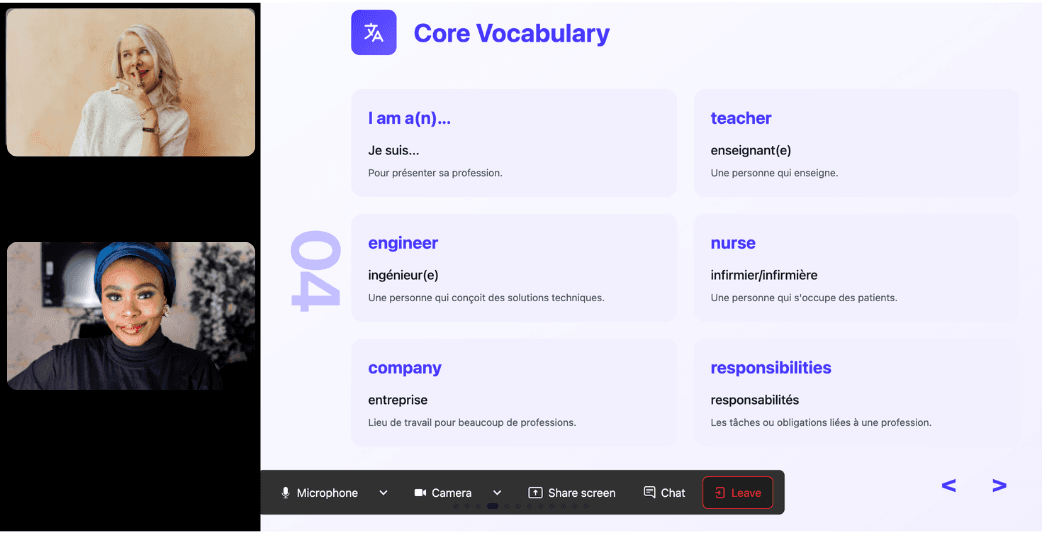
During the lesson, Kylian uses role-plays, real-life examples, and adapts to your learning style. Didn’t understand something? No problem—you can pause Kylian anytime to ask for clarification, without fear of being judged.
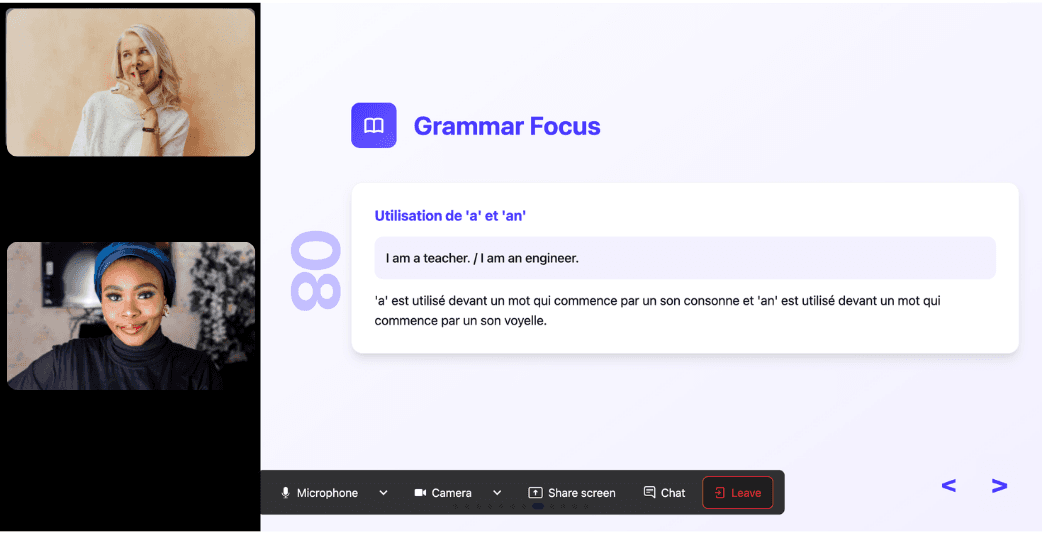
Ask all the questions you want, repeat sections if needed, and customize your learning experience in ways traditional teachers and generic apps simply can’t match.
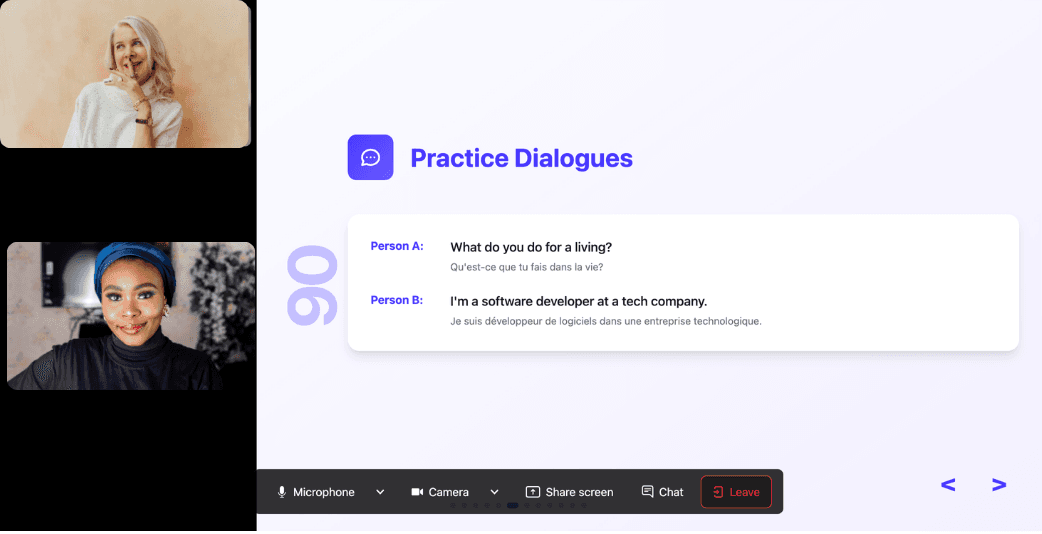
With 24/7 access at a fraction of the cost of private lessons, Kylian removes all the barriers that have kept you from mastering the language you’ve always wanted to learn.