

The distinction between "lightbulb" and "light bulb" represents more than orthographic preference—it reflects evolving linguistic conventions that impact professional communication, technical documentation, and formal writing standards. While both terms reference the same illumination device, their usage patterns reveal underlying principles about compound word formation, industry standards, and contextual appropriateness that warrant systematic examination.
In English, "lightbulb" functions as a single compound noun, typically employed in informal contexts and contemporary usage. Conversely, "light bulb" operates as a two-word noun phrase, predominantly found in technical specifications, formal documentation, and traditional publishing. Understanding when each form serves optimal communicative function requires analyzing their grammatical behavior, semantic implications, and contextual constraints.
What's the main difference between lightbulb and light bulb?
The fundamental distinction lies in their morphological structure and resulting semantic emphasis. "Lightbulb" represents complete lexical integration—a unified concept where the constituent elements have merged into a single semantic unit. This compound form emphasizes the object's functional identity rather than its component characteristics. The integration signals that users conceptualize the device as a distinct category rather than merely light contained within a bulb.
"Light bulb" maintains compositional transparency, preserving the relationship between modifier and head noun. This structure emphasizes the bulb's primary function (containing light) while maintaining analytical clarity about the object's construction. The two-word form allows for easier grammatical manipulation and technical precision, particularly when discussing specifications, variations, or comparative analyses.
Consider patent documentation: "The light bulb assembly includes a tungsten filament enclosed within a glass envelope" versus consumer marketing: "Replace your old lightbulbs with energy-efficient LED options." The former requires technical precision and component distinction, while the latter benefits from streamlined reference to a familiar household item.
This morphological difference extends beyond mere spelling convention. Compound words typically undergo semantic narrowing, where the combined meaning becomes more specific than the sum of parts. "Lightbulb" has achieved this narrowing, exclusively referencing the electrical illumination device, while "light bulb" retains broader applicability to any bulb-shaped object that produces or contains light.
How and when to use lightbulb and light bulb with examples?
Strategic deployment of each form depends on register, audience expectations, and communicative objectives. "Lightbulb" functions optimally in informal communication, creative writing, and contexts emphasizing accessibility over technical precision. Its compact form suits rapid communication and casual reference, particularly in digital environments where conciseness carries premium value.
Use "lightbulb" when addressing general audiences through blogs, social media, or consumer-facing materials: "Smart lightbulbs can reduce your electricity bill by 30%." The compound form aligns with conversational tone and contemporary usage patterns, facilitating reader engagement through familiar linguistic choices.
"Light bulb" serves formal communication, technical documentation, and professional contexts requiring precision. Its analytical structure supports detailed specification and technical accuracy: "The LED light bulb operates at 2700K color temperature with 800-lumen output." This form accommodates grammatical modification more readily, enabling precise technical communication.
Academic and scientific contexts typically favor "light bulb" for its compositional clarity and established convention in scholarly discourse. Research papers, technical manuals, and industry specifications consistently employ the two-word form: "Incandescent light bulb efficiency ratings demonstrate significant variation across manufacturing standards."
The choice also reflects publication style guides and institutional preferences. Many formal style guides, including those governing technical documentation and academic publishing, specify "light bulb" as the preferred form for consistency with compound noun treatment principles.
Real-life scenarios where lightbulb and light bulb can be used
Scenario 1: Home improvement retail communication When crafting product descriptions for consumer audiences, "lightbulb" enhances accessibility and purchase decision speed. "Browse our selection of smart lightbulbs compatible with Alexa and Google Home systems." This usage acknowledges consumer search patterns and linguistic preferences while maintaining product category clarity.
Scenario 2: Corporate procurement specifications Business contexts demanding precision and accountability require "light bulb" for unambiguous specification: "Facilities management shall procure LED light bulbs meeting Energy Star certification standards, with minimum 25,000-hour rated lifespan and 5-year manufacturer warranty." The formal structure supports contractual clarity and technical compliance verification.
Scenario 3: Patent filing and intellectual property documentation Legal contexts necessitate "light bulb" for definitional precision and prior art clarity: "The invention comprises a light bulb housing incorporating novel heat dissipation fins arranged in helical configuration around the base assembly." Patent language requires compositional transparency for legal interpretation and claim differentiation.
Scenario 4: Consumer electronics user manual Technical documentation balances accessibility with precision through "light bulb" usage: "Replace the projector's light bulb by accessing the rear panel compartment and following the illustrated removal procedure." This maintains technical authority while remaining comprehensible to non-specialist users.
Common mistakes to avoid when using lightbulb and light bulb
Inconsistency within formal documents represents the most frequent error pattern. Writers often alternate between forms without strategic justification, undermining document coherence and professional credibility. Establish form selection criteria based on document type, audience requirements, and institutional style guidelines, then maintain consistency throughout the text.
Inappropriate register matching occurs when writers select forms inconsistent with communication context. Using "lightbulb" in technical specifications diminishes precision expectations, while "light bulb" in casual social media posts appears unnecessarily formal. Assess audience expectations and communicative objectives before form selection.
Grammatical modification errors emerge more frequently with compound forms. Writers attempting to modify "lightbulb" often create awkward constructions: "the room's lightbulbs brightness" instead of "the light bulbs' brightness in the room." Compound words resist certain grammatical manipulations that two-word forms accommodate naturally.
Style guide violations constitute another common pitfall, particularly in professional environments with established documentation standards. Many organizations specify preferred forms for consistency across communications. Ignoring these specifications creates document inconsistency and may signal disregard for institutional standards.
4 other words you can use instead of lightbulb and light bulb
Instead of lightbulb in casual contexts:
"Bulb" serves as the most direct alternative, eliminating the light component while retaining clear reference: "The kitchen bulb burned out again." This abbreviated form suits informal communication and contexts where the lighting function is implicit.
"LED" or "CFL" function as category-specific alternatives when referring to particular bulb types: "Install energy-efficient LEDs throughout the house." These terms provide technical specificity while maintaining conversational accessibility.
Instead of light bulb in formal contexts:
"Illumination device" offers formal precision for technical documentation requiring generic reference: "Each illumination device shall undergo quality testing before installation." This phrase accommodates various lighting technologies while maintaining professional register.
"Lamp" provides industry-standard terminology, particularly in electrical and architectural specifications: "The fixture accommodates standard A19 lamps with medium screw bases." Professional lighting contexts often prefer "lamp" for technical accuracy and industry convention alignment.
Historical evolution and linguistic significance
The progression from "light bulb" to "lightbulb" reflects broader patterns in English compound word formation. Initially, most compound concepts begin as separate words, gradually evolve through hyphenated forms, and eventually merge into single words as usage frequency increases and semantic integration deepens.
Edison's original patents consistently used "light bulb," establishing the two-word form as the technical standard. However, as electric lighting became ubiquitous in household contexts, popular usage began favoring the more streamlined compound form. This evolution mirrors similar patterns in technology terminology, where technical precision gradually yields to popular accessibility.
Contemporary usage data suggests increasing preference for "lightbulb" in digital contexts, driven by character limits, search optimization, and mobile communication patterns. However, formal publications and technical documentation maintain strong preference for "light bulb," creating a bifurcated usage pattern based on communication context.
Industry standards and professional practice
Manufacturing specifications, building codes, and electrical standards universally employ "light bulb" for regulatory clarity and international standardization. The International Electrotechnical Commission (IEC) and American National Standards Institute (ANSI) specifications consistently use the two-word form, establishing it as the authoritative reference for professional practice.
Energy efficiency ratings, safety certifications, and performance specifications require precise terminology for regulatory compliance and consumer protection. "Light bulb" facilitates these requirements through compositional clarity and established convention, while "lightbulb" might introduce ambiguity in regulatory interpretation.
Professional lighting designers, electrical engineers, and facilities managers typically employ "light bulb" in specifications, proposals, and technical communications. This usage aligns with industry standards and facilitates clear communication with suppliers, contractors, and regulatory bodies.
Learn Any Language with Kylian AI
Private language lessons are expensive. Paying between 15 and 50 euros per lesson isn’t realistic for most people—especially when dozens of sessions are needed to see real progress.
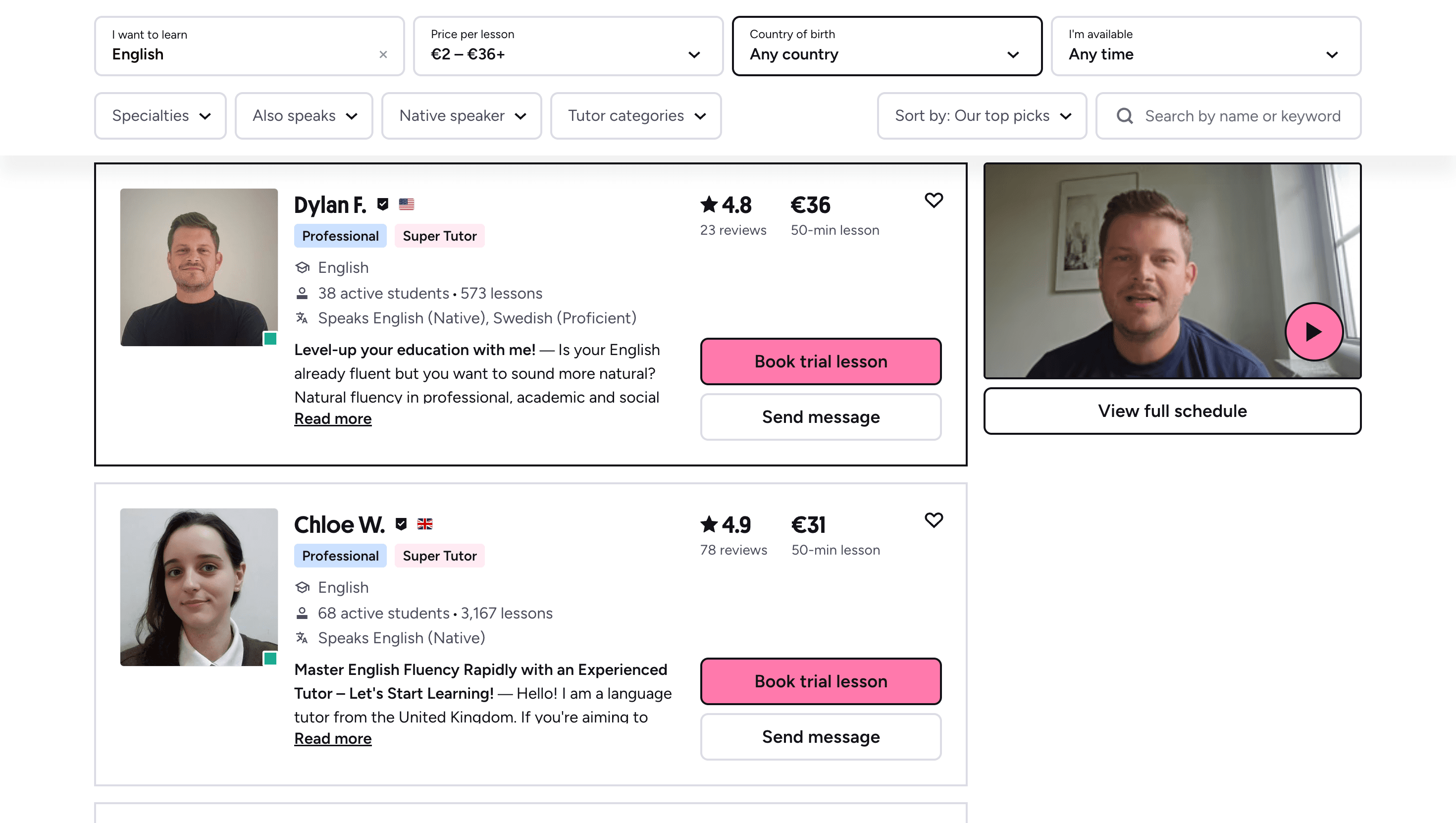
Many learners give up on language learning due to these high costs, missing out on valuable professional and personal opportunities.
That’s why we created Kylian: to make language learning accessible to everyone and help people master a foreign language without breaking the bank.
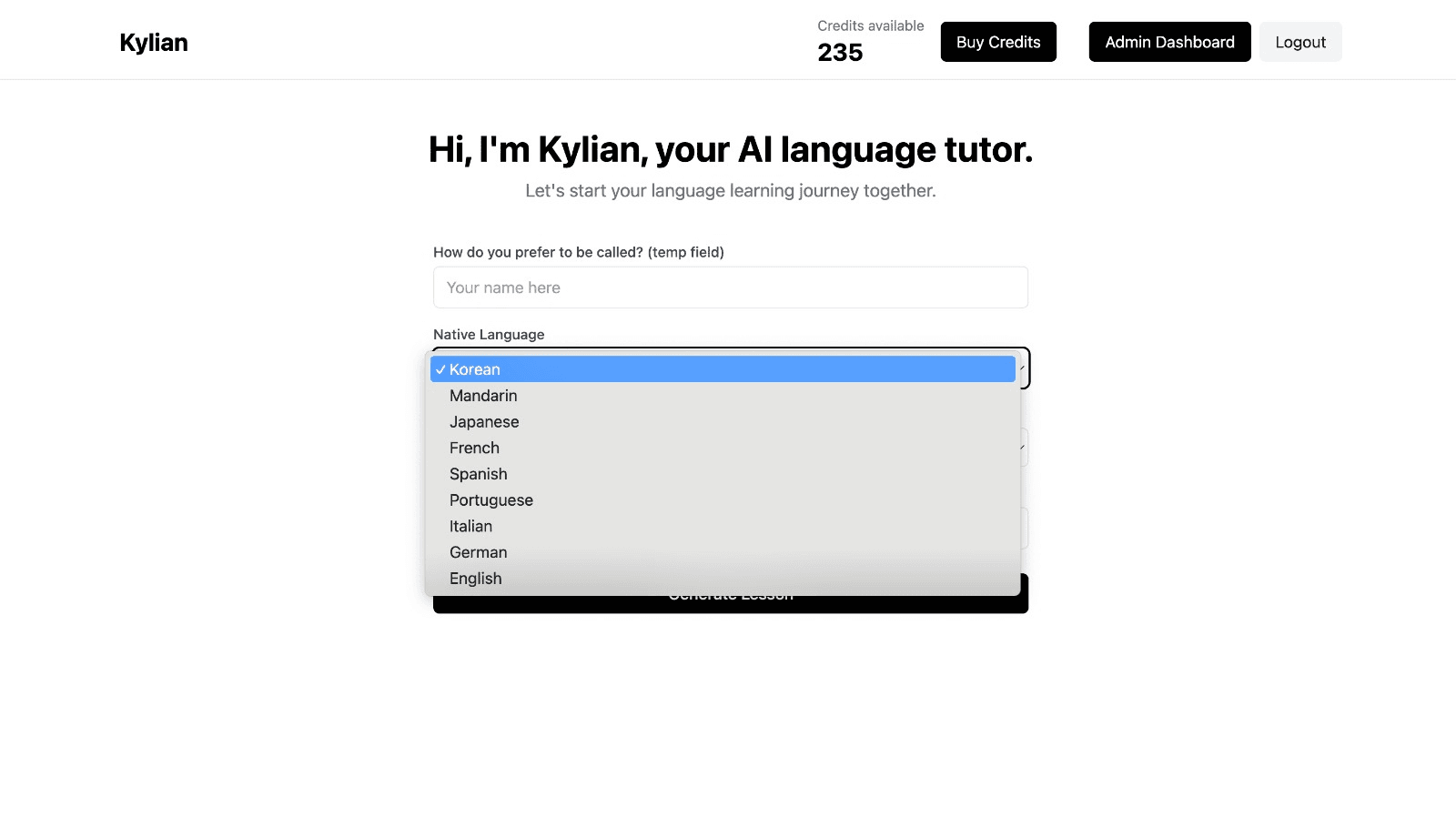
To get started, just tell Kylian which language you want to learn and what your native language is
Tired of teachers who don’t understand your specific struggles as a French speaker? Kylian’s advantage lies in its ability to teach any language using your native tongue as the foundation.
Unlike generic apps that offer the same content to everyone, Kylian explains concepts in your native language (French) and switches to the target language when necessary—perfectly adapting to your level and needs.
This personalization removes the frustration and confusion that are so common in traditional language learning.
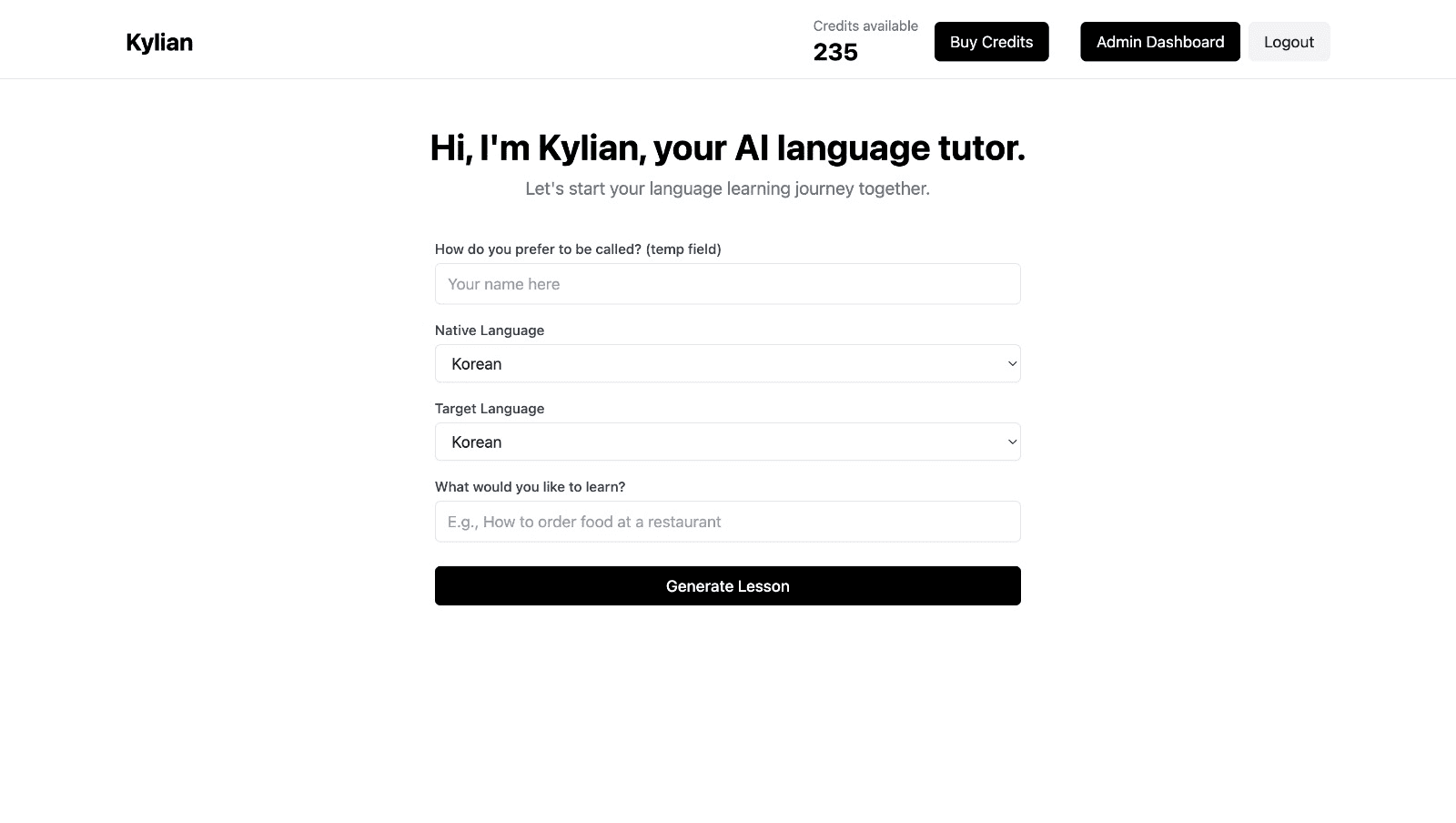
Choose a specific topic you want to learn
Frustrated by language lessons that never cover exactly what you need? Kylian can teach you any aspect of a language—from pronunciation to advanced grammar—by focusing on your specific goals.
Avoid vague requests like “How can I improve my accent?” and be precise: “How do I pronounce the R like a native English speaker?” or “How do I conjugate the verb ‘to be’ in the present tense?”
With Kylian, you’ll never again pay for irrelevant content or feel embarrassed asking “too basic” questions to a teacher. Your learning plan is entirely personalized.
Once you’ve chosen your topic, just hit the “Generate a Lesson” button, and within seconds, you’ll get a lesson designed exclusively for you.
Join the room to begin your lesson
The session feels like a one-on-one language class with a human tutor—but without the high price or time constraints.
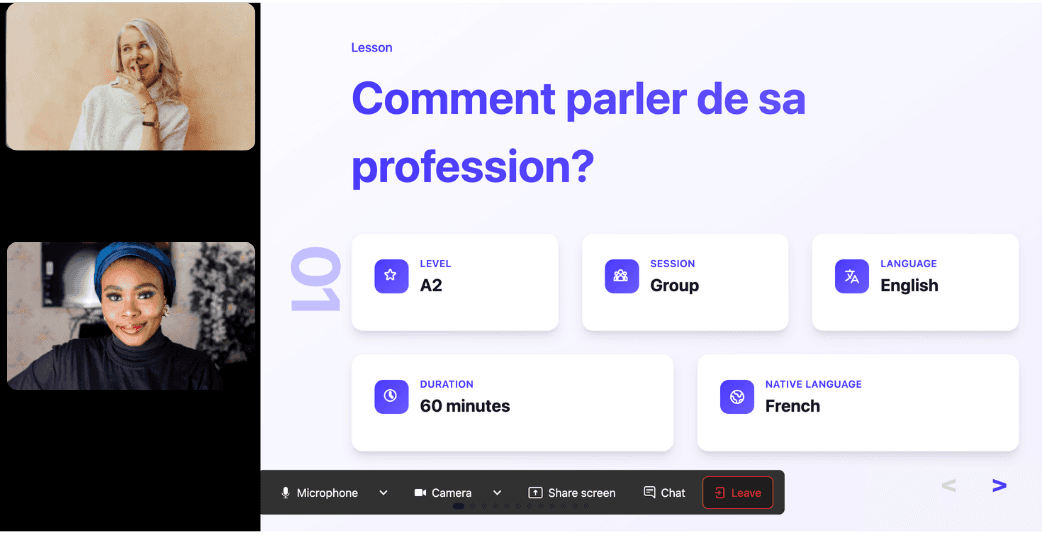
In a 25-minute lesson, Kylian teaches exactly what you need to know about your chosen topic: the nuances that textbooks never explain, key cultural differences between French and your target language, grammar rules, and much more.

Ever felt frustrated trying to keep up with a native-speaking teacher, or embarrassed to ask for something to be repeated? With Kylian, that problem disappears. It switches intelligently between French and the target language depending on your level, helping you understand every concept at your own pace.
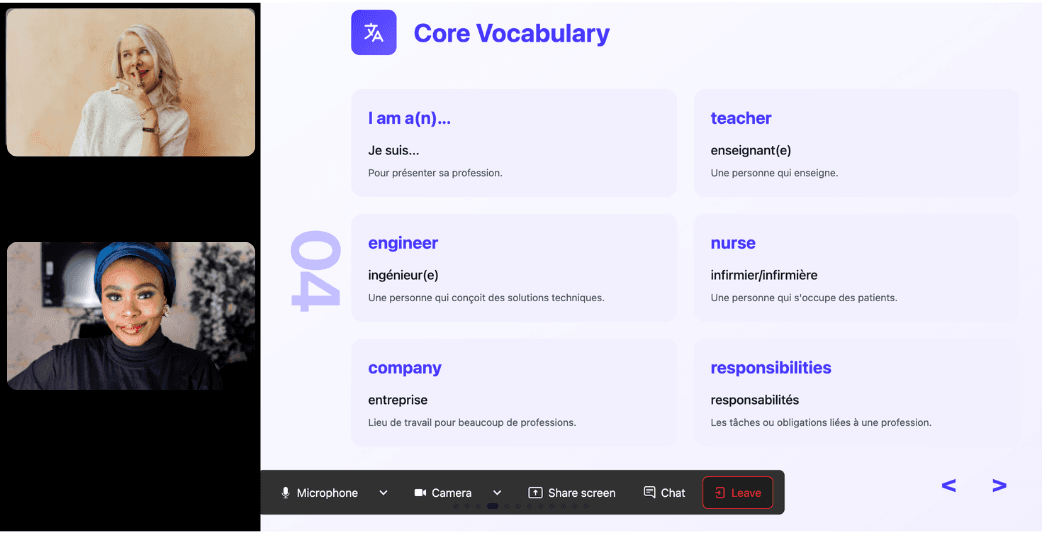
During the lesson, Kylian uses role-plays, real-life examples, and adapts to your learning style. Didn’t understand something? No problem—you can pause Kylian anytime to ask for clarification, without fear of being judged.
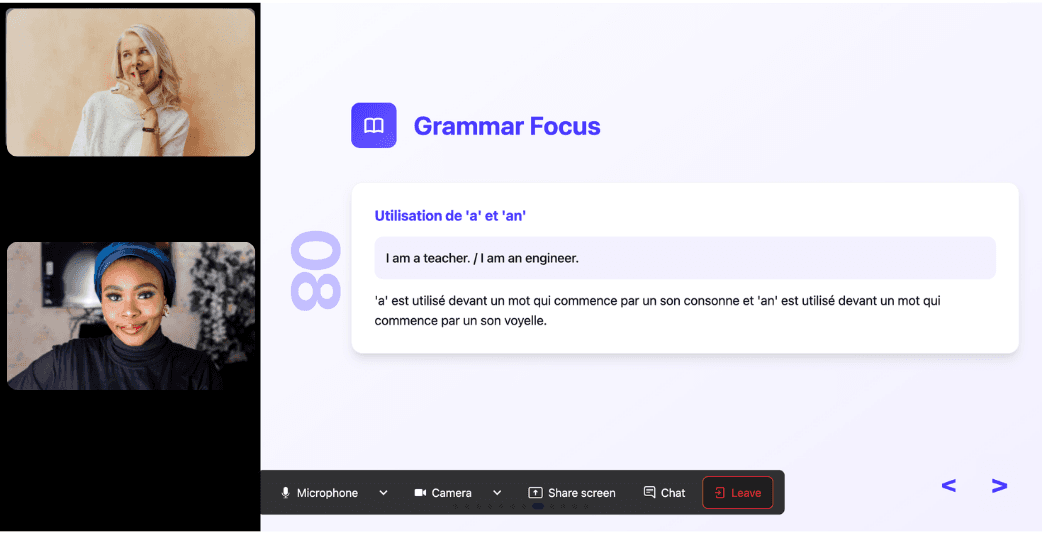
Ask all the questions you want, repeat sections if needed, and customize your learning experience in ways traditional teachers and generic apps simply can’t match.

With 24/7 access at a fraction of the cost of private lessons, Kylian removes all the barriers that have kept you from mastering the language you’ve always wanted to learn.
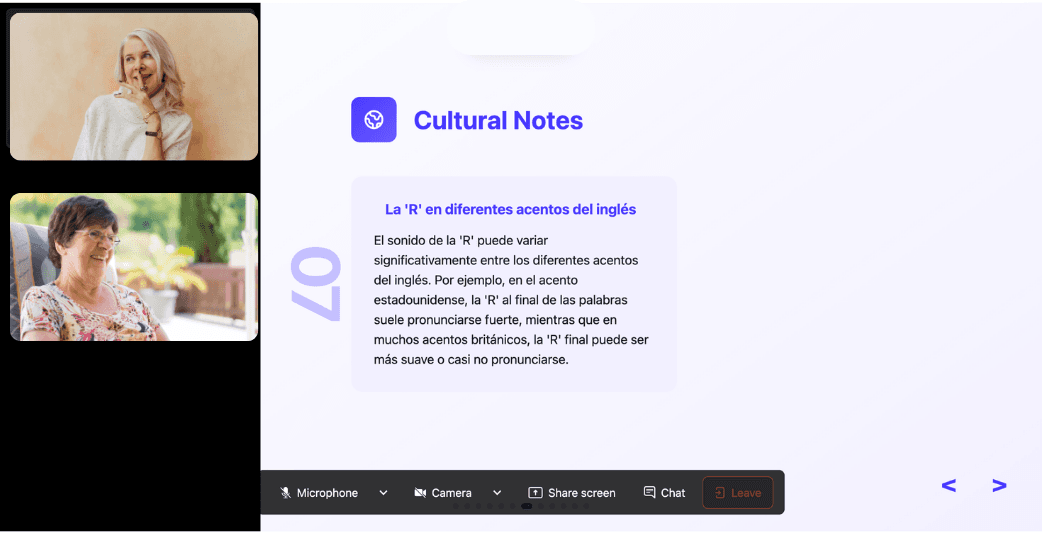


![50 Essential Spanish Words for Beginners [+ Translation]](/_next/image?url=https%3A%2F%2Fcdn.sanity.io%2Fimages%2F147z5m2d%2Fproduction%2F4f4eb1df25a5c2b15e1dcfed1009d2edb7db9a64-2240x1260.png%3Frect%3D175%2C0%2C1890%2C1260%26w%3D600%26h%3D400&w=3840&q=75)


