

Learning the days of the week is one of the first steps in mastering any language. In Portuguese, however, this seemingly simple concept carries unique linguistic and cultural elements that distinguish it from other Romance languages. Understanding these nuances not only enhances your vocabulary but provides insight into Portuguese history and culture.
1. The Religious Origins Behind Portuguese Weekday Names
Most Western languages derive their weekday names from Norse or Roman gods—Thursday comes from "Thor's day," for instance. Portuguese takes a dramatically different approach. The weekday naming system in Portuguese originates from the 7th century when a religious reform sought to eliminate pagan references from the calendar.
The Portuguese weekday naming convention uses ordinal numbers combined with "feira" (meaning "fair" or "market"):
- Segunda-feira (Monday): "Second fair"
- Terça-feira (Tuesday): "Third fair"
- Quarta-feira (Wednesday): "Fourth fair"
- Quinta-feira (Thursday): "Fifth fair"
- Sexta-feira (Friday): "Sixth fair"
This system treats Sunday as the first day of the week, though it doesn't follow the ordinal pattern. The term "feira" references the traditional market days that were once scheduled throughout the week, providing a practical calendar for everyday life.
This ecclesiastical influence on language represents a fascinating historical intersection between commerce, religion, and daily life that persists in modern Portuguese.
2. Exception to the Rule: Weekend Names Break the Pattern
While weekdays follow the ordinal number + feira pattern, the weekend breaks this system entirely:
- Sábado (Saturday): Derived from the Hebrew "Shabbat," reflecting the Jewish Sabbath
- Domingo (Sunday): From Latin "Dominicus," meaning "of the Lord" or "the Lord's Day"
This linguistic shift emphasizes the cultural and religious significance of these days. The break in pattern serves as a marker between working days and rest days, creating a clear linguistic boundary that mirrors the functional division of the week.
For Portuguese language learners, this inconsistency requires memorization, but it also offers a window into how religious traditions have shaped Portuguese linguistic development over centuries.
3. No Capitalization Required for Weekdays
Unlike English, Portuguese does not capitalize the days of the week. This grammatical rule extends to months as well:
- segunda-feira (not Segunda-feira)
- terça-feira (not Terça-feira)
- janeiro (January), fevereiro (February), etc.
This convention reflects broader Portuguese grammatical rules where capitalization is more limited than in English. For learners coming from languages that capitalize calendar terms, this requires a minor but important adjustment in writing habits.
The lack of capitalization doesn't diminish the importance of these time markers; rather, it integrates them more seamlessly into the flow of written Portuguese, treating them as common nouns rather than proper names.
4. Abbreviated Forms for Everyday Conversation
In casual conversation, Portuguese speakers frequently abbreviate weekday names by dropping the "feira" portion:
- Segunda (Monday)
- Terça (Tuesday)
- Quarta (Wednesday)
- Quinta (Thursday)
- Sexta (Friday)
This shorthand appears in both spoken and written contexts, particularly in informal situations like text messages, social media, or casual conversation. You might hear phrases like:
- "Vamos nos encontrar na quinta?" (Shall we meet on Thursday?)
- "A reunião é na segunda." (The meeting is on Monday.)
These abbreviated forms represent the natural linguistic evolution toward efficiency. Recognizing and using these shortened versions will make your Portuguese sound more natural and less textbook-rigid.
5. Preposition Usage with Days of the Week
Using the correct preposition with days of the week is crucial for temporal expressions in Portuguese. The most common prepositions used with weekdays are:
- Em + day: Indicates recurring actions
- "Em segunda-feira, eu sempre vou à academia." (On Mondays, I always go to the gym.)
- Na (em + a) + day: Refers to a specific day
- "Na segunda-feira, vou ao médico." (On Monday, I'm going to the doctor.)
- De + day: Used for specific times or periods within a day
- "De domingo à noite, gosto de relaxar." (On Sunday night, I like to relax.)
The distinction between habitual actions (em) and specific occurrences (na) is subtle but important for precise communication. Mastering these prepositions will significantly enhance your ability to discuss schedules and make plans in Portuguese.
6. Time-Related Vocabulary Essential for Planning
Beyond the days themselves, Portuguese offers rich vocabulary for discussing time in relation to the week:
Relative Days:
- Hoje (Today) - "Hoje é segunda-feira." (Today is Monday.)
- Ontem (Yesterday) - "Ontem foi domingo." (Yesterday was Sunday.)
- Anteontem (The day before yesterday)
- Amanhã (Tomorrow) - "Amanhã é terça-feira." (Tomorrow is Tuesday.)
- Depois de amanhã (The day after tomorrow)
Week References:
- Esta semana (This week)
- Semana passada (Last week)
- Semana que vem/próxima semana (Next week)
- Fim de semana (Weekend)
Time of Day:
- De manhã (In the morning)
- À tarde (In the afternoon)
- À noite (At night/In the evening)
Planning Phrases:
- "Está disponível na quarta-feira?" (Are you available on Wednesday?)
- "Vamos marcar para sexta à tarde?" (Shall we schedule it for Friday afternoon?)
- "Não posso no domingo, que tal na segunda?" (I can't on Sunday, how about Monday?)
This vocabulary forms the backbone of temporal reference in Portuguese, allowing for precise communication about scheduling, availability, and planning.
7. Regional Variations Between European and Brazilian Portuguese
While the days of the week are essentially the same in European and Brazilian Portuguese, there are subtle differences in usage and pronunciation:
European Portuguese (EP):
- Tends to retain the "feira" part more consistently in formal contexts
- Pronunciation: The "ei" in "feira" sounds closer to "ay" as in "hay"
- Example: "Sexta-feira" pronounced roughly as "SEHSH-tuh-FAY-ruh"
Brazilian Portuguese (BP):
- More frequently uses the abbreviated forms without "feira"
- Pronunciation: The "ei" in "feira" sounds closer to "ey" as in "they"
- Example: "Sexta-feira" pronounced roughly as "SEHS-tah-FEY-rah"
These regional distinctions extend to time-related phrases as well. In Brazil, you might hear "no final de semana" for "on the weekend," while in Portugal, "no fim de semana" is more common.
Understanding these differences is particularly important if you plan to interact with Portuguese speakers from different regions or if you're focusing on a specific variant of the language.
8. Practical Applications in Daily Conversation
Knowing the days of the week is essential for navigating daily conversations and planning. Here's a practical dialogue demonstrating how this vocabulary functions in real-world settings:
Dialogue: Making Plans
Ana: Olá, Carlos! Tudo bem? Quer ir ao cinema comigo? (Hi, Carlos! How are you? Want to go to the movies with me?)
Carlos: Tudo ótimo! Quando você está pensando? (Everything's great! When are you thinking?)
Ana: Estava pensando na quinta à noite. Estou livre depois das 19h. (I was thinking Thursday night. I'm free after 7 PM.)
Carlos: Quinta não posso. Que tal na sexta depois do trabalho? (I can't on Thursday. How about Friday after work?)
Ana: Sexta é perfeito! Nos encontramos às 20h no shopping? (Friday is perfect! Shall we meet at 8 PM at the mall?)
Carlos: Combinado! Até sexta! (It's a deal! See you Friday!)
This exchange demonstrates several key elements:
- Abbreviated day names (quinta, sexta)
- Time specifications (à noite, depois do trabalho)
- Confirmation phrases (Combinado!)
- Farewell with day reference (Até sexta!)
Mastering these conversational patterns will help you navigate social interactions and effectively plan activities in Portuguese-speaking environments.
9. Historical Development of the Portuguese Calendar System
The Portuguese calendar system's unique features didn't emerge overnight. Its development traces back to early Christian influence on the Iberian Peninsula, with significant evolution through the medieval period.
The term "feira" in weekday names derives from the Latin "feria," which originally referred to religious festivals. The Roman Church used "feria secunda" (second festival) for Monday, "feria tertia" for Tuesday, and so on—with Sunday as "Dominica" (the Lord's Day).
Portugal, with its deep Catholic traditions, maintained this ecclesiastical naming system while other Romance languages adopted or retained planetary names (like French "lundi" from "luna/moon day").
This linguistic conservation reflects Portugal's historical position as a defender of Catholic tradition during the Reconquista and Age of Discovery. The naming convention stands as a living linguistic artifact of Portuguese religious and cultural history.
Learn Any Language with Kylian AI
Private language lessons are expensive. Paying between 15 and 50 euros per lesson isn’t realistic for most people—especially when dozens of sessions are needed to see real progress.
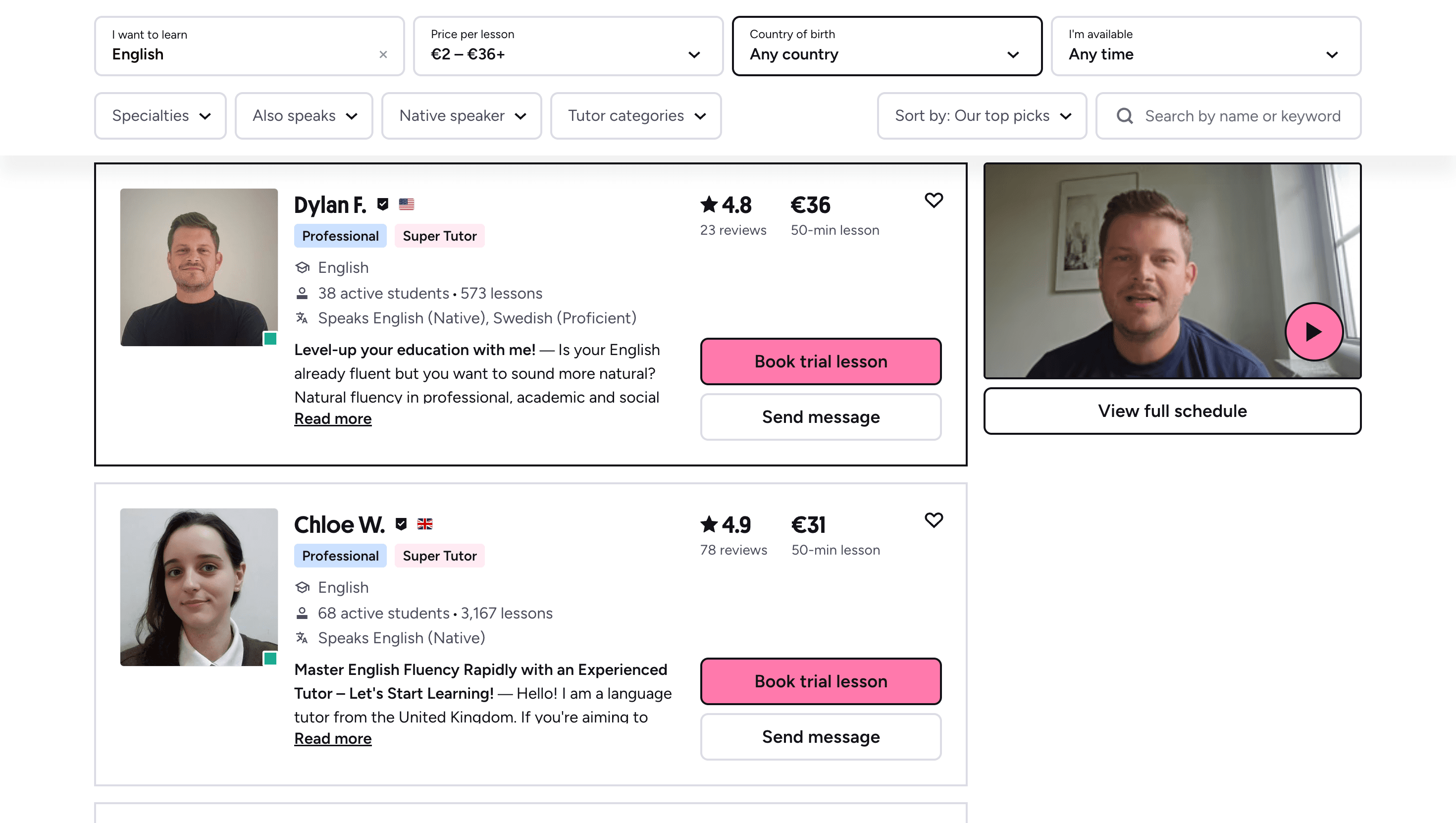
Many learners give up on language learning due to these high costs, missing out on valuable professional and personal opportunities.
That’s why we created Kylian: to make language learning accessible to everyone and help people master a foreign language without breaking the bank.
To get started, just tell Kylian which language you want to learn and what your native language is
Tired of teachers who don’t understand your specific struggles as a French speaker? Kylian’s advantage lies in its ability to teach any language using your native tongue as the foundation.
Unlike generic apps that offer the same content to everyone, Kylian explains concepts in your native language (French) and switches to the target language when necessary—perfectly adapting to your level and needs.
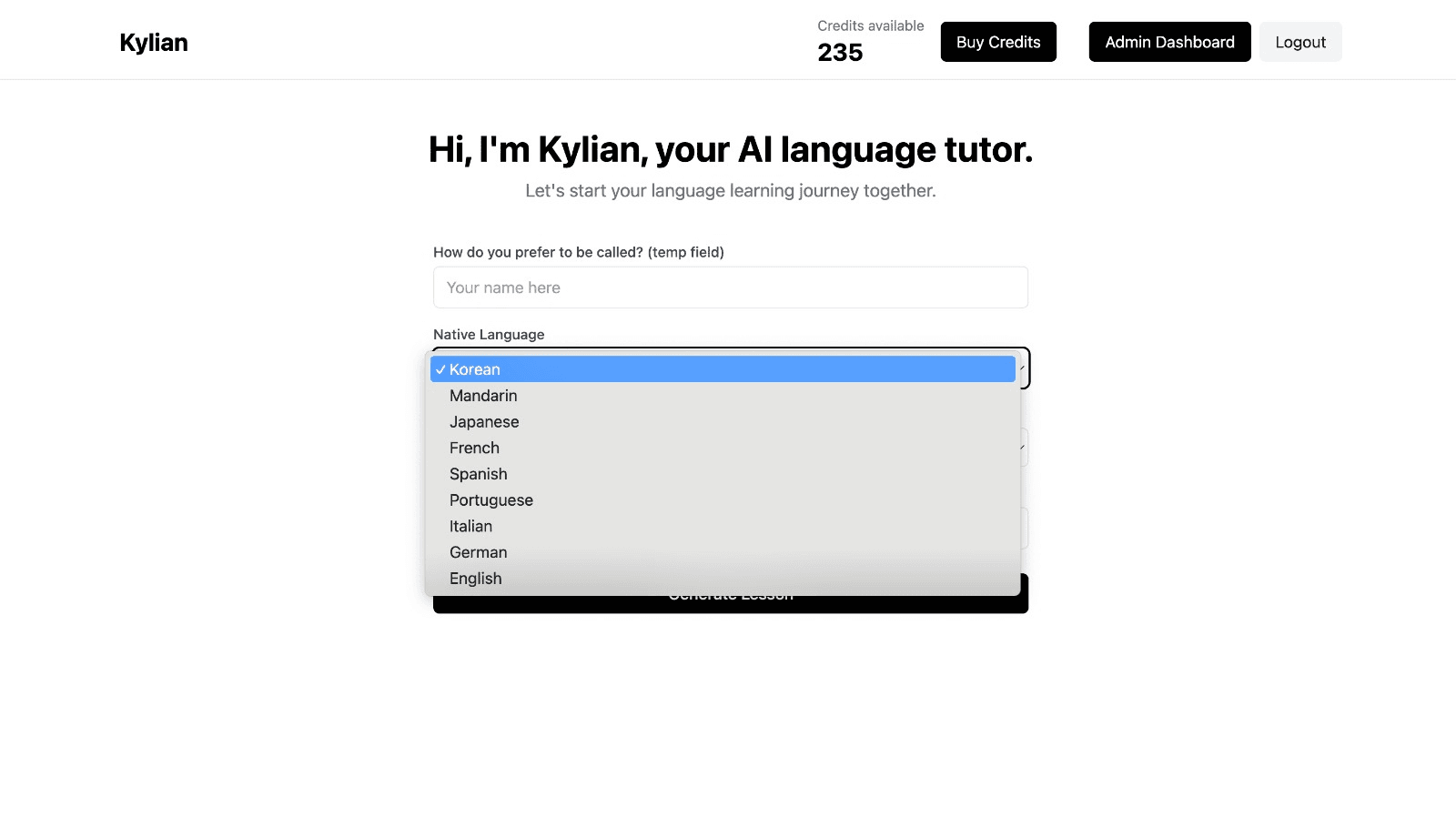
This personalization removes the frustration and confusion that are so common in traditional language learning.
Choose a specific topic you want to learn
Frustrated by language lessons that never cover exactly what you need? Kylian can teach you any aspect of a language—from pronunciation to advanced grammar—by focusing on your specific goals.
Avoid vague requests like “How can I improve my accent?” and be precise: “How do I pronounce the R like a native English speaker?” or “How do I conjugate the verb ‘to be’ in the present tense?”
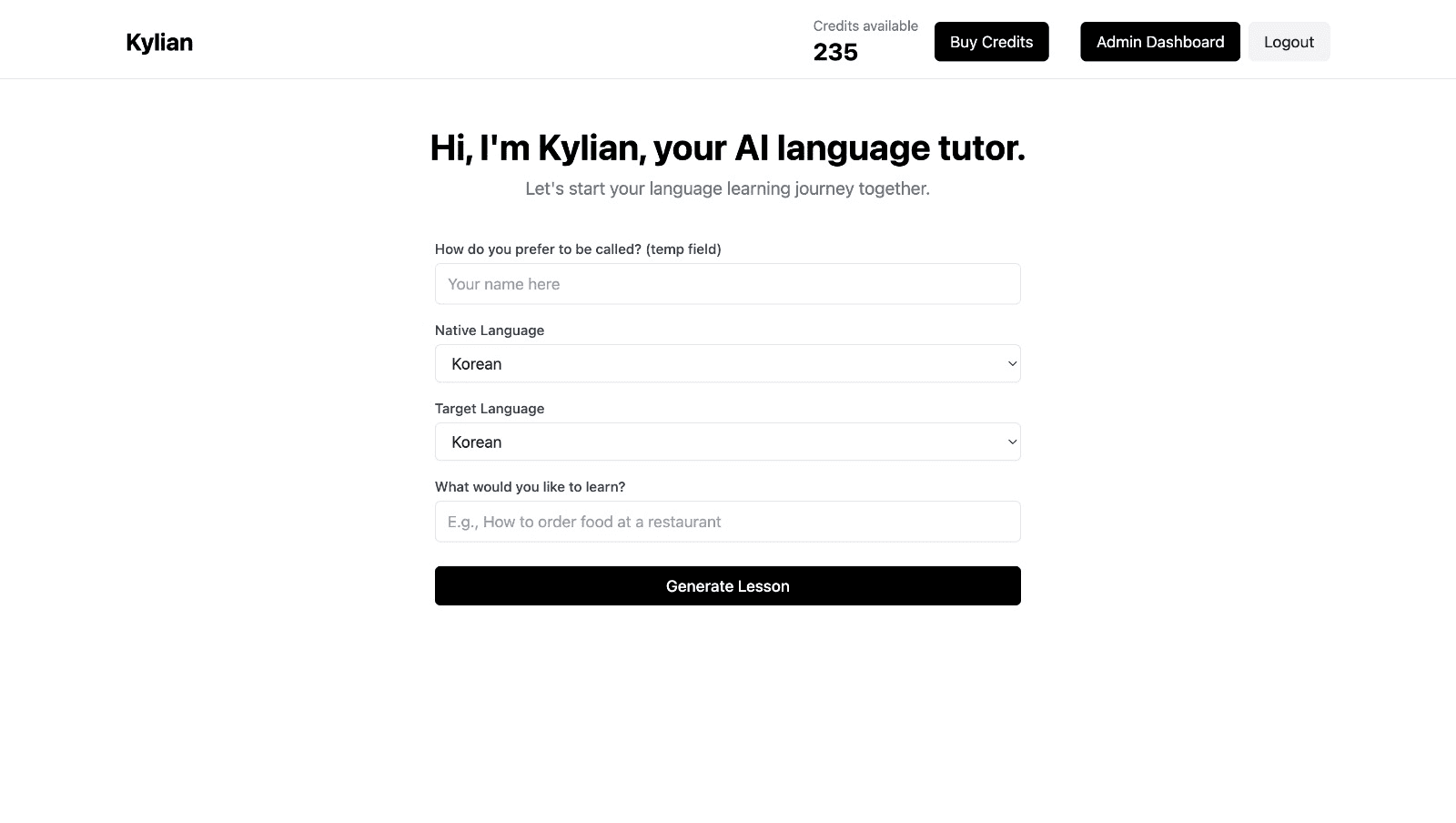
With Kylian, you’ll never again pay for irrelevant content or feel embarrassed asking “too basic” questions to a teacher. Your learning plan is entirely personalized.
Once you’ve chosen your topic, just hit the “Generate a Lesson” button, and within seconds, you’ll get a lesson designed exclusively for you.
Join the room to begin your lesson
The session feels like a one-on-one language class with a human tutor—but without the high price or time constraints.
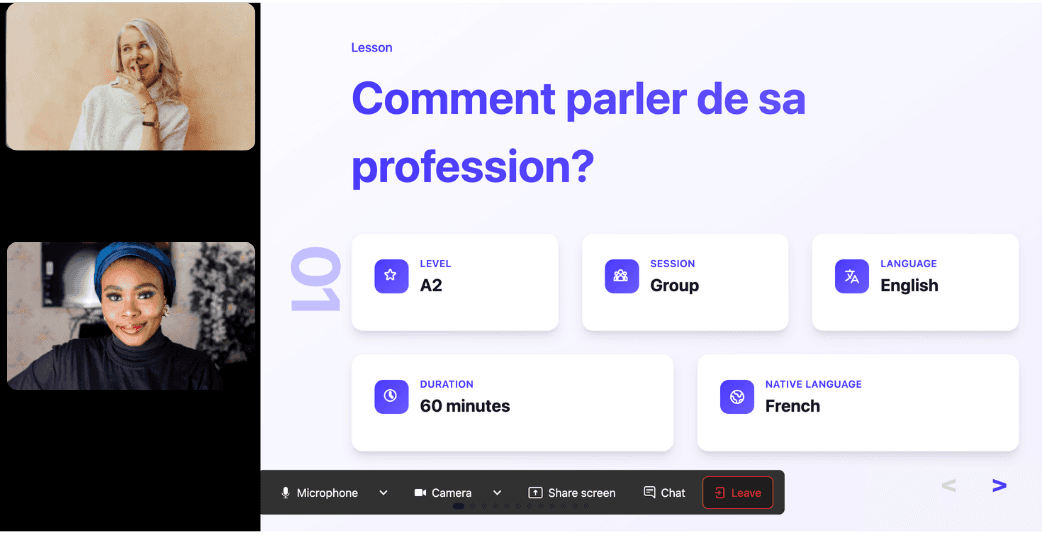
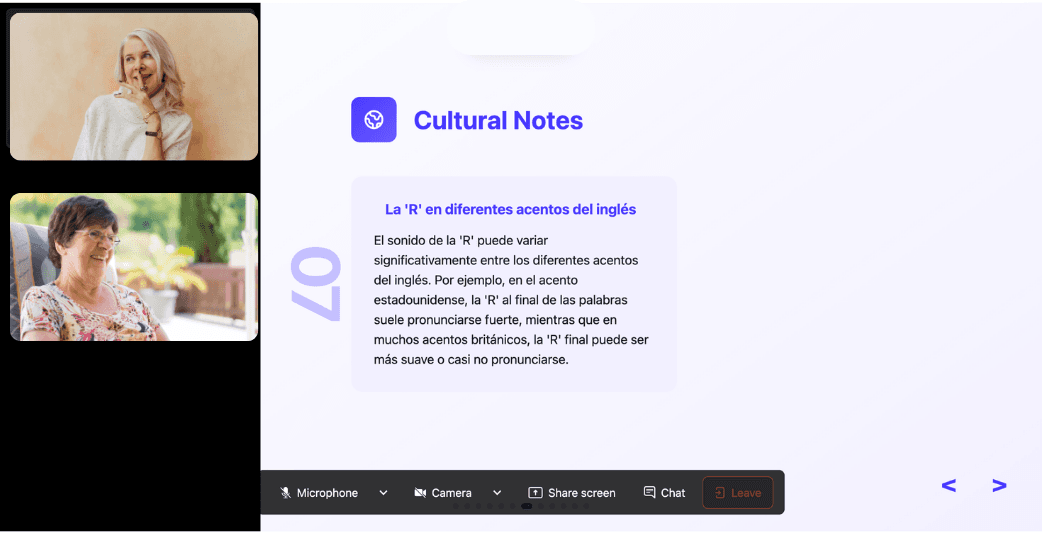
In a 25-minute lesson, Kylian teaches exactly what you need to know about your chosen topic: the nuances that textbooks never explain, key cultural differences between French and your target language, grammar rules, and much more.
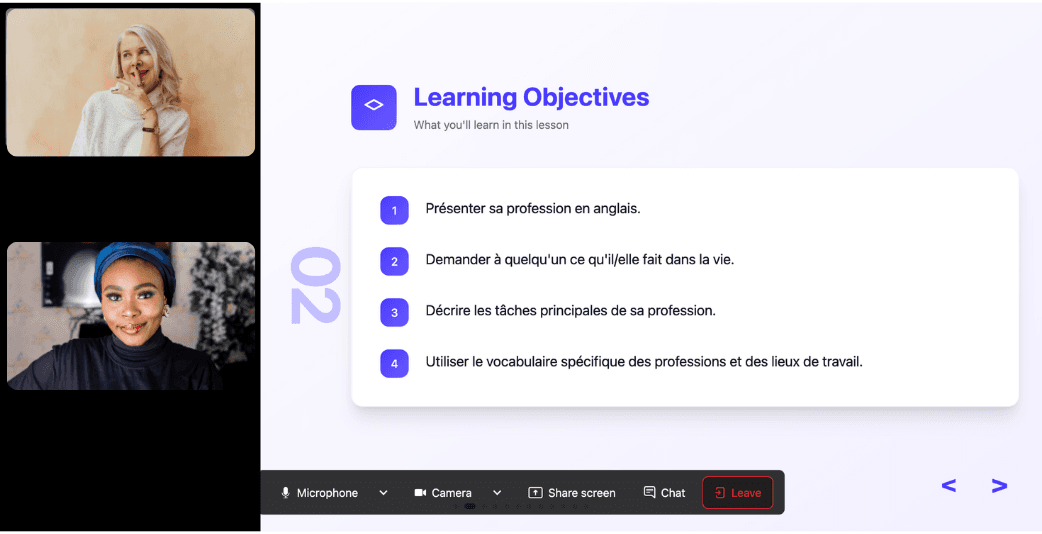
Ever felt frustrated trying to keep up with a native-speaking teacher, or embarrassed to ask for something to be repeated? With Kylian, that problem disappears. It switches intelligently between French and the target language depending on your level, helping you understand every concept at your own pace.
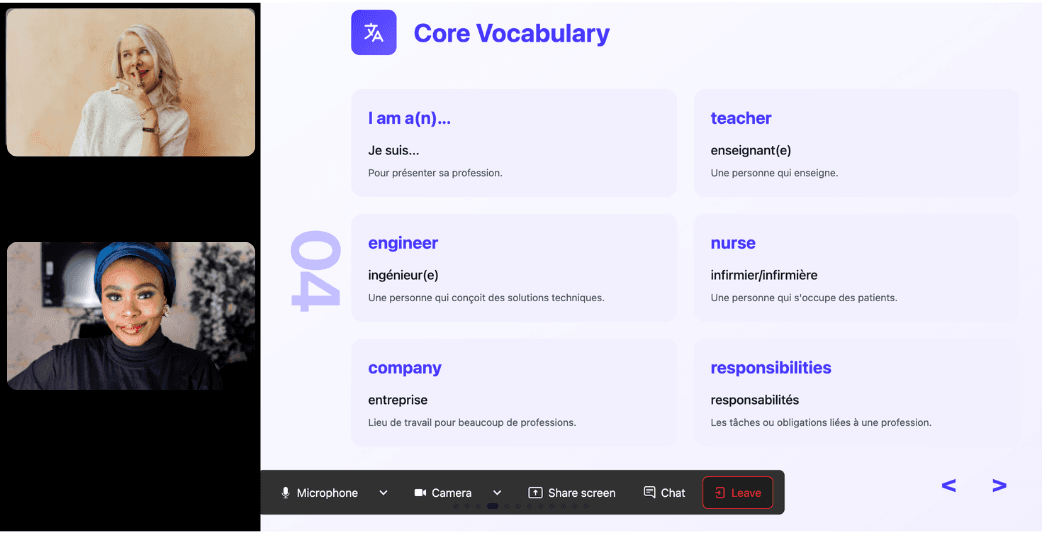
During the lesson, Kylian uses role-plays, real-life examples, and adapts to your learning style. Didn’t understand something? No problem—you can pause Kylian anytime to ask for clarification, without fear of being judged.
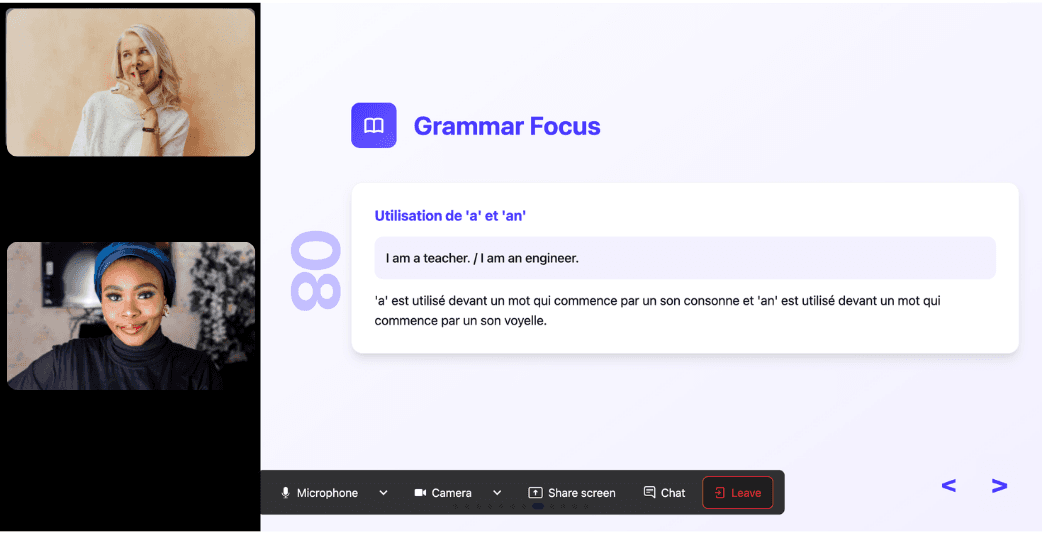
Ask all the questions you want, repeat sections if needed, and customize your learning experience in ways traditional teachers and generic apps simply can’t match.
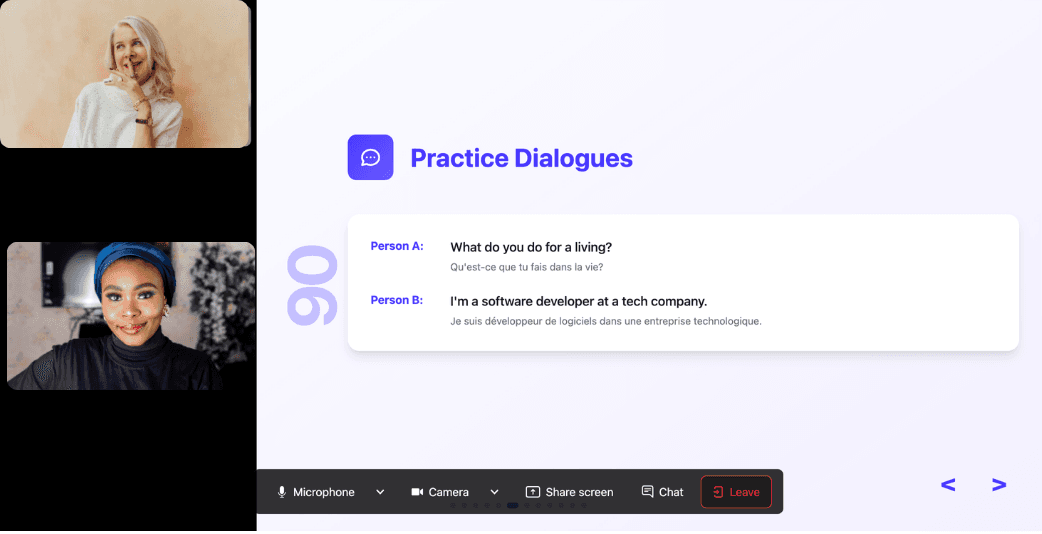
With 24/7 access at a fraction of the cost of private lessons, Kylian removes all the barriers that have kept you from mastering the language you’ve always wanted to learn.


![What is the Plural of Software? Complete Guide [English]](/_next/image?url=https%3A%2F%2Fcdn.sanity.io%2Fimages%2F147z5m2d%2Fproduction%2Fcb336f3a361b658c914d08dce62c8dc9be02506b-2240x1260.png%3Frect%3D175%2C0%2C1890%2C1260%26w%3D600%26h%3D400&w=3840&q=75)


