Words that can function as multiple parts of speech often create confusion among English learners and even native speakers. The term "backup" (or "back up") exemplifies this challenge perfectly, presenting distinct meanings and grammatical functions depending on context. Understanding these differences proves crucial for precise communication in both formal and casual settings.
When to use "back up" vs. "backup"
The distinction between "back up" and "backup" hinges on grammatical function. This differentiation mirrors other similar two-word phrases in English that transform into single words when shifting between verb phrases and nouns or adjectives.
"Back up" as a verb phrase
As a verb phrase, "back up" always appears as two separate words. It carries several meanings:
- To move in reverse: "Please back up your car so I can park."
- To provide support or validation: "Her research backs up our initial hypothesis."
- To create a duplicate copy for safekeeping: "Remember to back up your files before updating your system."
- To cause congestion: "The accident backed up traffic for miles."
The verb form maintains separation regardless of tense:
- Present: I back up my data weekly.
- Past: She backed up her claim with solid evidence.
- Future: They will back up their teammates during the competition.
- Present participle: He's backing up slowly to avoid hitting the curb.
"Backup" as a noun
As a single-word noun, "backup" refers to:
- A duplicate copy: "Store your backup in a secure location."
- A person or thing that provides support: "She's my backup if I can't attend the meeting."
- A reserve or alternative: "We need a backup plan in case of rain."
- A traffic jam: "There's a major backup on the highway."
"Backup" as an adjective
When functioning as an adjective, "backup" appears as one word and modifies a noun:
- "The backup generator kicked in during the power outage."
- "Our backup strategy needs improvement."
- "The backup singer harmonized perfectly with the lead vocalist."
Common mistakes with "back up" and "backup"
Even proficient English speakers occasionally confuse these terms. Here are typical errors to avoid:
Incorrectly using "backup" as a verb
❌ "I need to backup my computer files." ✓ "I need to back up my computer files."
Splitting "backup" when it functions as a noun or adjective
❌ "Do you have a back up of this document?" ✓ "Do you have a backup of this document?"
❌ "The back up plan failed." ✓ "The backup plan failed."
Inconsistency within the same document
Maintaining consistency proves vital. Switching between "backup" and "back up" inappropriately within a single document indicates imprecise language use and diminishes professional credibility.
Similar two-word/one-word patterns in English
This grammatical pattern isn't unique to "back up/backup." Many verb phrases in English become single compound words when functioning as nouns or adjectives:
- Log in (verb) vs. login (noun/adjective)
- "Log in to your account." vs. "Your login credentials"
- Set up (verb) vs. setup (noun/adjective)
- "Let's set up the equipment." vs. "The setup process was complex."
- Break down (verb) vs. breakdown (noun)
- "The negotiations might break down." vs. "She had a mental breakdown."
- Check out (verb) vs. checkout (noun/adjective)
- "Please check out by noon." vs. "The checkout counter is busy."
- Sign up (verb) vs. signup (noun/adjective)
- "Sign up for the newsletter." vs. "The signup process is simple."
Real-world applications
Understanding the correct usage of "back up" and "backup" matters significantly in professional settings. Here's why:
Professional writing and communication
In business correspondence, technical documentation, and academic writing, proper usage demonstrates linguistic precision and attention to detail. Misusing these terms could undermine credibility, particularly in fields where accuracy is paramount.
Technical contexts
In IT, cybersecurity, and data management, the distinction between "back up" (the action) and "backup" (the copy or process) becomes especially important. Clear communication about data protection procedures requires proper terminology.
Content creation and editing
For writers, editors, and content creators, mastering these distinctions enhances the quality and professionalism of produced materials. Style guides often specifically address these common confusions.
How context affects usage
The meaning of "back up" or "backup" often depends heavily on context:
In data management
- "Back up your data daily." (verb phrase – the action of creating copies)
- "Cloud backups offer protection against hardware failure." (noun – the copies themselves)
- "Our backup protocol includes offline storage." (adjective – describing the protocol)
In transportation
- "The truck had to back up carefully." (verb phrase – moving in reverse)
- "There's a significant backup on I-95." (noun – traffic congestion)
- "Backup routes should be planned during rush hour." (adjective – alternative routes)
In teamwork scenarios
- "I'll back up your decision in the meeting." (verb phrase – supporting)
- "She serves as a reliable backup when the manager is away." (noun – substitute)
- "The backup team handled the crisis efficiently." (adjective – secondary team)
Memory aids for correct usage
To consistently apply the correct form:
- Function test: Ask whether you're describing an action (use "back up") or a thing/description (use "backup").
- Substitution method: Replace with another phrasal verb/noun pair. If you would write "pick up the pace" (not "pickup the pace"), then you should write "back up your files" (not "backup your files").
- Emphasis check: Try emphasizing each word. You can emphasize both words in "back UP your files" but not in "BACKup generator."
Language evolution and accepted variations
Language constantly evolves, and usage standards shift over time. While traditional grammar rules maintain the distinction between "back up" and "backup," some observations about current trends include:
Regional differences
American English tends to combine words into compounds more readily than British English, though the rules for "back up" and "backup" remain largely consistent across English variants.
Technological influence
The prevalence of computer terminology has potentially accelerated the use of "backup" as a verb in casual communication, though this remains technically incorrect in formal writing.
Industry-specific conventions
Certain technical fields may have developed their own standardized usage that sometimes diverges from general grammar rules, particularly in specialized documentation.
Expert guidance on tricky cases
Some situations present particular challenges:
Hyphenation questions
Hyphens typically don't appear in either form:
- ❌ "back-up files"
- ✓ "backup files"
However, in rare cases where ambiguity might arise, hyphenation could serve as clarification.
Possessive forms
When showing possession with the noun form:
- "The backup's restoration failed." (referring to a single backup)
- "The backups' integrity must be verified." (referring to multiple backups)
Compound structures
When "backup" modifies another compound term:
- "The backup power supply" (not "the backup-power supply")
Contextual examples for clarity
To solidify understanding, consider these contextual examples:
In technical instructions
"First, back up your smartphone before upgrading the operating system. Store your backup in a secure location. Your backup files should be encrypted for additional protection."
In business communication
"Our presentation will back up these projections with market data. We've prepared backup slides addressing potential questions. The backup strategy includes alternative suppliers."
In everyday conversation
"Could you back up a bit so I can open this drawer? There's quite a backup at the grocery store checkout. We should have a backup plan for the picnic in case it rains."
Technology-specific usage
In computing contexts, specific terminology has emerged:
Types of backups
- Full backup: Complete copy of all selected data
- Incremental backup: Copy of data changed since the last backup
- Differential backup: Copy of data changed since the last full backup
- Mirror backup: Exact copy that reflects the current data state
Backup scheduling terminology
- Backup window: Timeframe allocated for performing backups
- Backup rotation: Schedule for reusing backup media
- Backup verification: Process of confirming backup integrity
Evolving language in digital contexts
As technology advances, language adapts accordingly:
New compound terms
The digital era has spawned numerous related compound terms:
- Backup-as-a-Service (BaaS)
- Backup appliance
- Backup software
- Backup media
Verbing nouns
While technically incorrect, the transformation of "backup" (noun) into a verb appears increasingly in informal technical discourse, highlighting language's fluid nature.
Cross-linguistic perspective
Understanding how other languages handle similar concepts can provide insight:
Comparison with other languages
Many languages use separate terms for the action versus the result:
- French: "sauvegarder" (verb) vs. "sauvegarde" (noun)
- German: "sichern" (verb) vs. "Sicherungskopie" (noun)
- Spanish: "respaldar" (verb) vs. "respaldo" (noun)
This pattern reinforces the logic behind English's distinction between "back up" and "backup."
Educational implications
For language instructors and learners, this distinction offers valuable teaching opportunities:
Teaching strategies
- Compare with similar verb/noun pairs to establish pattern recognition
- Provide contextual examples across different fields
- Use visual cues to distinguish between forms
Common student challenges
Non-native speakers often struggle with:
- Remembering when to separate the words
- Understanding the multiple meanings beyond data copying
- Applying the concept in fast-paced conversation
Practical applications for professional writing
Professional writers can implement these guidelines:
Style guide recommendations
Most professional style guides address this distinction explicitly. For example:
- The Chicago Manual of Style maintains the two-word form for verbs and one-word form for nouns/adjectives
- The AP Stylebook follows similar conventions
Content creation best practices
- Maintain consistency throughout documents
- Consider audience expertise level when determining whether to explain usage
- Use each form deliberately rather than interchangeably
Beyond grammar: Cultural impact
The concept has permeated beyond mere grammatical usage:
In popular culture
"Backup" as a concept appears in entertainment:
- Songs about being someone's "backup" (secondary romantic option)
- Films featuring "backup plans" as central plot devices
- Sports terminology regarding backup players
In organizational psychology
The notion of "backing up" colleagues has become central to teamwork literature, with research examining how support behaviors affect group performance.
Learn Any Language with Kylian AI
Private language lessons are expensive. Paying between 15 and 50 euros per lesson isn’t realistic for most people—especially when dozens of sessions are needed to see real progress.
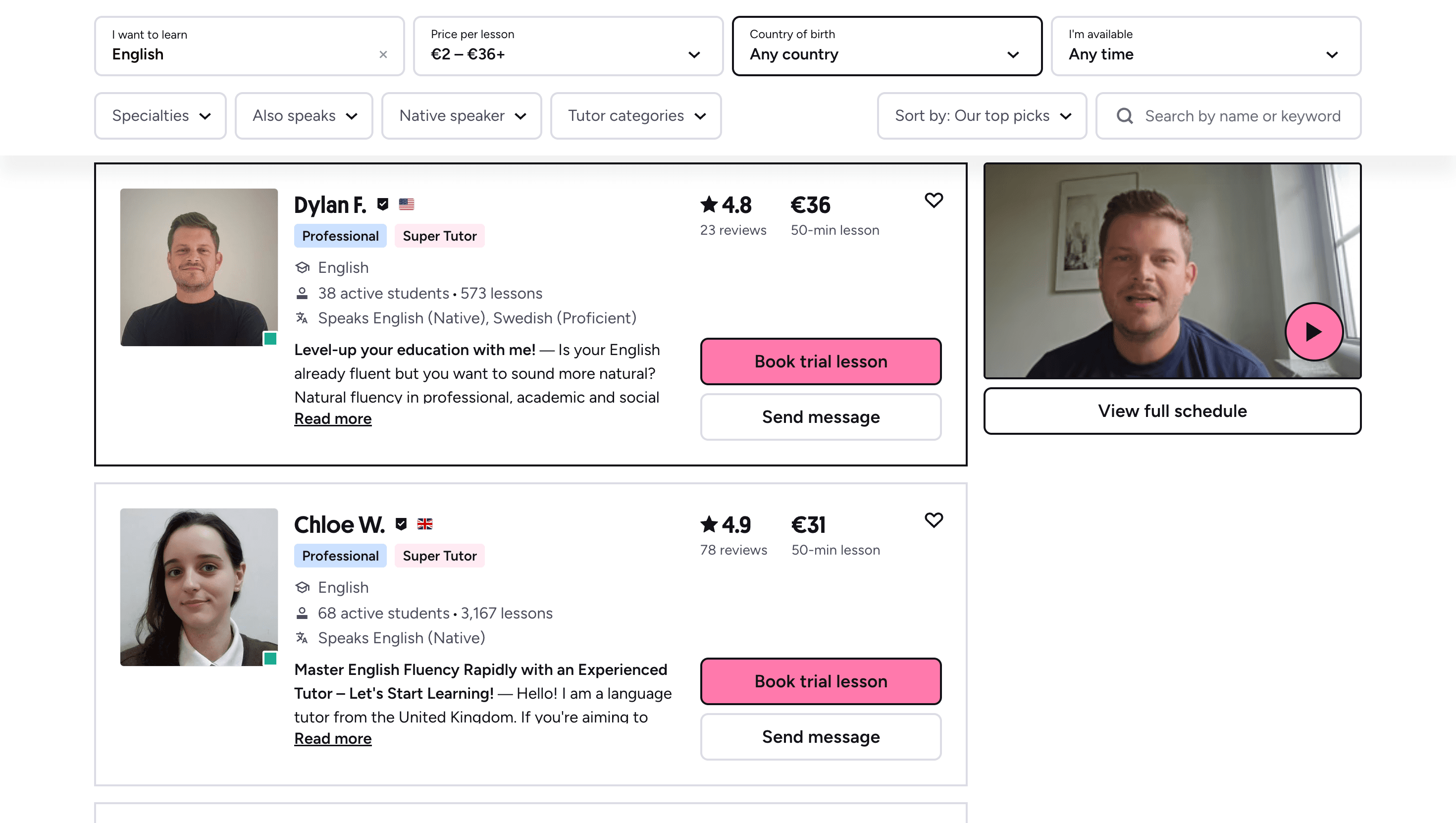
Many learners give up on language learning due to these high costs, missing out on valuable professional and personal opportunities.
That’s why we created Kylian: to make language learning accessible to everyone and help people master a foreign language without breaking the bank.
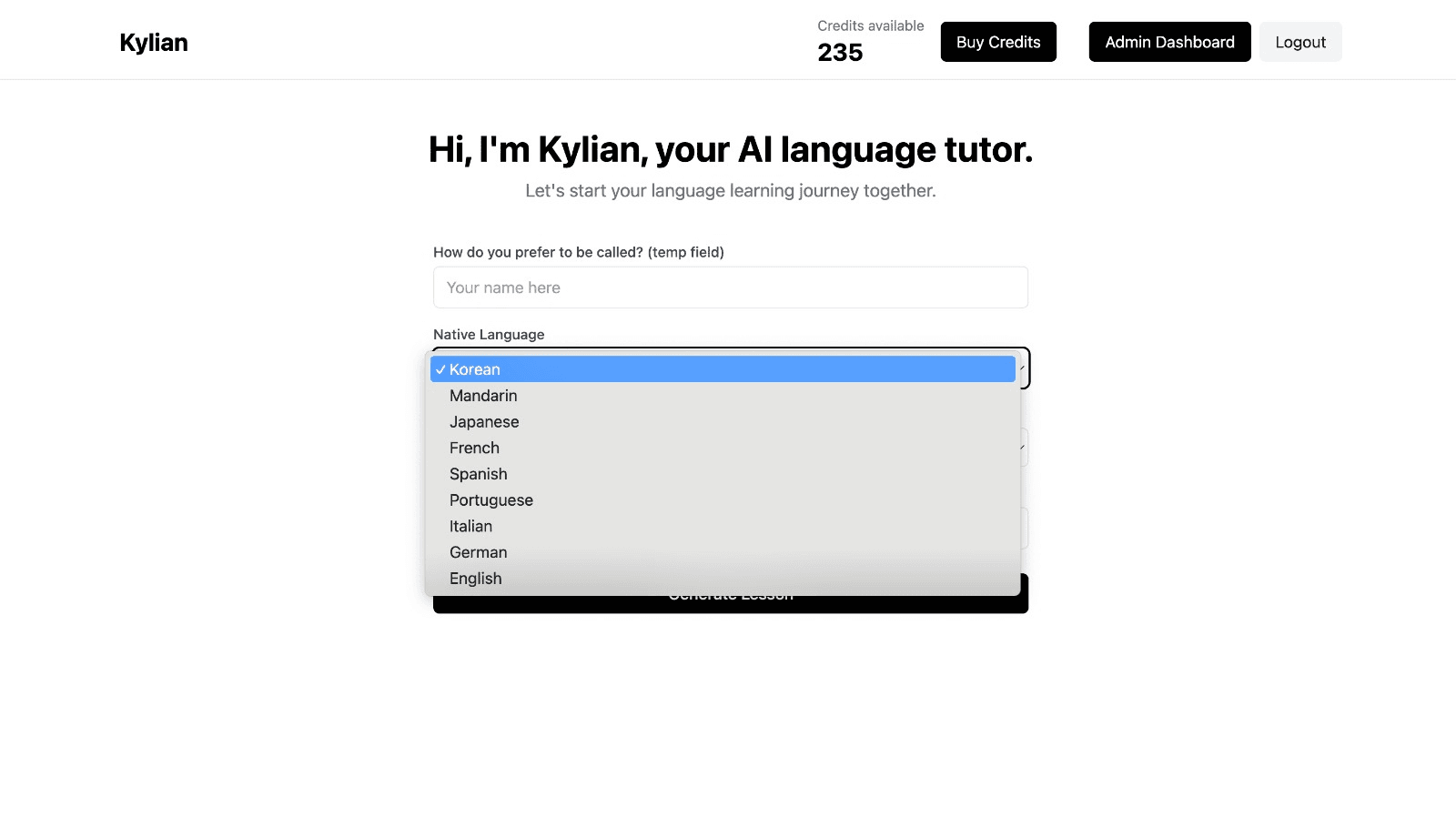
To get started, just tell Kylian which language you want to learn and what your native language is
Tired of teachers who don’t understand your specific struggles as a French speaker? Kylian’s advantage lies in its ability to teach any language using your native tongue as the foundation.
Unlike generic apps that offer the same content to everyone, Kylian explains concepts in your native language (French) and switches to the target language when necessary—perfectly adapting to your level and needs.
This personalization removes the frustration and confusion that are so common in traditional language learning.
Choose a specific topic you want to learn
Frustrated by language lessons that never cover exactly what you need? Kylian can teach you any aspect of a language—from pronunciation to advanced grammar—by focusing on your specific goals.
Avoid vague requests like “How can I improve my accent?” and be precise: “How do I pronounce the R like a native English speaker?” or “How do I conjugate the verb ‘to be’ in the present tense?”
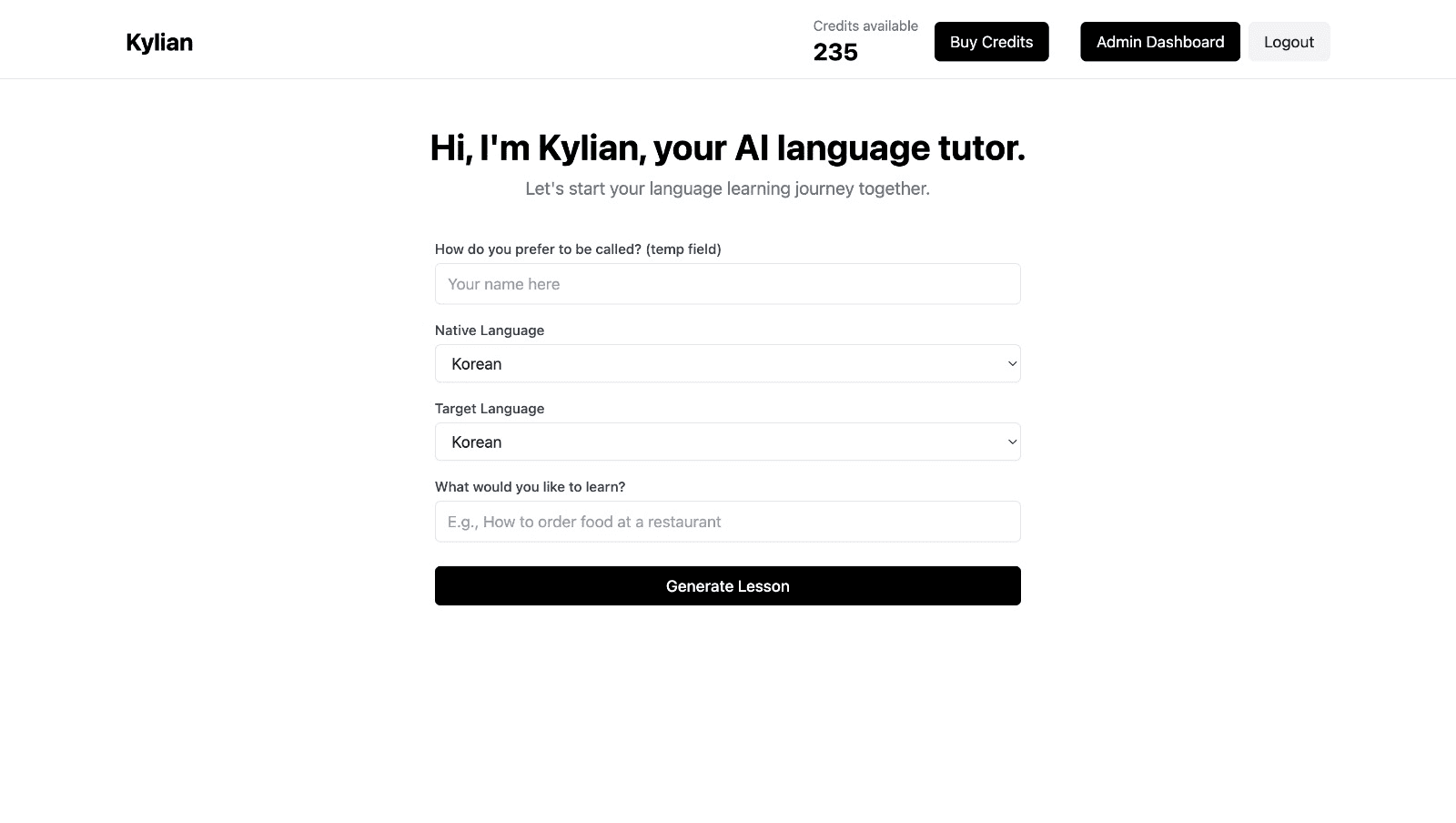
With Kylian, you’ll never again pay for irrelevant content or feel embarrassed asking “too basic” questions to a teacher. Your learning plan is entirely personalized.
Once you’ve chosen your topic, just hit the “Generate a Lesson” button, and within seconds, you’ll get a lesson designed exclusively for you.
Join the room to begin your lesson
The session feels like a one-on-one language class with a human tutor—but without the high price or time constraints.
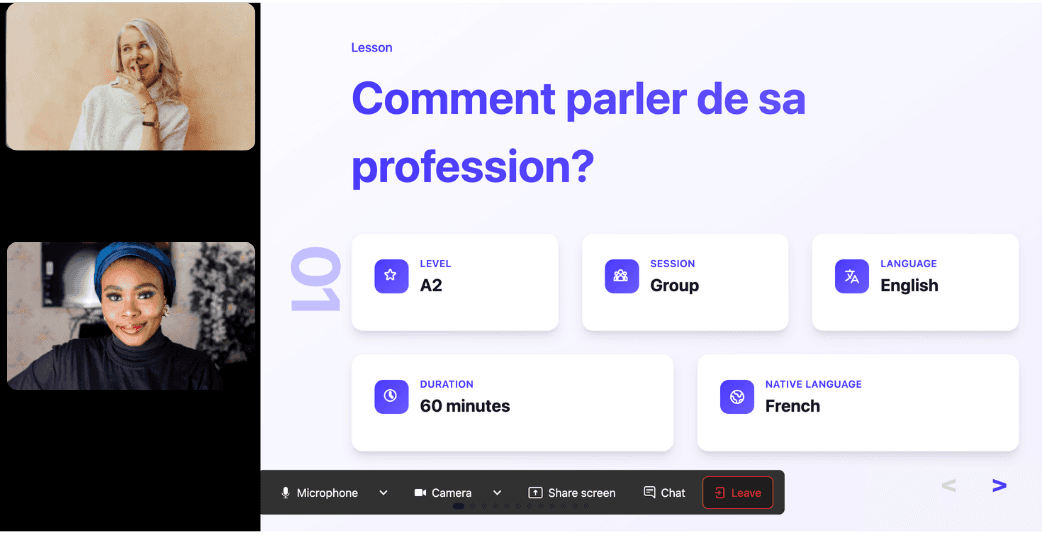
In a 25-minute lesson, Kylian teaches exactly what you need to know about your chosen topic: the nuances that textbooks never explain, key cultural differences between French and your target language, grammar rules, and much more.
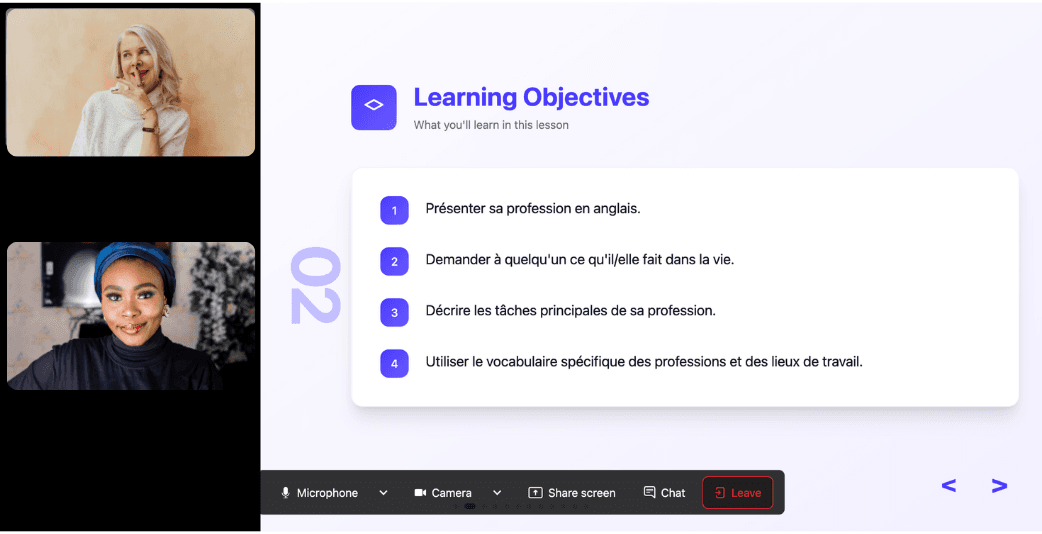
Ever felt frustrated trying to keep up with a native-speaking teacher, or embarrassed to ask for something to be repeated? With Kylian, that problem disappears. It switches intelligently between French and the target language depending on your level, helping you understand every concept at your own pace.
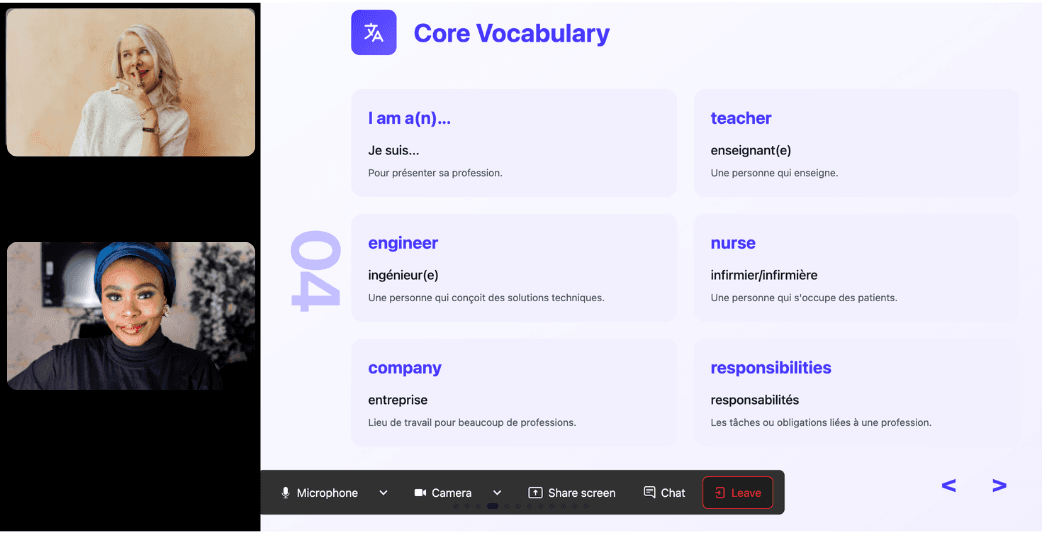
During the lesson, Kylian uses role-plays, real-life examples, and adapts to your learning style. Didn’t understand something? No problem—you can pause Kylian anytime to ask for clarification, without fear of being judged.
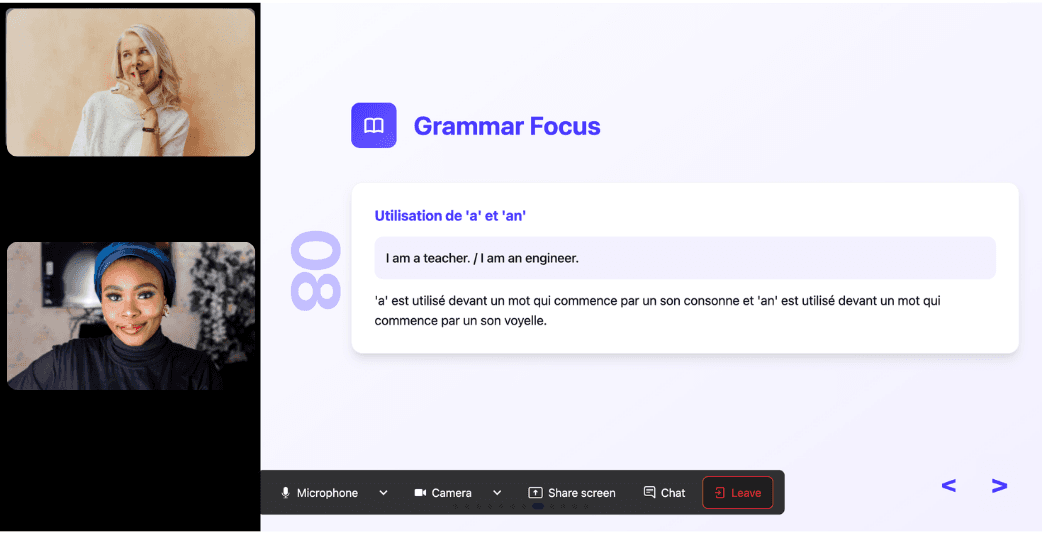
Ask all the questions you want, repeat sections if needed, and customize your learning experience in ways traditional teachers and generic apps simply can’t match.
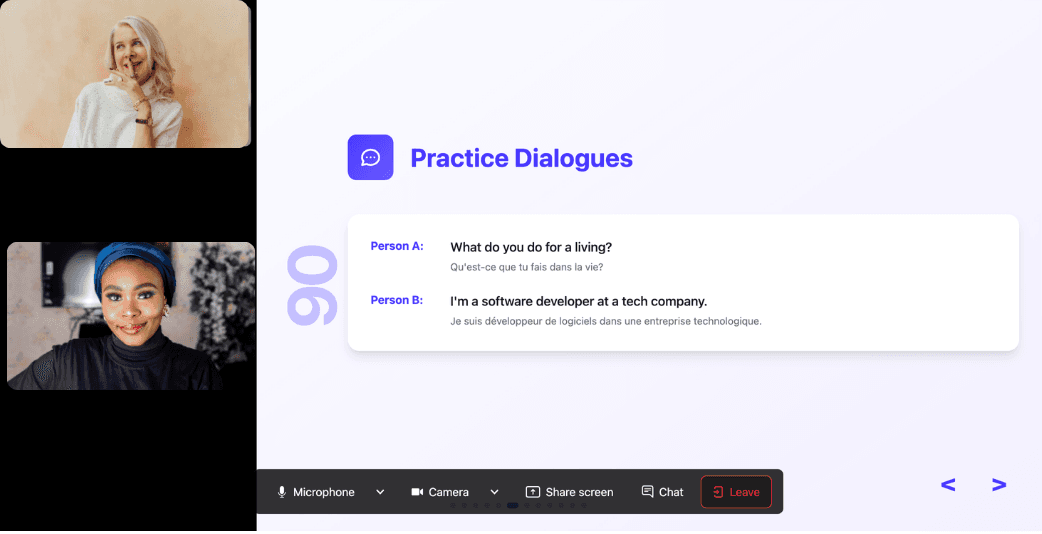
With 24/7 access at a fraction of the cost of private lessons, Kylian removes all the barriers that have kept you from mastering the language you’ve always wanted to learn.